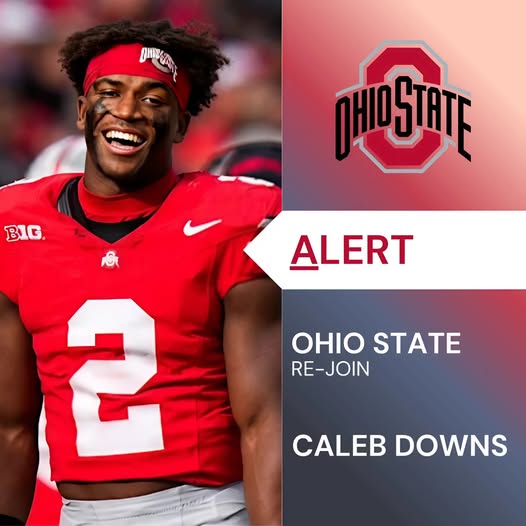
COLUMBUS, Ohio — In an era where college football’s brightest stars often sprint toward the professional ranks at the first whisper of first-round projections, Caleb Downs has delivered a decision that cuts against the grain and resonates far beyond the walls of the Woody Hayes Athletic Center. The standout defensive back announced he will forgo the NFL Draft and instead return to Ohio State Buckeyes football, reaffirming his commitment to unfinished business, team loyalty, and a championship pursuit that now burns even brighter in Columbus.
The announcement, which came amid mounting speculation that Downs would be among the most coveted defensive prospects available, immediately sent waves through the college football landscape. Analysts, scouts, and fans had largely penciled his name into the early rounds, with many projecting him as a potential top-10 selection given his elite instincts, versatility, and production in the secondary. Yet for Downs, the calculus extended beyond draft stock and financial projections. It was rooted in something less quantifiable but deeply powerful: the bond with his teammates and the mission that remains incomplete.
Sources close to the program described the moment as emotional and, in many ways, defining. When Downs addressed his teammates to share his decision, the room reportedly erupted—not with surprise alone, but with a collective sense of validation. This was not merely a talented player choosing to stay; it was a leader reinforcing belief in a shared vision. For a roster already brimming with talent, his return transforms potential into something more tangible: expectation.
Downs’ impact on the field has been nothing short of transformative. Known for his range, physicality, and preternatural ability to read offenses, he has anchored a defense that prides itself on discipline and aggression. His presence allows coordinators to disguise coverages, take calculated risks, and trust that the back end will hold firm. Whether stepping into the box to stop the run or patrolling deep zones to erase big-play threats, Downs has consistently delivered at a level that separates the good from the elite.
It is precisely that level of play that made his draft decision so compelling. In modern college football, where the margin for injury and the lure of professional contracts often tilt decisions toward early departure, returning to school carries both risk and conviction. Downs’ choice reflects a belief not only in his own durability and continued growth, but in the infrastructure around him—the coaching staff, the development pipeline, and the culture cultivated within the program.
Head coach Ryan Day, who has overseen Ohio State’s evolution into a perennial national contender, has emphasized player development and NFL readiness as cornerstones of his tenure. Yet he has also consistently highlighted the importance of team identity and internal leadership. Downs embodies that intersection. His decision to stay is as much a vote of confidence in the program as it is a personal statement of intent.
For the Buckeyes, the timing could not be more significant. Coming off a season that fell short of ultimate expectations, the program has spent the offseason recalibrating, addressing weaknesses, and reinforcing its competitive edge. The return of a player of Downs’ caliber injects both stability and momentum. It signals to the locker room—and to the broader college football world—that Ohio State is not simply reloading; it is doubling down.
Teammates have been quick to echo that sentiment. Several veterans spoke about the ripple effect of Downs’ decision, noting that leadership is often demonstrated through actions rather than words. By choosing to return, Downs has set a tone that reverberates through every position group. It challenges others to elevate their commitment, to embrace the grind of another season, and to pursue goals that demand collective sacrifice.
The emotional dimension of his announcement cannot be overstated. College football, for all its commercialization and professional parallels, still thrives on moments of authenticity—instances where personal choice aligns with team ethos. Downs’ reunion with his teammates, described by those present as both heartfelt and galvanizing, serves as a reminder of the human element that underpins the sport. These are not just athletes navigating career trajectories; they are individuals forging bonds that shape decisions in profound ways.
From a strategic standpoint, Downs’ return reshapes expectations for Ohio State’s defense. Opposing offenses will once again be forced to account for a player who can disrupt game plans in multiple ways. His ability to diagnose plays pre-snap and react with precision post-snap makes him a cornerstone of any defensive scheme. With another year of experience and physical development, there is a strong argument that his ceiling remains even higher than what he has already displayed.
NFL scouts, while undoubtedly eager to evaluate him at the next level, are unlikely to view his decision negatively. On the contrary, an additional season offers Downs the opportunity to refine aspects of his game, showcase leadership qualities, and further solidify his status as a premier prospect. History has shown that players who return to school and continue to excel often enhance their draft positioning rather than diminish it.
For Ohio State, the implications extend beyond individual performance. Recruiting, always a critical component of sustained success, stands to benefit from such a high-profile commitment. Prospective players take note when established stars choose to remain, interpreting it as a sign of a program that fosters both development and loyalty. Downs’ decision becomes part of the narrative that coaches can present to recruits: a testament to the environment cultivated in Columbus.
The broader college football ecosystem also feels the impact. In an era increasingly defined by player mobility, transfer portals, and early draft declarations, moments like this stand out. They offer a counterpoint to prevailing trends, highlighting that, for some players, the collegiate experience still holds intrinsic value beyond its role as a stepping stone to the professional ranks.
As the offseason progresses, attention will inevitably shift toward how this decision translates on the field. Expectations will rise, scrutiny will intensify, and every performance will be analyzed through the lens of what could have been versus what is being pursued. Downs, however, appears unfazed by such narratives. Those who know him describe a player grounded in routine, focused on incremental improvement, and motivated by team success above individual accolades.
That mindset will be crucial as Ohio State navigates a schedule that promises both challenges and opportunities. The path to a national championship is rarely straightforward, and the presence of a leader like Downs provides both guidance and resilience. In moments of adversity, his voice and example are likely to carry significant weight.
There is also a symbolic dimension to consider. College football thrives on storylines—on arcs that span seasons and define legacies. Downs’ decision adds a compelling chapter to his own narrative and to that of Ohio State. It transforms what could have been a farewell into a continuation, a chance to build upon what has already been achieved and to chase what remains elusive.
For fans, the announcement has been met with a mixture of relief and renewed excitement. The prospect of watching one of the nation’s premier defensive players don the scarlet and gray for another season is a gift in itself. It reinforces the connection between team and community, reminding supporters that their investment in the program is reciprocated by players who choose to stay and fight.
Media reaction has been equally emphatic. Analysts have praised the maturity of the decision, noting that it reflects a broader understanding of career development. While the allure of the NFL is undeniable, the value of an additional collegiate season—particularly within a program of Ohio State’s stature—cannot be overlooked. It offers a platform for growth, exposure, and, perhaps most importantly, the pursuit of a championship that would define a legacy.
As the narrative continues to unfold, one thing remains clear: Caleb Downs’ decision is about more than football. It is about commitment, leadership, and the enduring appeal of a shared goal. In choosing to return, he has not only altered the trajectory of his own career but also reinforced the foundation upon which Ohio State’s ambitions rest.
The coming season will provide the ultimate measure of this choice. Success is never guaranteed, and the pressures of expectation can be formidable. Yet with Downs at the heart of the defense, the Buckeyes enter the campaign with a renewed sense of purpose and possibility.
In a sport often defined by departures and transitions, his return stands as a powerful statement. It underscores the idea that, sometimes, the greatest opportunity lies not in moving forward, but in staying the course—fighting alongside teammates, embracing the journey, and striving for a goal that demands everything.
For Ohio State, for its fans, and for Caleb Downs himself, that journey continues.