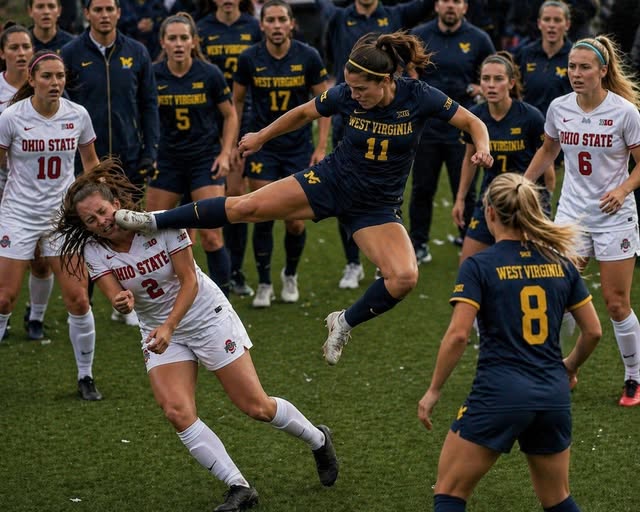
The Ohio State Buckeyes community has been left stunned and deeply frustrated following a controversial and widely circulated incident from their recent matchup against the West Virginia Mountaineers, in which a West Virginia player is accused of unsportsmanlike conduct after appearing to kick an Ohio State player in the face during a heated sequence of play. The moment, which quickly spread across social media and sports highlight platforms, has sparked intense debate among fans, analysts, and former players, with many calling for a formal review by conference officials and governing bodies.
The incident occurred during a physical stretch of the game that had already been marked by increased intensity, hard tackles, and escalating emotions on both sides. According to multiple broadcast angles replayed after the match, a collision near the sideline led to both players falling to the ground in a contested scramble. In the aftermath of the tackle, as bodies converged and players attempted to regain their footing, one West Virginia player appeared to make contact with the face of an Ohio State opponent in a motion that many observers described as a kick.
While no official ruling at the time of publication has definitively categorized the act as intentional, the visual evidence has been enough to ignite outrage among the Buckeyes fanbase. Clips of the moment have been dissected frame-by-frame, with supporters arguing that the movement was avoidable and reckless at best, and deliberate at worst. The phrase “unsportsmanlike conduct” has since dominated online discussions, with many insisting that such behavior has no place in high-level collegiate competition.
Ohio State supporters were quick to voice their frustration both inside the stadium and across digital platforms. Within minutes of the replay airing on broadcast coverage, reactions flooded social media, with fans demanding accountability and questioning how the officiating crew did not immediately escalate the situation. Some pointed to the speed of the play and chaotic positioning of bodies as possible explanations for why no immediate ejection or penalty was assessed on the field.
West Virginia fans, meanwhile, have pushed back strongly against the accusations, arguing that the incident has been exaggerated through selective replay angles and emotional interpretation. Many insist that the contact, while unfortunate in appearance, was incidental and occurred in the natural motion of players scrambling on the ground. The divide in interpretation has only intensified the controversy, turning what was already a competitive matchup into a flashpoint for broader discussions about player conduct and officiating standards.
Officials on the field did confer after the play, according to broadcast commentary, but ultimately allowed the game to proceed without issuing a disqualifying penalty at that moment. That decision has since come under scrutiny, with analysts questioning whether additional review protocols should have been triggered immediately given the severity of the visual evidence. In modern collegiate sports, where video review systems are designed to catch missed infractions, the absence of a decisive ruling has fueled further debate.
The Big 12 and Big Ten conferences, which oversee disciplinary standards for their respective programs, have not yet released a formal statement regarding the incident. However, sources familiar with standard procedure indicate that plays of this nature are typically reviewed postgame for potential supplemental discipline, especially when video evidence raises questions about player safety and intent.
Former players and analysts have also weighed in, offering differing perspectives on what the footage shows. Some argue that football, by its nature, is a chaotic and physical sport where unintended contact can often be misinterpreted in real time or even in slow motion. Others counter that regardless of intent, players are responsible for maintaining control of their actions, particularly when opponents are in vulnerable positions on the ground.
Ohio State’s coaching staff addressed the incident briefly in postgame comments, emphasizing the importance of player safety while avoiding direct accusations. The focus, according to team representatives, remains on preparing for upcoming matchups, though it was acknowledged that the program expects conference officials to review all relevant footage thoroughly. The tone reflected a balance between frustration and professionalism, consistent with institutional expectations at the collegiate level.
West Virginia’s coaching staff similarly refrained from engaging in detailed public commentary, instead deferring to the officiating and review process. However, insiders suggest that internal discussions within the program have already begun, as teams often conduct their own assessments of game footage regardless of external rulings. Such internal reviews are standard practice in maintaining discipline and reinforcing proper technique among players.
The broader college football community has also reacted strongly, with analysts highlighting how quickly moments like these can define narratives around teams and players in the social media era. Within minutes of the game’s conclusion, the clip in question had been widely shared, captioned, and interpreted in varying ways depending on fan allegiance. This rapid dissemination has added pressure on governing bodies to respond swiftly and transparently in order to maintain trust in officiating integrity.
Sports safety advocates have also entered the conversation, noting that regardless of intent, any contact involving the head region is taken seriously due to the heightened concern surrounding head injuries in contact sports. While no official report has confirmed an injury resulting from the incident, the mere appearance of contact to the face has been enough to elevate scrutiny and trigger calls for stricter enforcement of existing rules.
The emotional intensity surrounding Ohio State football, one of the most followed programs in the country, has only amplified the reaction. Fans are accustomed to high expectations and national spotlight moments, and incidents perceived as unfair or dangerous often generate outsized responses. This latest controversy has once again highlighted the intersection of passion, perception, and officiating in modern college athletics.
At the heart of the debate remains a fundamental question: whether the act was a deliberate violation of sportsmanship or an unfortunate byproduct of a fast-moving, chaotic play. Without a definitive statement from review authorities, the discussion remains open-ended, fueled by slow-motion replays, expert commentary, and passionate fan interpretation.
The NCAA’s emphasis on sportsmanship and player safety means that incidents of this nature are typically reviewed with caution and seriousness. If the review process determines that the action violated conduct rules, potential consequences could include fines, suspensions, or other disciplinary measures depending on intent and severity. However, until such determinations are made, the situation remains in a state of uncertainty.
In the meantime, both programs are expected to shift focus back to competition, though the lingering tension from the matchup may carry into future encounters. Rivalries in college football are often shaped not only by scores and standings but also by moments of controversy that linger in collective memory long after the final whistle.
As the investigation process unfolds, attention will remain fixed on conference officials and whether additional clarification or discipline will be issued. For now, the incident stands as one of the most debated moments of the week in college football, underscoring how quickly a single sequence of play can escalate into a national talking point.
What remains clear is that emotions are running high on all sides. Ohio State supporters continue to demand accountability, West Virginia supporters continue to defend their program’s integrity, and neutral observers are left parsing conflicting interpretations of a split-second moment. In the modern era of constant replay analysis and instant reaction, such controversies rarely fade quickly.
Until an official ruling is delivered, the incident will continue to dominate discussions around the matchup, serving as a reminder of how thin the line can be between aggressive competition and perceived misconduct in high-stakes collegiate football.