The story of greatness in basketball is rarely told in isolation. It is often a continuum—an unbroken thread of influence, admiration, and inspiration passed from one generation to the next. Few examples capture this lineage more vividly than the relationship, albeit indirect, between LeBron James and Michael Jordan—two names that dominate conversations about basketball excellence across eras. While comparisons between the two have fueled debates for years, James himself has consistently pointed to Jordan not as a rival in legacy, but as a foundational figure in his personal and professional journey.
Long before he became a four-time NBA champion and one of the most statistically dominant players in league history, LeBron James was a young kid in Akron, Ohio, captivated by the electrifying presence of Michael Jordan. In the 1990s, Jordan was not just a basketball player; he was a global phenomenon. His impact extended far beyond the hardwood, shaping fashion, marketing, and the very identity of the NBA. For a young James, watching Jordan dominate with the Chicago Bulls was more than entertainment—it was a blueprint for greatness.
James has often spoken about how deeply Jordan’s career resonated with him during his formative years. From the gravity-defying dunks to the relentless competitiveness, Jordan embodied everything a young athlete could aspire to be. But it wasn’t just the highlights or championships that left a lasting impression; it was the mentality. Jordan’s unyielding drive, his refusal to accept defeat, and his ability to deliver in the biggest moments became qualities that James sought to emulate as he developed his own game.
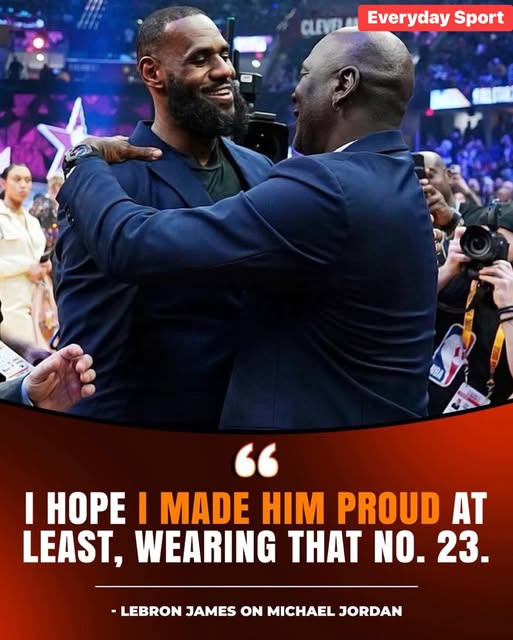
One of the most visible symbols of that influence came in the form of a number—23. For Jordan, the number became synonymous with excellence, a numerical representation of dominance that transcended sport. For James, choosing to wear No. 23 was not a casual decision. It was a deliberate homage, a way of honoring the player who had shaped his dreams. James has openly acknowledged that his decision to don the number was rooted in admiration for Jordan, describing it as a tribute to the player who made him fall in love with basketball.
As James transitioned from a high school prodigy at St. Vincent–St. Mary High School to the first overall pick in the 2003 NBA Draft, the expectations placed upon him were immense. Dubbed “The Chosen One,” he entered the league with a level of hype rarely seen in professional sports. Inevitably, the comparisons to Jordan began almost immediately. Could this young star live up to the standard set by the six-time NBA champion? Would he carve out his own identity, or forever exist in the shadow of the game’s most iconic figure?
For James, the answer was never about replacing Jordan or surpassing him in a mythical hierarchy. Instead, it was about building upon the foundation Jordan had laid. In numerous interviews over the years, James has emphasized that his journey was inspired—not defined—by Jordan’s legacy. He studied Jordan’s game, his footwork, his mid-range mastery, and his ability to control the tempo of a contest. Yet, James also understood the importance of evolution. While Jordan thrived as a scoring machine, James expanded his repertoire to include elite playmaking, rebounding, and positional versatility, adapting to the modern demands of the game.
The influence of Jordan on James also extended to the mental aspects of basketball. Jordan’s legendary competitiveness became a benchmark for what it meant to be great. Stories of his relentless practice habits and psychological edge over opponents became part of NBA folklore. James absorbed these lessons, developing a mindset that prioritized preparation, resilience, and leadership. While their personalities and approaches to leadership differ—Jordan often led with intensity and confrontation, while James has been more vocal and collaborative—the underlying drive to win remains a shared trait.
Throughout his career, James has paid tribute to Jordan in subtle and overt ways. From wearing No. 23 for the majority of his career to publicly acknowledging Jordan as his idol, James has never shied away from expressing gratitude. Even during moments when debates about the “greatest of all time” reached a fever pitch, James has maintained a tone of respect. Rather than dismissing Jordan’s achievements, he has framed his own success as part of a larger narrative—one that Jordan helped author.
The cultural significance of this connection cannot be overstated. Jordan’s rise in the 1990s coincided with the globalization of the NBA, turning the league into an international powerhouse. By the time James entered the league, the path had already been paved. The global audience, the marketing machine, and the elevated expectations for superstardom were all, in part, products of Jordan’s influence. James stepped into this world not as an outsider, but as a beneficiary of the legacy Jordan created.
This dynamic has also shaped how fans and analysts perceive both players. The constant comparisons, while often reductive, highlight the enduring impact of Jordan’s career. For many, Jordan set the gold standard, the benchmark against which all future players would be measured. James, by embracing rather than rejecting this comparison, has added a layer of depth to the conversation. His acknowledgment of Jordan’s influence humanizes the debate, reminding fans that greatness is often built upon admiration and inspiration.
Beyond the court, the parallels between the two players further illustrate the depth of Jordan’s influence. Both have become influential figures in business and philanthropy, leveraging their platforms to create opportunities beyond basketball. While Jordan’s partnership with Nike revolutionized athlete branding through the Air Jordan line, James has expanded his own brand into media, education, and community development. His initiatives, including the founding of the I PROMISE School, reflect a commitment to giving back—a value that aligns with the broader responsibilities that come with global stardom.
James’ journey also underscores the evolution of the athlete’s voice in modern sports. While Jordan famously maintained a more reserved stance on social and political issues, James has embraced a more outspoken role, using his platform to advocate for change. This distinction highlights how each player has navigated the expectations of their respective eras. Yet, even in this divergence, the thread of influence remains. Jordan’s success created the platform; James has expanded its possibilities.
As the years have passed, James’ career has taken on a legacy of its own. With multiple championships, MVP awards, and a record-breaking list of achievements, he has firmly established himself as one of the greatest players in NBA history. Yet, despite his accomplishments, he continues to reflect on the role Jordan played in shaping his aspirations. This acknowledgment serves as a reminder that even the most iconic figures are, at their core, products of inspiration.
The symbolism of No. 23 remains a powerful element of this narrative. When fans see James wearing the number, they are witnessing more than just a jersey choice; they are seeing a connection that spans generations. It is a tribute to the past and a bridge to the future, linking two eras of basketball through a shared symbol of excellence. For James, the number represents not just admiration, but a commitment to upholding the standard set by the player who made it legendary.
In many ways, the story of LeBron James and Michael Jordan is not about comparison, but about continuity. It is about how greatness inspires greatness, how one player’s achievements can ignite the dreams of another. James’ openness about Jordan’s influence adds a layer of authenticity to his legacy, reinforcing the idea that even the most dominant figures in sports are shaped by those who came before them.
As the NBA continues to evolve, new stars will emerge, each with their own influences and inspirations. Just as Jordan inspired James, and James now inspires the next generation, the cycle will continue. Young players watching James today may one day speak about how his career shaped their own journeys, creating a new chapter in the ongoing story of basketball excellence.
For now, the connection between LeBron James and Michael Jordan stands as one of the most compelling narratives in sports. It is a testament to the power of influence, the importance of role models, and the enduring impact of greatness. James’ decision to wear No. 23, rooted in admiration for Jordan, serves as a visible reminder of this connection—a symbol of respect that transcends competition.
In the end, the legacy of LeBron James cannot be fully understood without acknowledging the role Michael Jordan played in shaping it. Not as a shadow, but as a source of inspiration. Not as a rival, but as a pioneer. Through his words and actions, James has made it clear that his journey is, in part, a continuation of the path Jordan helped create. And in doing so, he has added a new dimension to the story of basketball—a story where greatness is not just measured by achievements, but by the ability to inspire those who follow.