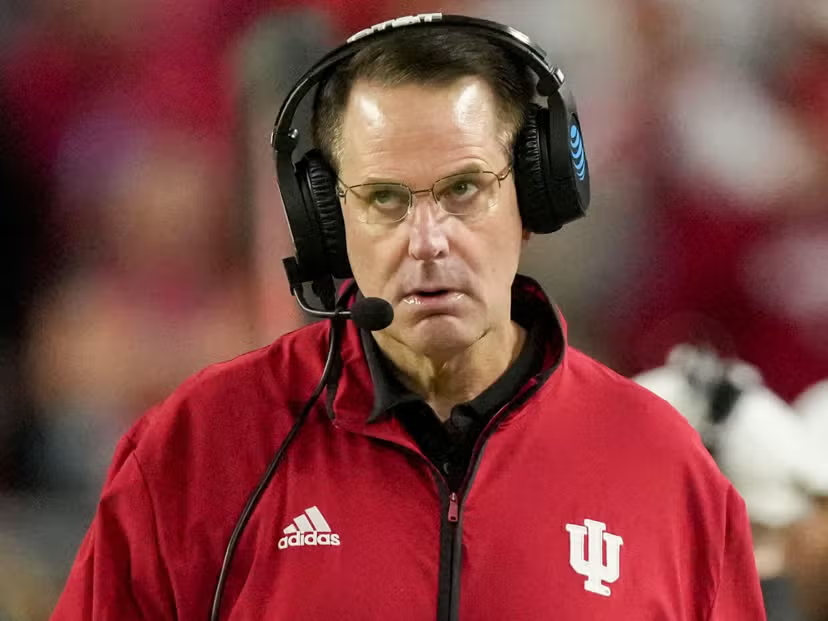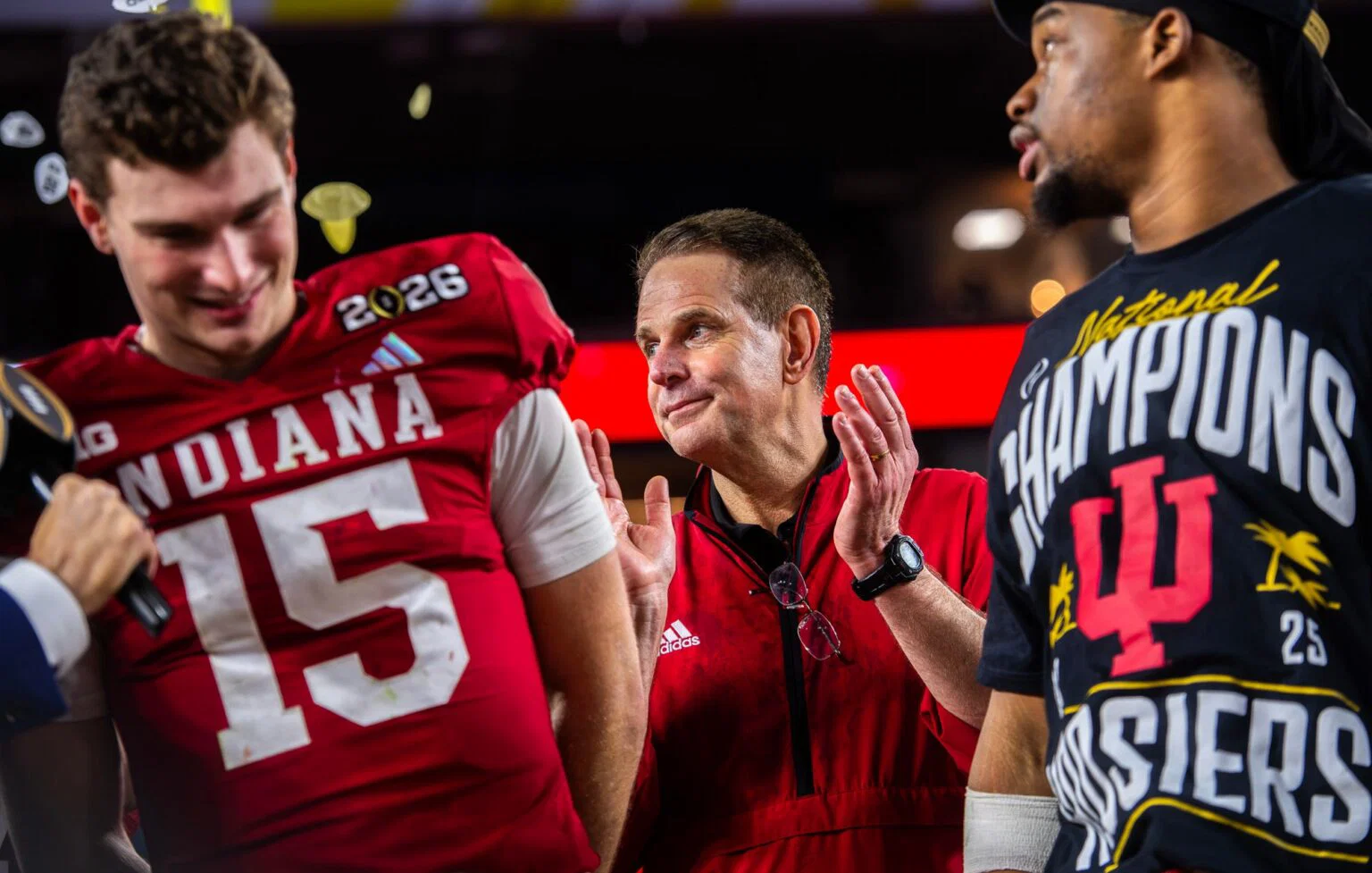
Indiana’s decision to invest heavily in Curt Cignetti is already shaping up as one of the most scrutinized and, increasingly, one of the most validated financial commitments in modern college football. With a contract valued at approximately $13.2 million, expectations were never going to be modest when Indiana made the bold move to bring in a coach known for turning programs into disciplined, competitive, and physically imposing teams. What has followed, however, has gone beyond routine program building. It has been a visible cultural reset, a competitive reawakening, and a statement that Indiana football intends to operate with seriousness in a conference that leaves little room for hesitation.
From the moment Cignetti arrived in Bloomington, the messaging was direct and unambiguous. Indiana football would no longer be defined by moral victories, occasional upsets, or years of rebuilding narratives that never fully materialized. Instead, it would be defined by accountability, physical toughness, roster clarity, and a commitment to winning in ways that translate in the Big Ten. That tone alone marked a shift from previous eras, but it is the execution that has given weight to the investment.
Cignetti’s coaching reputation preceded him. His success at James Madison was built on efficiency, physical dominance at the Group of Five level, and a program identity that consistently overwhelmed opponents who underestimated structure and discipline. Indiana did not hire him for experimentation. They hired him for replication at a higher level of competition. The challenge, of course, was whether those principles could survive the jump into a conference filled with elite recruiting pipelines, entrenched powerhouses, and weekly physical battles that punish even small lapses in preparation.
Early indications suggest that not only has Cignetti adapted, but Indiana has begun to reflect his identity faster than many expected. The Hoosiers’ roster management has become more intentional, with clearer roles and reduced ambiguity about expectations. Players have responded to a system that emphasizes accountability over reputation, performance over pedigree, and consistency over flashes of potential. In a program that has often struggled with sustained execution, that shift alone has been transformative.
One of the most noticeable changes under Cignetti has been the overall demeanor of the team. Indiana no longer looks like a program hoping to stay competitive. It looks like a program expecting to compete. That psychological shift is often overlooked in discussions of coaching value, but within the locker room and on the field, it is often the difference between teams that fold under pressure and those that continue to execute when games tighten in the fourth quarter. Indiana’s body language in recent matchups reflects a team that believes it belongs in the same conversation as its opponents, regardless of historical hierarchy.
The financial commitment attached to Cignetti’s contract places him among the more significant investments in Indiana football history, and understandably so. The Big Ten landscape is unforgiving, and programs that fail to invest in coaching infrastructure often find themselves permanently trailing the conference’s elite. Indiana’s leadership made a calculated decision that stability and identity were worth the price tag. In return, they have seen immediate returns in competitiveness, structure, and national perception.
Recruiting has also begun to reflect the change in leadership. While Indiana is not expected to out-recruit Ohio State, Michigan, or Penn State on a consistent basis, the program’s ability to identify fit-based players and develop them within a defined system has improved. Cignetti’s track record suggests he prioritizes evaluation accuracy over recruiting rankings alone, and that philosophy is beginning to influence Indiana’s roster construction. The result is a team built less on hype and more on functional cohesion.
On the field, Indiana has shown signs of becoming more balanced and physically resilient. The offensive structure under Cignetti emphasizes efficiency and situational control. Rather than relying on sporadic explosive plays to mask inconsistencies, the Hoosiers have worked toward sustaining drives, reducing self-inflicted errors, and controlling tempo in a way that keeps them competitive deep into games. That approach is not flashy, but it is often what separates middling programs from legitimate conference threats.
Defensively, the emphasis has been on discipline and assignment integrity. Big Ten football punishes breakdowns more severely than most conferences, and Indiana’s improvements in gap control, tackling consistency, and situational awareness have been noticeable. While the roster still faces challenges in matching the sheer depth of top-tier conference opponents, the schematic clarity has allowed Indiana to stay competitive longer into games than in previous seasons.
Perhaps the most important element of Cignetti’s impact is the cultural reset. College football programs are often shaped as much by internal belief systems as by talent alone. Indiana has historically struggled with sustained confidence when facing elite opposition. That hesitation has been replaced with a more assertive approach, one that reflects preparation and belief in the system rather than fear of the opponent. That intangible shift is difficult to quantify but increasingly visible in how Indiana competes possession by possession.
The $13.2 million contract inevitably invites scrutiny, particularly in an era where athletic departments are balancing revenue sharing, facilities upgrades, and escalating coaching salaries. However, when evaluating return on investment, Indiana’s administration appears to be prioritizing trajectory over immediate perfection. Cignetti was not hired for a single season turnaround. He was hired to establish a foundation that can sustain competitiveness in a conference that demands long-term structural strength.
From a leadership perspective, Cignetti’s approach has been defined by directness. There is little ambiguity in his communication style, and players are expected to respond accordingly. That clarity has been a stabilizing force in a program that, at times in the past, appeared to lack consistent direction. The benefit of such clarity is that it reduces uncertainty. Players understand expectations, coaching staff align around consistent messaging, and performance becomes easier to evaluate without subjective confusion.
The broader Big Ten context also underscores the significance of Indiana’s move. The conference has become increasingly stratified at the top, with programs investing heavily in both coaching and roster construction. For Indiana to avoid being permanently relegated to the lower tier of standings, aggressive investment in leadership was necessary. Cignetti represents that aggression translated into a tangible football identity.
There is also the matter of perception. Indiana football has often struggled with national relevance, particularly outside of occasional breakthrough seasons or isolated upsets. The presence of a proven, structured, and demanding head coach alters that perception over time. Opponents prepare differently when facing a program that consistently executes fundamentals and limits unforced errors. That respect is earned, not declared, and Cignetti’s teams have begun to earn it in measurable ways.
Financially, the contract also reflects a broader trend in college athletics where coaching value is increasingly measured not just in wins, but in program stability, fan engagement, and long-term competitiveness. Indiana’s investment signals an understanding that modern college football requires bold spending decisions to avoid stagnation. In that sense, Cignetti’s salary is not just a reflection of past success, but a projection of expected stability and growth.
The early returns suggest that projection is not unfounded. Indiana’s competitiveness has improved, but perhaps more importantly, its consistency has become more reliable. Even in challenging matchups, the team’s ability to remain structurally intact has been a noticeable improvement. That consistency is often the first step toward broader program elevation.
Looking forward, the question is not whether Cignetti has already justified portions of his contract—early indicators suggest he has—but whether Indiana can sustain and expand upon the foundation being built. The Big Ten remains unforgiving, and progress in the conference is rarely linear. Depth, development, and recruiting cycles will ultimately determine how far Indiana can rise under his leadership.
Still, there is a growing sense within the program that the trajectory has shifted. Indiana is no longer operating as a program hoping for occasional relevance. It is attempting to construct sustained competitiveness, and Cignetti’s presence is central to that mission. The structure is clearer, the expectations are higher, and the accountability is more visible than in previous iterations of the program.
In that context, the $13.2 million figure becomes less of a headline and more of a baseline investment in identity. Indiana did not simply purchase a coach. It purchased a system, a culture, and a philosophy built around consistency and competitiveness. And while results will ultimately determine final judgment, the early evidence suggests that Curt Cignetti is already delivering on the foundation that justified every dollar of his contract.