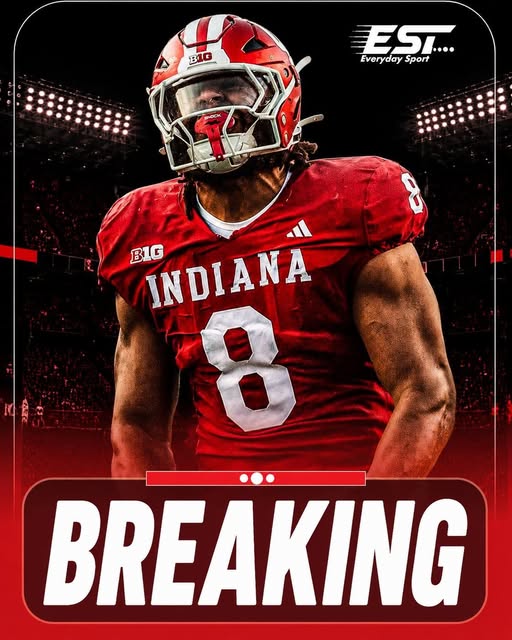
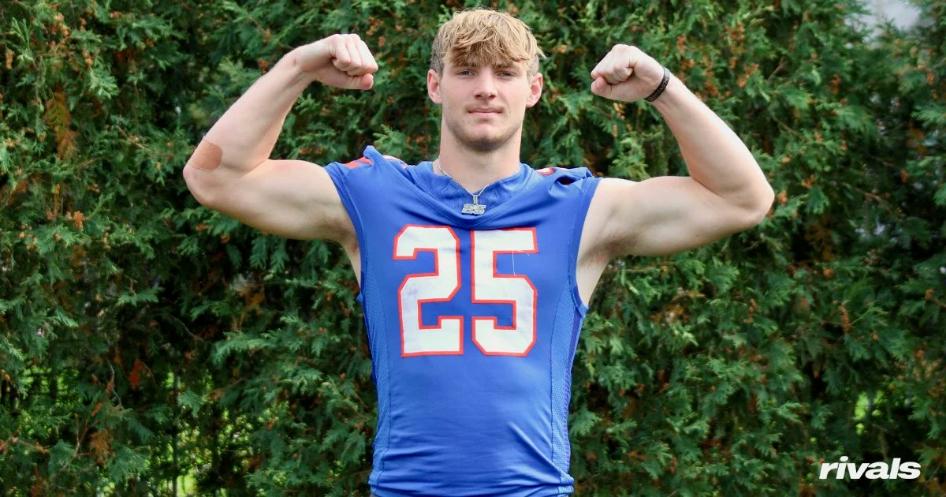
The Las Vegas Raiders’ decision to select Fernando Mendoza with the No. 1 overall pick in last weekend’s NFL Draft was always going to reshape the franchise’s offensive identity, but few expected the ripple effect to extend so quickly into the rest of his former Indiana teammates. What began as a straightforward franchise-altering quarterback selection has evolved into a broader storyline about chemistry, familiarity, and the possibility that Las Vegas is quietly building a pipeline from the Hoosiers’ historic national championship roster.
Mendoza arrived in Las Vegas as the centerpiece of a long-term rebuild, the kind of quarterback prospect teams structure entire draft cycles around. But almost immediately after his selection, speculation began circulating around whether the Raiders might look to recreate some of the supporting cast that helped him thrive in college. Indiana’s offense last season was widely regarded as one of the most balanced and efficient units in college football, and Mendoza’s connection with his surrounding skill players was a central reason for the program’s first-ever national championship run.
That speculation quickly centered on three names: wide receivers Omar Cooper and Elijah Sarratt, along with running back Kaelon Black. All three were considered potential late-round or priority undrafted free agent candidates who could benefit from continuity with Mendoza. However, when the draft concluded, none of them heard their names called by the Raiders.
On paper, it looked like Las Vegas had passed on the opportunity to fully recreate the Hoosiers’ offensive ecosystem. But as is often the case in the days following the draft, the real roster construction was only just beginning. While Mendoza was the only Indiana player selected by the Raiders, the organization’s post-draft activity quickly suggested that their interest in his former teammates was far from finished.
According to multiple reports, the Raiders have since signed Indiana running back Roman Hemby and wide receiver E.J. Williams as undrafted free agents, while also extending a rookie minicamp invitation to wide receiver Jonathan Brady. None of these transactions have been formally announced by the team, but league sources indicate that all three players are expected to be given legitimate opportunities to compete for roster or practice squad spots.
The move is subtle on the surface but meaningful in context. It reflects a growing trend across the NFL where teams, particularly those drafting quarterbacks at the top of the board, attempt to stabilize early development by surrounding them with familiar personnel. The logic is simple: if a quarterback already trusts certain receivers or understands the timing of a running back’s reads, the transition to professional speed becomes less about adaptation and more about refinement.
For the Raiders, this approach appears especially deliberate. Mendoza is expected to take over a franchise that has cycled through multiple quarterbacks in recent years without finding long-term stability. His development will be the organization’s top priority, and anything that accelerates his adjustment to NFL defenses is being treated as valuable currency.
Roman Hemby stands out as one of the most intriguing additions. The running back delivered a highly productive season for Indiana, rushing for 1,120 yards on a 4.9 yards-per-carry average while adding seven touchdowns. His combination of vision, balance, and downhill burst made him a reliable component of the Hoosiers’ offensive identity, particularly in games where controlling tempo was critical.
From the Raiders’ perspective, Hemby represents both depth and competition. He enters a crowded backfield that already includes first-round pick Ashton Jeanty, a dynamic runner expected to contribute immediately, along with fourth-round selection Mike Washington. While Hemby is not projected to unseat either player, his collegiate production suggests he is far from a camp body. Instead, he profiles as a developmental option who could carve out a role as a rotational back or special teams contributor.
His familiarity with Mendoza could also be a subtle advantage. While running backs are less dependent on quarterback chemistry than wide receivers, shared offensive language and timing still matter in modern spread concepts. Hemby’s experience operating within Indiana’s system alongside Mendoza gives him an understanding of cadence, read progression, and pre-snap adjustments that could prove valuable in a competitive training camp environment.
If Hemby represents stability in the backfield conversation, E.J. Williams brings a different kind of upside to the Raiders’ receiver room. At 6-foot-4 and 203 pounds, Williams offers a prototypical boundary receiver frame that the NFL continues to prioritize. His statistical output last season—36 receptions for 438 yards and six touchdowns—does not fully capture his role within Indiana’s offense, where he often functioned as a situational target in red-zone and third-down packages.
Williams’ average of 12.2 yards per reception underscores his ability to stretch the field vertically while also serving as a reliable possession option. More importantly for Las Vegas, his connection with Mendoza could be a key differentiator during training camp. Timing between quarterback and receiver is one of the most difficult elements to develop at the professional level, particularly for late-round picks and undrafted players. The Raiders are effectively betting that existing chemistry can accelerate that learning curve.
If Williams can translate that familiarity into consistent practice performances, he could find himself in contention for a practice squad spot or even push for a depth role depending on injuries and roster dynamics. Teams routinely keep receivers who demonstrate reliable rapport with their starting quarterback, especially during preseason games where timing and trust are heavily evaluated.
Jonathan Brady’s path is perhaps the most challenging of the three, but not without intrigue. His college production—14 receptions for 115 yards and three touchdowns—suggests a limited but efficient role in Indiana’s passing attack. At 8.2 yards per catch, Brady was often used in short-yardage and red-zone situations where precision mattered more than volume.
His invitation to rookie minicamp is significant because it places him in direct competition with other undrafted receivers fighting for limited opportunities. While his statistical profile does not immediately stand out, his value may lie in detail-oriented execution and special teams versatility. For fringe roster players, those traits can often outweigh raw production.
Brady’s connection to Mendoza, while less statistically prominent than Williams’, still provides a baseline level of familiarity that coaching staffs tend to appreciate. In high-pressure camp environments, where players are adjusting to complex playbooks and elevated speed, even marginal chemistry advantages can help a player stand out in small but meaningful ways.
What makes the Raiders’ approach particularly interesting is not just the individual signings but the broader pattern they suggest. This is not a franchise randomly collecting undrafted talent from a championship team. Instead, it appears to be a targeted effort to surround their new franchise quarterback with pieces he already understands. Even if only one or two of these players ultimately make the roster, the intent behind the moves is clear.
It also speaks to the significance of Indiana’s championship run. Programs that win national titles often see their players enter the draft with heightened attention, but rarely does an NFL team so directly integrate multiple undrafted players from the same college system into a quarterback-led rebuild. The Raiders’ coaching staff appears to be valuing system familiarity as much as individual athletic upside.
Of course, none of these roster moves guarantee long-term success. NFL history is filled with examples of college chemistry failing to translate under professional pressure. Speed increases, windows tighten, and defensive complexity often neutralizes even the most well-synchronized college partnerships. The Raiders are well aware of this reality, and their decisions likely reflect a balance between optimism and practicality.
For Mendoza, however, the presence of familiar faces—if even temporarily—could ease one of the most difficult transitions in professional sports. Rookie quarterbacks are often tasked with learning entirely new terminology, building timing with unfamiliar receivers, and adjusting to defensive schemes that bear little resemblance to college football. Having even one or two players who understand his rhythm and preferences could provide a subtle but meaningful stabilizing effect.
At the same time, competition remains the driving force behind every roster decision. Hemby, Williams, and Brady will not be handed opportunities simply because of their shared history with Mendoza. They will need to prove they can win one-on-one matchups, absorb the playbook quickly, and contribute on special teams. The NFL has little patience for sentimentality, and familiarity alone is never enough to secure a roster spot.
Still, the Raiders’ post-draft strategy paints a clear picture of an organization trying to maximize every possible advantage in developing its new quarterback. By blending high-end draft capital with targeted undrafted signings from Mendoza’s collegiate system, they are attempting to create an environment where their No. 1 pick can succeed as quickly as possible.
Whether this approach ultimately pays off will depend on far more than shared college experience. It will hinge on Mendoza’s adaptation to the speed of the NFL, the effectiveness of the coaching staff, and the ability of these undrafted players to rise above their labels. But for now, the early signs suggest that Las Vegas is committed to giving its new franchise cornerstone every possible tool to thrive.
And if even a small portion of Indiana’s championship chemistry survives the leap to the professional level, the Raiders may have found more than just a quarterback of the future. They may have stumbled into a developmental blueprint built on trust, timing, and familiarity—one that begins with Fernando Mendoza, but may not end with him alone.