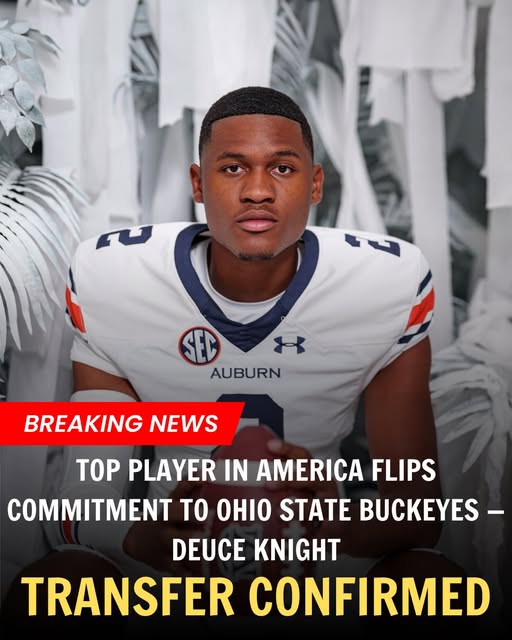
BREAKING NEWS: The college football recruiting landscape was shaken to its core on Monday as five-star quarterback Deuce Knight announced a stunning flip in his commitment, moving away from the Auburn Tigers and pledging instead to the Ohio State Buckeyes. The decision lands as one of the most consequential recruiting swings of the cycle, immediately altering quarterback depth charts, reshaping future offensive projections, and sending shockwaves through two of the most passionate fan bases in college football.
Knight, widely regarded as one of the premier quarterback prospects in the country, had long been considered a cornerstone of Auburn’s future recruiting class. His commitment to the Tigers earlier in the cycle was viewed as a major recruiting win for the program, a signal that Auburn could once again compete for elite offensive talent in the highly competitive SEC landscape. But in a dramatic turn that few inside recruiting circles fully anticipated, Knight reversed course and chose Columbus over the Plains, citing a combination of developmental opportunity, offensive fit, and long-term NFL preparation as driving factors behind the decision.
The move instantly elevates Ohio State’s already elite quarterback pipeline. The Buckeyes have built a national reputation for developing high-level quarterback talent, with recent history reinforcing their ability to turn top recruits into polished NFL prospects. Knight’s arrival only strengthens that narrative. At 6-foot-4 with a strong arm, mobility, and a rapidly developing command of complex passing concepts, he projects as a potential day-one competitor for the starting role once he arrives on campus. While competition will be fierce, Ohio State’s track record suggests that the quarterback room will be both demanding and productive.
For Auburn, the loss is as symbolic as it is strategic. The Tigers had centered portions of their offensive rebuild around Knight’s commitment, envisioning him as a foundational piece for future SEC contention. His decommitment not only leaves a void at the most important position in football but also raises broader questions about roster stability and recruiting momentum moving forward. Auburn now faces the challenge of recalibrating its quarterback board late in the cycle, a difficult task given the scarcity of elite quarterbacks still available and the timing of Knight’s decision.
The ripple effects extend far beyond the two programs directly involved. In the broader college football ecosystem, Knight’s flip reinforces the increasingly fluid nature of recruiting commitments in the NIL era. While verbal commitments were once treated as relatively stable indicators of future enrollment, modern recruiting has become far more dynamic, with late-stage flips, re-evaluations, and strategic decisions becoming increasingly common among elite prospects. Knight’s decision is yet another example of how coaching relationships, offensive schemes, development pathways, and program stability can outweigh early commitments.
For Ohio State, the addition of Knight continues a strategic trend of securing elite quarterbacks early or winning late recruiting battles for top-tier talent. The Buckeyes have consistently positioned themselves as a destination program for quarterbacks who aspire to play in pro-style systems with wide receiver talent and national championship expectations. Knight’s skill set appears tailor-made for that environment. His ability to extend plays, push the ball vertically, and operate within structured reads gives him versatility in an offense that demands both precision and creativity.
Recruiting analysts have long praised Knight’s poise under pressure, noting that he rarely appears rattled even in high-stakes environments. That trait will serve him well in Columbus, where expectations are immediate and competition is relentless. The Buckeyes’ quarterback room is expected to remain competitive year after year, but Knight’s talent level ensures he will not be entering as a passive developmental piece. Instead, he arrives with the pedigree and skill set to compete for meaningful snaps sooner rather than later.
The timing of the flip also adds another layer of intrigue. With recruiting cycles accelerating and early enrollment becoming increasingly important, Knight’s decision allows him to fully integrate into Ohio State’s offseason development program sooner than if he had remained with Auburn. That head start could prove significant in his adjustment to the college game, particularly given the complexity of Ohio State’s offensive system and the speed of Big Ten defenses.
For Auburn, the immediate focus will turn to damage control and recalibration. Losing a five-star quarterback late in the cycle is a significant setback for any program, but particularly one working to reestablish offensive consistency at the highest level of SEC competition. The Tigers’ coaching staff will now be forced to explore transfer portal options, flip candidates, or developmental prospects to stabilize the position group. While Auburn has historically shown resilience in recruiting, replacing a talent of Knight’s caliber is never a straightforward process.
Fan reaction across both programs has been intense. Ohio State supporters view the commitment as a reaffirmation of their program’s elite recruiting status, particularly at the quarterback position, which has often been the defining factor in national championship contention. Auburn fans, meanwhile, are grappling with disappointment and frustration, as the loss underscores the volatility of modern recruiting battles and the challenges of maintaining commitments against national powerhouse programs.
From a scouting perspective, Knight’s upside remains unchanged regardless of his destination. Evaluators consistently highlight his arm strength as one of the most natural in the class, capable of driving deep throws with velocity and accuracy. His athleticism adds another dimension, allowing him to extend plays outside the pocket and create opportunities when protection breaks down. While still refining his decision-making and consistency, his ceiling remains among the highest of any quarterback in his recruiting class.
Ohio State’s offensive staff will likely tailor portions of its system to maximize Knight’s strengths once he develops into a central figure in the offense. The Buckeyes have shown flexibility in adapting schemes to fit quarterback skill sets, and Knight’s dual-threat capabilities could open additional layers in both designed quarterback runs and improvisational passing situations. His presence also strengthens Ohio State’s recruiting pitch to future wide receivers, who often prioritize quarterbacks capable of delivering accurate, explosive passing opportunities.
The broader recruiting class implications are also significant. Knight’s flip may trigger additional movement among offensive skill players who had been aligned with Auburn or considering the Tigers as part of their decision-making process. Conversely, Ohio State could see a recruiting boost as elite pass catchers recalibrate their options in light of Knight’s commitment, recognizing the opportunity to play alongside one of the nation’s most highly regarded quarterbacks.
In the long term, this decision could become one of the defining recruiting moments of the cycle. If Knight develops as projected, his tenure in Columbus could reinforce Ohio State’s reputation as a quarterback development powerhouse and potentially fuel future recruiting victories at the position. If Auburn rebounds successfully from the loss, it may also serve as a testament to the program’s resilience and ability to adapt under pressure.
For now, however, the immediate reality is clear: Ohio State has secured one of the most coveted quarterback prospects in the nation, while Auburn must regroup after a significant late-cycle loss. In the ever-evolving world of college football recruiting, few events carry as much weight as a five-star quarterback flip, and this one will be analyzed, debated, and dissected for months to come.
Knight’s decision underscores the modern truth of college football recruiting: no commitment is ever truly final until the ink is dry on signing day. And even then, the story rarely stops there.