The money flowing through college football has never been bigger, and neither has the pressure attached to the sidelines. As universities battle for national championships, playoff appearances, recruiting dominance, and television relevance, head coaches are now among the most powerful — and highest-paid — figures in American sports. The 2026 salary rankings for college football head coaches reveal just how aggressively schools are investing in leadership, culture, and long-term success.
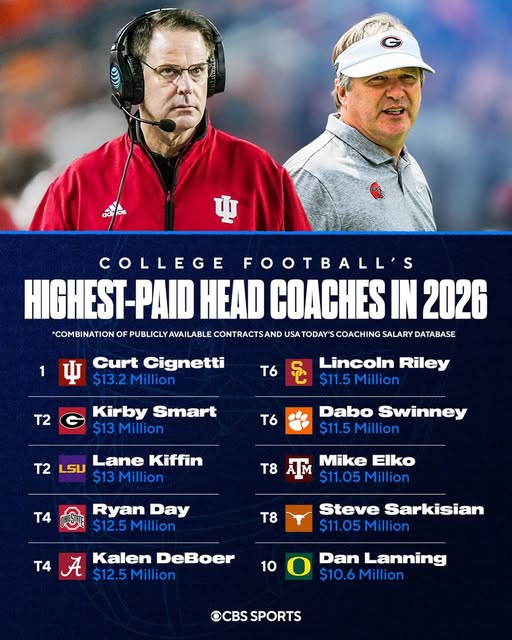
At the top of the list stands Curt Cignetti, whose stunning rise through the coaching ranks has culminated in a staggering $13.2 million annual salary. Right behind him are Kirby Smart and Lane Kiffin at $13 million each, highlighting how the arms race in college football continues to escalate at a historic pace.
The salaries are not simply reflections of wins and losses anymore. They represent television value, recruiting influence, donor confidence, playoff expectations, and institutional ambition. In 2026, the head coach is no longer just a football strategist. He is the face of an athletic department, the centerpiece of recruiting operations, and often the most recognizable employee at an entire university.
Cignetti’s position atop the list may surprise casual fans, but within coaching circles, his rise has been years in the making. Known for building disciplined programs and engineering rapid turnarounds, Cignetti has become one of the sport’s most respected leaders. His massive deal signals that schools are willing to pay elite money not only for brand-name coaches but also for proven program builders capable of delivering sustained success in the expanded College Football Playoff era.
Not long ago, salaries above $10 million were considered almost unimaginable in college athletics. Now, the threshold has become the standard for elite programs hoping to remain competitive in the SEC, Big Ten, and other power conferences. Schools understand that changing coaches frequently can destabilize recruiting, alienate boosters, and derail championship windows. Stability now carries an enormous price tag.
Smart’s continued presence near the top of the rankings comes as little surprise. Under his leadership, the Georgia Bulldogs have transformed into a modern dynasty. Recruiting dominance, elite defensive development, and multiple championship runs have cemented Smart’s status as one of the most valuable coaches in the sport. Georgia’s willingness to commit $13 million annually underscores how critical continuity is for programs chasing national titles every season.
Kiffin’s appearance beside Smart reflects a different kind of coaching success story. Long viewed as one of football’s most innovative offensive minds, the Ole Miss Rebels head coach has reinvented both his public image and his coaching reputation. Once considered a risky hire due to his nomadic career path, Kiffin has evolved into one of the most influential personalities in college football. His offensive creativity, recruiting savvy, and ability to keep Ole Miss nationally relevant have made him invaluable in an increasingly competitive SEC landscape.
Just behind the top trio is Ryan Day at $12.5 million. Few coaches operate under greater pressure than the leader of the Ohio State Buckeyes. Every season begins with championship expectations, and every loss is scrutinized nationally. Day’s record remains among the strongest in college football, but expectations in Columbus extend far beyond regular-season success. Big Ten championships, playoff victories, and wins over rivals are mandatory benchmarks. Ohio State’s financial commitment reflects its belief that Day remains capable of delivering at the highest level.
Matching Day at $12.5 million is Kalen DeBoer, who stepped into one of the most difficult jobs in sports after the legendary era of Nick Saban. Replacing a coaching icon was always going to bring immense scrutiny, but Alabama’s investment in DeBoer shows the university’s determination to maintain its place atop the college football hierarchy. DeBoer’s offensive systems, calm leadership style, and track record of winning quickly made him one of the most sought-after coaches in the nation before arriving in Tuscaloosa.
The presence of DeBoer and Smart near the top of the salary rankings also illustrates the SEC’s financial dominance. The conference continues to generate massive television revenue, attract elite recruits, and command national attention nearly every weekend. As media rights deals continue to expand, SEC schools remain willing to spend aggressively to secure coaching stability.
At $11.5 million each are Lincoln Riley and Dabo Swinney, two coaches representing very different program trajectories.
Riley remains one of football’s most respected offensive architects. His ability to develop quarterbacks and produce explosive offenses has kept the USC Trojans nationally relevant despite defensive inconsistencies that have at times limited championship aspirations. USC’s move into the Big Ten only intensified the pressure surrounding Riley’s tenure. The university is investing heavily in facilities, recruiting, and coaching infrastructure in hopes of returning to national-title contention.
Swinney, meanwhile, represents one of the most remarkable success stories of the modern era. The Clemson Tigers coach transformed Clemson from a strong regional program into a national powerhouse with multiple national championships and playoff appearances. Though the Tigers have faced questions about whether they can reclaim their previous dominance, Clemson’s commitment to Swinney remains unwavering. His culture-building ability, player development, and consistency over more than a decade continue to carry immense value.
The next tier features Mike Elko and Steve Sarkisian at $11.05 million each. Their inclusion reflects the extraordinary financial power of football in the state of Texas.
Texas A&M’s investment in Elko demonstrates the university’s determination to finally turn enormous resources into championship-level results. Few programs spend more aggressively on facilities, recruiting, and coaching than the Texas A&M Aggies. Elko earned widespread respect for his defensive expertise and leadership abilities before taking over the Aggies, and the school believes he can eventually elevate the program into consistent playoff contention.
Sarkisian’s salary reflects the resurgence of the Texas Longhorns under his leadership. After years of inconsistency, Texas has re-emerged as a national force thanks to elite recruiting, offensive creativity, and improved roster development. Sarkisian’s work has restored confidence among fans and donors while positioning Texas as a major player entering the SEC era. The university’s willingness to commit more than $11 million annually shows how badly it wants sustained national relevance.
Rounding out the top ten is Dan Lanning at $10.6 million. Lanning’s rapid ascent mirrors the broader evolution of the Oregon Ducks program itself. Oregon has long embraced innovation, speed, and aggressive recruiting strategies, and Lanning fits that identity perfectly. His energetic leadership and recruiting momentum have helped Oregon remain one of the nation’s most intriguing programs during a time of major conference realignment.
The salaries themselves also highlight the changing economics of college athletics. Television contracts continue to inject billions into major conferences, while the expanded playoff format has created even more financial incentives for programs to remain nationally competitive. Coaching salaries have risen alongside those revenues, with universities increasingly treating football success as a critical business investment.
Critics argue that the escalating salaries create an uncomfortable contrast with the broader educational missions of universities. Many point to budget concerns, academic funding debates, and the growing commercialization of college sports. Yet supporters counter that football revenue often funds entire athletic departments, supporting non-revenue sports and generating national visibility for universities.
The coaching market has also changed because of the transfer portal and NIL environment. Modern coaches are required to manage far more than practice schedules and game plans. They must oversee roster retention, navigate player compensation dynamics, maintain donor relationships, handle media obligations, and compete in nonstop recruiting battles. The demands of the profession have intensified dramatically, and salaries have risen accordingly.
Another major factor behind these contracts is fear. Universities understand how devastating a failed coaching hire can become. One bad decision can set a program back for years, damage recruiting pipelines, and cost millions in lost revenue. Athletic departments now prefer to pay premium salaries for proven leadership rather than risk instability.
The concentration of wealth among elite coaches also reinforces the widening gap between college football’s power programs and everyone else. Schools in the SEC and Big Ten possess financial resources that many smaller programs simply cannot match. As television revenue expands further, that divide may only continue to grow.
For fans, however, the numbers ultimately create expectations. A coach earning more than $10 million annually is expected to deliver championships, playoff appearances, and recruiting success consistently. Anything less often triggers criticism, speculation, and pressure from boosters and supporters.
That reality may weigh most heavily on coaches like Day, Riley, and Sarkisian, who operate in massive football markets where every game becomes a national story. In today’s environment, elite salaries come with elite scrutiny. Every recruiting class, every quarterback decision, and every late-game mistake is analyzed relentlessly.
Still, universities continue to spend because winning in college football has never mattered more. Successful programs generate merchandise sales, television exposure, alumni engagement, and national relevance that extend far beyond athletics. Coaches are viewed as the driving force behind that success, making them worth enormous investments in the eyes of administrators and donors.
The 2026 salary rankings offer a revealing snapshot of where college football stands today — a sport fueled by billion-dollar television deals, massive playoff stakes, and unprecedented financial ambition. Coaches are no longer simply educators and strategists. They are CEOs of multimillion-dollar enterprises operating under constant national attention.
And as long as championships continue to define legacies, schools will keep paying whatever it takes to stay in the race.