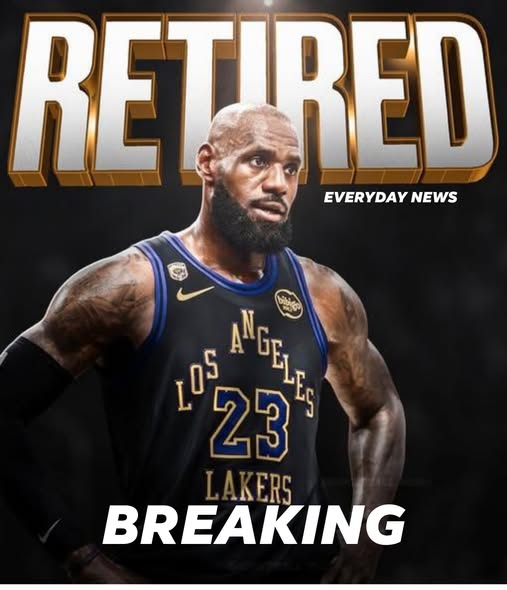
The basketball world stood still Tuesday night as LeBron James reportedly announced his retirement from the NBA following the Los Angeles Lakers’ playoff-ending loss to the Oklahoma City Thunder, bringing an emotional close to one of the greatest careers professional sports has ever witnessed.
For more than two decades, LeBron James was not merely the face of basketball — he was the center of the global sports conversation. From his arrival as a teenage prodigy out of St. Vincent–St. Mary High School in Akron, Ohio, to becoming the NBA’s all-time leading scorer and a four-time NBA champion, James built a résumé that transcended generations, franchises, and eras.
Now, after 21 remarkable seasons filled with championships, MVP awards, iconic playoff moments, Olympic glory, and countless records, the curtain has finally fallen on a career that changed basketball forever.
The announcement reportedly came shortly after the Lakers’ season-ending defeat to Oklahoma City, a loss that officially eliminated Los Angeles from postseason contention and marked what would become the final game of James’ historic career. Fans inside the arena remained frozen in disbelief as speculation quickly turned into heartbreak across social media, sports television, and locker rooms around the league.
For millions of basketball fans worldwide, the idea of an NBA without LeBron James feels almost impossible to comprehend.
James entered the league in 2003 as the most anticipated prospect in basketball history. Dubbed “The Chosen One” while still in high school, he carried expectations few athletes could ever survive. Yet somehow, he exceeded all of them.
Selected first overall by the Cleveland Cavaliers in the 2003 NBA Draft, James immediately transformed the franchise and the league itself. He won Rookie of the Year honors and quickly became one of the NBA’s premier superstars. By his early twenties, he was already being compared to legends such as Michael Jordan, Magic Johnson, and Kobe Bryant.
What separated James from many all-time greats was not only his talent but his longevity. Through two decades of constant scrutiny, championship pressure, and physical punishment, he remained elite deep into his late 30s and early 40s. While most stars faded with time, James continued rewriting history.
His first defining chapter came in Cleveland, where he carried undermanned Cavaliers rosters to playoff contention and eventually an NBA Finals appearance in 2007. Though Cleveland lost to the San Antonio Spurs, the basketball world understood that James was destined for far greater accomplishments.
Then came “The Decision” in 2010 — perhaps the most controversial moment of his career.
James’ nationally televised announcement that he would join the Miami Heat alongside Dwyane Wade and Chris Bosh ignited fury among Cleveland fans and reshaped modern player empowerment in professional sports. Villainized across the league, James embraced the pressure and eventually delivered championships in Miami, winning titles in 2012 and 2013 while capturing back-to-back NBA MVP awards.
Those Heat teams became one of the defining dynasties of the era, and James evolved into a nearly unstoppable force. His combination of size, vision, power, and basketball IQ created matchup nightmares never before seen in league history. At his peak, he could dominate every aspect of the game — scoring, rebounding, playmaking, and defending all five positions.
Yet even amid championship success in Miami, Cleveland remained unfinished business.
In 2014, James returned to the Cavaliers in a move that instantly became one of the most emotional homecomings in sports history. Two years later, he delivered on his promise in unforgettable fashion.
The 2016 NBA Finals cemented his legacy forever.
Facing a Golden State Warriors team that had won a record 73 regular-season games, the Cavaliers fell behind 3-1 in the series. No team in NBA Finals history had ever recovered from such a deficit.
Then James produced arguably the greatest three-game stretch the sport has ever seen.
His iconic chase-down block on Andre Iguodala in Game 7 became one of the most replayed moments in basketball history. Cleveland completed the comeback, capturing the city’s first major professional sports championship in more than 50 years.
For many fans and analysts, that championship elevated James into the greatest-of-all-time debate permanently.
After another dominant run in Cleveland, James signed with the Lakers in 2018, adding another legendary chapter to one of the NBA’s most iconic franchises. While the early years brought challenges, injuries, and roster instability, James eventually guided Los Angeles to the 2020 NBA championship inside the Orlando bubble during one of the most emotionally difficult periods in league history.
That title — his fourth overall — showcased his adaptability and leadership at an age when most superstars had long retired.
But James’ impact reached far beyond championships and statistics.
Off the court, he emerged as one of the most influential athletes of his generation. Through business ventures, philanthropy, media production, and social activism, James expanded the modern definition of what a superstar athlete could become.
His “I PROMISE School” initiative in Akron became one of the most celebrated educational projects launched by a professional athlete. Through his production company, SpringHill Entertainment, James helped create documentaries, television programs, and films that amplified athlete voices and cultural storytelling.
He also became increasingly outspoken on political and social justice issues, embracing a role that many global athletes had historically avoided.
Throughout his career, James faced criticism unlike almost any athlete before him. Every playoff loss, every roster move, every public comment became headline news. Yet despite the pressure, scandals and controversies that derail many superstars never truly defined his career.
Instead, consistency became his trademark.
Year after year, season after season, James delivered greatness.
He finished his career as the NBA’s all-time leading scorer, surpassing Kareem Abdul-Jabbar’s long-standing scoring record in one of the league’s most celebrated moments. He also ranked among the all-time leaders in assists, playoff points, All-NBA selections, and postseason victories.
Numbers alone, however, fail to capture what James represented to basketball fans around the world.
For one generation, he was the superstar who followed Jordan.
For another, he was their Jordan.
Young fans grew up watching James dominate playoff series, appear in NBA Finals after NBA Finals, and perform impossible feats under relentless expectations. His career bridged multiple eras — from battling veteran legends in the early 2000s to eventually competing against players young enough to have watched him as children.
In one of the most surreal moments of his career, James even shared the NBA floor with his son, a milestone that symbolized both his longevity and the passing of basketball history from one generation to the next.
The emotional reaction to his retirement spread immediately throughout the sports world.
Current and former players flooded social media with tributes, calling James one of the greatest competitors and leaders the game has ever seen. Coaches praised his basketball intelligence and durability, while fans shared memories of unforgettable buzzer-beaters, Finals performances, and highlight plays that defined an era.
Outside Crypto.com Arena, stunned Lakers fans gathered wearing James jerseys, many refusing to believe they had witnessed the final game of his career. Across Cleveland, Miami, Los Angeles, and countless cities worldwide, basketball supporters reflected on more than two decades of memories attached to his journey.
For the NBA itself, James’ retirement marks the end of a transformative chapter.
Few athletes in league history have influenced the business, media coverage, and global popularity of basketball as profoundly as he did. Television ratings surged during his playoff runs. Jersey sales exploded wherever he played. His free agency decisions altered league balance and reshaped how superstars approached player movement.
He entered the league before Twitter existed and retired in an age dominated by global digital media — yet through every transformation, James remained the defining figure of basketball conversation.
The challenge now facing the NBA is enormous.
For years, the league benefited from the overlapping eras of James, Stephen Curry, Kevin Durant, and other iconic stars who elevated professional basketball into a worldwide entertainment powerhouse. As those legends gradually move toward retirement, the NBA enters a new era led by younger superstars attempting to carry the torch.
Still, there will never be another LeBron James.
No player has combined sustained dominance, statistical excellence, cultural influence, media attention, and longevity on such a scale. Even among basketball immortals, James occupies a category almost entirely his own.
The debate over whether he or Michael Jordan deserves the title of greatest player in NBA history will continue for decades. Fans, analysts, and former players will endlessly compare championships, eras, statistics, and influence.
But perhaps James’ greatest achievement was forcing basketball to evolve around him.
He changed expectations for athletes entering the league straight from high school. He changed how players controlled their careers. He changed positional basketball by becoming a superstar capable of functioning as scorer, point guard, forward, and defensive anchor simultaneously.
Most importantly, he gave fans unforgettable moments that transcended sports.
From thunderous dunks and game-winning shots to emotional championship celebrations and historic records, James created a career filled with memories that defined modern basketball culture.
As arenas, analysts, and fans begin adjusting to an NBA without him, one reality remains undeniable: the game will never fully replace what LeBron James brought to it.
An era has officially ended.
And basketball may never see another player quite like him again.