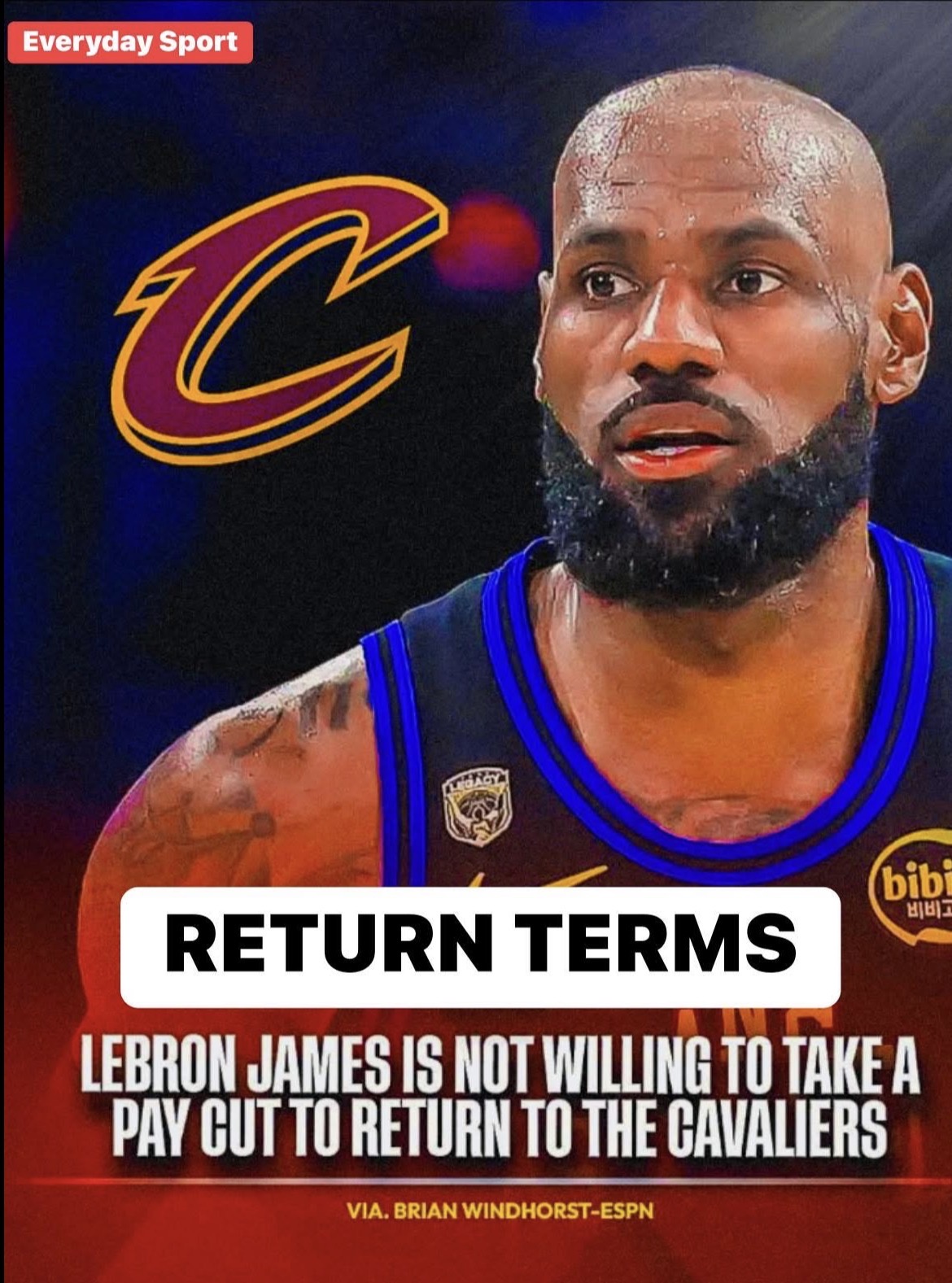
The possibility of LeBron James returning to the Cleveland Cavaliers has once again become one of the NBA’s most compelling offseason storylines, but according to ESPN’s Brian Windhorst, any dream reunion between the four-time NBA champion and the franchise where his legendary career began would come with a significant condition: James is reportedly unwilling to accept a reduced salary if he decides to return to Cleveland for another season.
That detail, while perhaps unsurprising for a player of James’ stature, instantly changes the dynamics surrounding what would already be one of the most complicated roster-building scenarios in the league. The Cavaliers have spent the past several years constructing a young, talented core capable of contending deep into the Eastern Conference playoffs, but fitting James onto the roster without financial concessions would present major challenges for Cleveland’s front office.
Even so, the mere suggestion of a return has reignited excitement across northeast Ohio and throughout the basketball world. Nearly two decades after James first entered the NBA as the most hyped prospect in league history, the idea of him finishing his career where it all began still carries emotional weight unlike almost any other story in professional sports.
For the Cavaliers, the equation is both simple and extraordinarily difficult at the same time.
On one hand, LeBron James remains one of the most productive players in basketball despite entering his 40s. Age has become almost irrelevant in discussions about his value because he continues to perform at an All-NBA level while maintaining the ability to control games mentally, physically and strategically. His presence alone changes championship expectations for any franchise fortunate enough to have him.
On the other hand, the modern NBA’s financial landscape has become increasingly restrictive under the league’s updated collective bargaining agreement. Teams operating near or above the second apron face severe limitations regarding roster flexibility, trades and future team-building strategies. For Cleveland, which has already invested heavily in its young core, adding James at full salary would require difficult decisions involving both current contributors and long-term planning.
Windhorst’s report underscores an important reality around James at this stage of his career. While speculation has often centered around the possibility of him sacrificing money to join a contender or reunite with familiar organizations, there has been little indication from James’ camp that he views himself as a player who should take less than maximum-level compensation. From a purely basketball perspective, there is logic behind that stance.
James continues to deliver elite production night after night. He remains one of the league’s best playmakers, one of its smartest offensive orchestrators and still possesses the physical strength to overwhelm defenders even after more than two decades in the NBA. Last season again demonstrated his durability and ability to impact winning at the highest level. Few players in league history have maintained this level of excellence so deep into their careers.
The Cavaliers understand that reality as well as anyone.
James’ connection to Cleveland transcends basketball accomplishments. He rescued a struggling franchise from irrelevance in 2003, carried the organization to its first NBA Finals appearance in 2007 and returned in 2014 to fulfill a promise that ultimately delivered the city its first major professional sports championship in more than half a century. His block against Andre Iguodala in Game 7 of the 2016 NBA Finals remains one of the defining moments in modern sports history.
Because of that legacy, the possibility of James wearing a Cavaliers jersey again automatically becomes emotional, nostalgic and commercially massive. Ticket sales would explode. National television appearances would increase. Cleveland would instantly become the center of the NBA universe once more.
But sentiment alone does not build championship rosters.
The Cavaliers have spent years carefully assembling a group centered around Donovan Mitchell, Darius Garland, Evan Mobley and Jarrett Allen. That core represents both the present and future of the organization. Cleveland believes Mobley can become one of the league’s premier two-way players, while Mitchell has already established himself as one of basketball’s elite scorers. Garland remains a dynamic creator, and Allen anchors the interior defensively.
Adding James to that group would undoubtedly raise Cleveland’s ceiling, but it would also require enormous financial maneuvering. The Cavaliers would need to navigate salary cap restrictions while maintaining enough depth to compete against powerhouses such as the Boston Celtics, Milwaukee Bucks and whatever emerges from the Western Conference.
That challenge becomes even steeper if James expects to maintain his current salary level.
The NBA’s new collective bargaining agreement has fundamentally altered how teams approach superstar construction. Franchises can no longer endlessly stack expensive talent without consequences. Teams above the second apron lose access to critical roster-building tools, including certain trade exceptions and flexibility mechanisms that previously allowed contenders to remain aggressive.
For Cleveland, that means every dollar matters.
If James were willing to take a reduced salary, the Cavaliers could potentially preserve more of their supporting cast while maintaining flexibility to strengthen the roster around him. Windhorst’s report suggests that may not be an option.
Still, around the league, there is widespread understanding of why James may feel no obligation to sacrifice financially.
Superstars have historically carried the burden of maximizing organizational revenue, television ratings and franchise valuation. James has arguably been the NBA’s most influential player for two decades. His arrival alone transforms franchises economically and competitively. From his perspective, accepting less money while still performing at an elite level may not align with either his value or his legacy.
There is also the matter of precedent.
Throughout NBA history, aging superstars have often faced intense pressure to accept reduced roles or diminished salaries in pursuit of championships. James has largely resisted those narratives because his production continues to justify star-level compensation. Unlike many late-career legends who transitioned into secondary contributors, James remains the engine of elite offenses and one of basketball’s premier attractions.
That distinction matters in negotiations.
The Lakers, meanwhile, continue to monitor every development surrounding James’ future. Although speculation about his next move has become an annual tradition, Los Angeles still views him as central to its championship aspirations. The organization understands that as long as James remains under contract, the expectation is contention.
At the same time, uncertainty surrounding the Lakers’ long-term direction has fueled outside speculation. Questions about roster depth, championship viability and future planning have all contributed to ongoing discussions about whether James could ultimately decide to finish his career elsewhere.
Cleveland naturally sits atop that list because of the emotional resonance attached to the franchise.
There is something uniquely poetic about the possibility of James ending his historic journey where it began. Sports fans are drawn to symmetry, and few endings would carry more narrative power than James returning home one final time. The image of him walking onto the Rocket Mortgage FieldHouse floor in a Cavaliers uniform again would immediately become one of the defining moments of the NBA calendar.
Players around the league would feel it. Fans would feel it. The entire basketball world would stop to watch.
But reality remains more complicated than nostalgia.
The Cavaliers are no longer the desperate franchise James rescued as a teenager. This is now a competitive organization with legitimate ambitions independent of his presence. Cleveland has developed its own identity, built around defense, athleticism and young star talent. Any decision involving James must align not only with emotion but also with basketball logic.
That means difficult conversations about fit, usage and long-term flexibility.
Would Garland remain comfortable in a system increasingly orchestrated by James? Could Mitchell continue thriving alongside one of the most ball-dominant creators in NBA history? Would Mobley’s development accelerate or stagnate sharing the floor with a player who naturally commands offensive structure?
Those are legitimate basketball questions executives must answer honestly.
At the same time, there is no denying what James still provides.
He elevates teammates through his passing vision. He slows games down mentally in postseason environments where decision-making becomes everything. He attracts defensive attention unlike almost any player in league history. Even in his 40s, opposing coaches still design entire game plans around limiting his impact.
Few players command that level of respect.
And perhaps most importantly for Cleveland, James still understands championship basketball better than nearly anyone alive. Young teams often struggle not because of talent deficiencies but because they lack playoff experience and composure under pressure. James instantly changes that dynamic. His leadership, preparation and understanding of postseason adjustments could accelerate Cleveland’s championship timeline dramatically.
That reality explains why the conversation surrounding his potential return refuses to disappear.
Inside league circles, executives continue to monitor every hint, every quote and every report connected to James’ future. Even the smallest development involving him can reshape offseason strategies because his decisions ripple throughout the NBA.
Windhorst’s report now adds another layer to that equation.
If James is indeed unwilling to accept a reduced salary, teams interested in pursuing him must prepare for the financial consequences attached to adding a superstar at full value. That may narrow the field of realistic destinations, but it certainly does not eliminate Cleveland from consideration.
The Cavaliers possess something few organizations can offer James at this stage: emotional significance.
For many superstars, the end of a career becomes a search for one final opportunity to define legacy. James’ legacy is already secure. He has championships, MVP awards, scoring records and a résumé unmatched by almost anyone in basketball history. What remains are the final chapters — the moments that shape how fans emotionally remember the conclusion of his career.
Returning to Cleveland could represent exactly that kind of defining chapter.
Imagine the atmosphere surrounding opening night if James rejoined the Cavaliers. Every arena would become a celebration tour. Every playoff game would carry enormous historical weight. Every moment would be analyzed through the lens of legacy, redemption and basketball immortality.
That level of attention follows James everywhere, but in Cleveland it becomes personal.
The city still reveres him for delivering the 2016 championship. Murals, jerseys and memories continue to define his relationship with the fan base. Time has softened the bitterness surrounding his original departure to Miami, replacing it with appreciation for what he ultimately accomplished upon returning.
In many ways, James and Cleveland became permanently linked through shared history.
Now the basketball question becomes whether a reunion makes competitive and financial sense.
The Cavaliers must determine whether the short-term championship boost outweighs potential long-term complications. They must evaluate whether maintaining their young core while adding James at full salary is realistic under current cap restrictions. And perhaps most importantly, they must decide how aggressively they are willing to pursue a move that would instantly dominate the sports world.
For James, the decision may ultimately come down to balancing legacy, family considerations, championship aspirations and financial respect.
If Windhorst’s reporting proves accurate, one thing is already clear: James does not intend to approach the next phase of his career as a diminished star willing to accept reduced compensation simply for sentimental reasons.
He still sees himself as one of the NBA’s elite players.
Based on his production, it is difficult to argue otherwise.
And as another pivotal offseason approaches, the possibility of LeBron James returning to Cleveland has once again become far more than a nostalgic fantasy. It is now a genuine basketball conversation with enormous implications for the Cavaliers, the Lakers and the league itself.
Whether that conversation ultimately becomes reality remains uncertain.
But in the NBA, where legacy, business and emotion constantly collide, few stories carry more intrigue than the idea of LeBron James going home one final time — on his own terms, and at his full value.