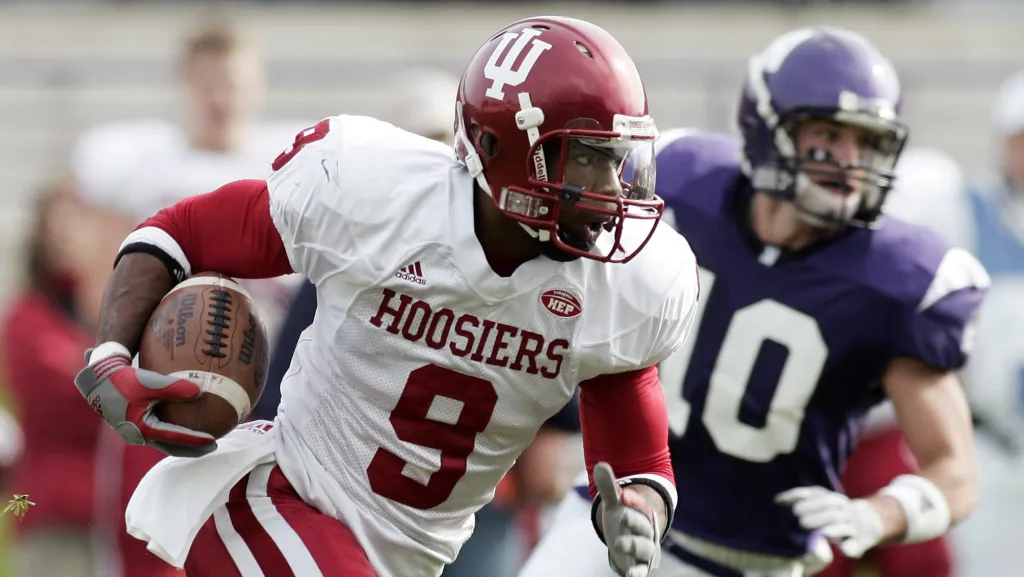
In college football, anonymity tends to sharpen truth. Coaches are rarely willing to publicly grade opponents in anything other than polished clichés, but when their names are removed, the language changes—candor replaces caution, and projection replaces politeness. That dynamic is once again centered on the Indiana Hoosiers, a program that has gone from perennial underachiever to the reigning national standard, and now finds itself under a microscope heading into the 2026 season.
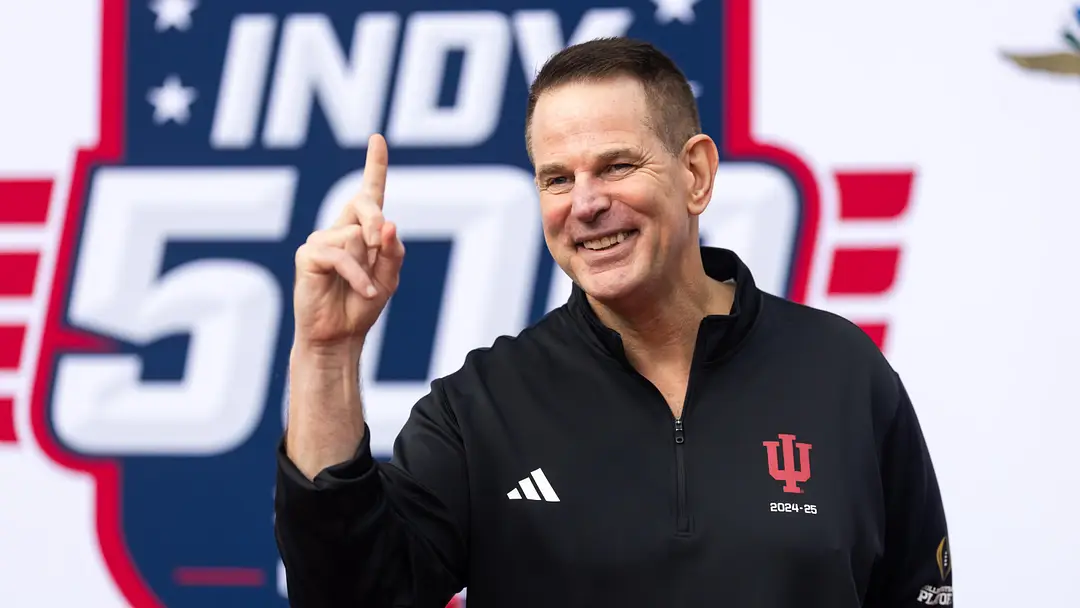
According to multiple anonymous coaching evaluations compiled in national preseason previews, Indiana is no longer being discussed as a surprise story or feel-good anomaly. Instead, it is being treated as a measuring stick for the rest of the Big Ten—and in some cases, the entire sport. Coaches across the conference, speaking to outlets including Athlon Sports and SI, broadly acknowledged Indiana’s rise under head coach Curt Cignetti while simultaneously questioning whether the program can sustain the historic pace it set during its championship run.
The tension in those evaluations defines Indiana’s 2026 reality. The Hoosiers are no longer chasing respect. They have it. What they are now chasing is permanence.
Indiana enters the season after a seismic 2025 campaign that ended with a College Football Playoff national title, a Big Ten championship, and the program’s first sustained run at the top of the sport in modern history. The transformation under Cignetti has been widely chronicled, from a culture built on discipline and transfer-portal efficiency to a roster construction model that emphasizes production over pedigree. The result has been one of the most rapid ascents in college football history, culminating in Indiana being viewed not as an outlier but as a standard-setter.
Now, in 2026, the tone around Bloomington has shifted. The anonymous coaches surveyed across the Big Ten and Power Four landscape repeatedly returned to two themes: Indiana’s roster talent is legitimate, and the target on its back is unavoidable. One recurring sentiment is that the Hoosiers are no longer sneaking up on anyone. Every opponent, from nonconference openers to late-November rivalry matchups, will treat Indiana as a “season-defining” game.
That reality begins immediately with the schedule. Indiana opens its 2026 campaign on Sept. 5 against North Texas in Bloomington in a nationally televised Big Noon Kickoff matchup, a game that reflects just how far the program has climbed in terms of visibility and expectation. From there, the Hoosiers step into the unforgiving rhythm of Big Ten play, a slate that no longer offers any disguise or easing-in period for a defending champion.
The coaching sentiment around Indiana’s offense is particularly split. On one hand, evaluators consistently praise the system continuity under Cignetti and offensive coordinator Mike Shanahan, whose “pro spread” structure has become synonymous with efficiency and adaptability. On the other, there is skepticism about whether Indiana can replicate its explosive balance after major personnel turnover typical of a championship roster in the modern transfer era.
Quarterback play remains the focal point. While Indiana’s 2025 championship run was defined by elite quarterback efficiency and timely execution, opposing coaches anonymously told preseason analysts that the challenge in 2026 will be maintaining that standard without the same margin for error. In the Big Ten, defenses adjust quickly. Once tendencies are identified, they are attacked relentlessly. That, more than anything, is the concern voiced behind closed doors.
Still, even the skeptics acknowledge the infrastructure. Indiana’s offensive identity is no longer experimental. It is established. The system is built to minimize volatility and maximize control of game tempo, something several coaches described as “hard to disrupt when it’s clicking.” The Hoosiers’ offensive line development and run-game coordination have also become points of respect around the conference, especially given how quickly those units were rebuilt through portal additions during the Cignetti era.
Defensively, Indiana may be even more respected. Coordinator Bryant Haines’ unit is widely described in anonymous scouting circles as “disciplined, fast, and structurally sound,” with multiple Big Ten assistants noting that Indiana’s defensive back end is among the most consistent in the league. The return of veteran safety Amare Ferrell has been singled out as a stabilizing factor, giving Indiana an experienced anchor in the secondary after a championship season in which takeaways and situational stops defined critical moments.
Opposing coaches, however, have pointed to the natural regression question that follows any dominant defensive year. Turnover production is difficult to sustain year over year, and Indiana’s aggressive style—built on anticipation and calculated risk—will be tested by quarterbacks who now have full offseason film study on the Hoosiers’ tendencies.
The broader coaching consensus is not that Indiana will fall off, but that the margin between dominance and “merely excellent” is razor-thin.
What makes Indiana’s position even more fascinating is how the external perception has evolved. A year ago, opponents still framed the Hoosiers as an overachieving program playing with house money. That language has disappeared. In its place is the language reserved for elite programs: “standard,” “expectation,” and “weekly measuring stick.”
One anonymous Big Ten defensive coach described Indiana’s transformation in blunt terms to preseason analysts, essentially noting that preparation for the Hoosiers now resembles preparation for Ohio State or Michigan: maximum focus, minimal mistakes, and no assumption of weaknesses.
That shift in perception is directly tied to Cignetti, whose contract extension and program control have further solidified Indiana’s trajectory as a long-term contender. His ability to retain staff continuity and demand roster consistency through the transfer portal has become a talking point across the sport.
But even with that stability, the anonymous coach commentary carries an undercurrent of caution. Sustaining elite performance in the modern college football ecosystem—especially after a championship season—is notoriously difficult. Roster turnover, NFL declarations, NIL movement, and scheduling volatility all combine to make repeat dominance rare. Several coaches surveyed pointed to that historical trend as the primary reason they expect Indiana to face more resistance in 2026, even if the talent remains high.
At the same time, there is no mistaking the respect level. Indiana is now discussed in the same breath as perennial contenders, not because of reputation built over decades, but because of recent proof. That distinction matters in coaching circles, where belief is earned almost exclusively through film.
The Big Ten landscape itself only amplifies the challenge. With programs like Ohio State, Oregon, Penn State, Michigan, and USC all operating in similar national contention windows, Indiana’s path to sustained dominance runs through a weekly gauntlet of opponents who no longer view the Hoosiers as a surprise but as a benchmark opportunity. Every matchup carries implications not just for standings, but for perception.
Even so, Indiana’s internal confidence is not expected to waver. Programs that reach the summit under modern conditions tend to retain a certain identity edge—the belief that structure, preparation, and execution can offset volatility elsewhere. That belief is precisely what anonymous coaches say makes Indiana dangerous even in a “down year.”
In other words, the floor remains high.
What remains uncertain is the ceiling.
Some evaluators believe Indiana’s 2025 season represented a peak that will be difficult to replicate in the playoff era, especially given how dominant that championship run appeared in hindsight. Others argue that the program’s structural advantages—system continuity, coaching stability, and portal efficiency—make sustained success not only possible, but likely.
The truth, as always in college football, lies somewhere in between.
Indiana is not being picked apart in preseason conversations. It is being measured. That alone represents a fundamental shift for a program that, not long ago, was an afterthought in its own conference hierarchy. Now, the Hoosiers are the team others study to understand what elite football looks like in the modern era.
As one anonymous coach summarized in preseason discussions across the Big Ten, Indiana is no longer chasing validation. It is defending it.
And in 2026, that may be the hardest job in college football.