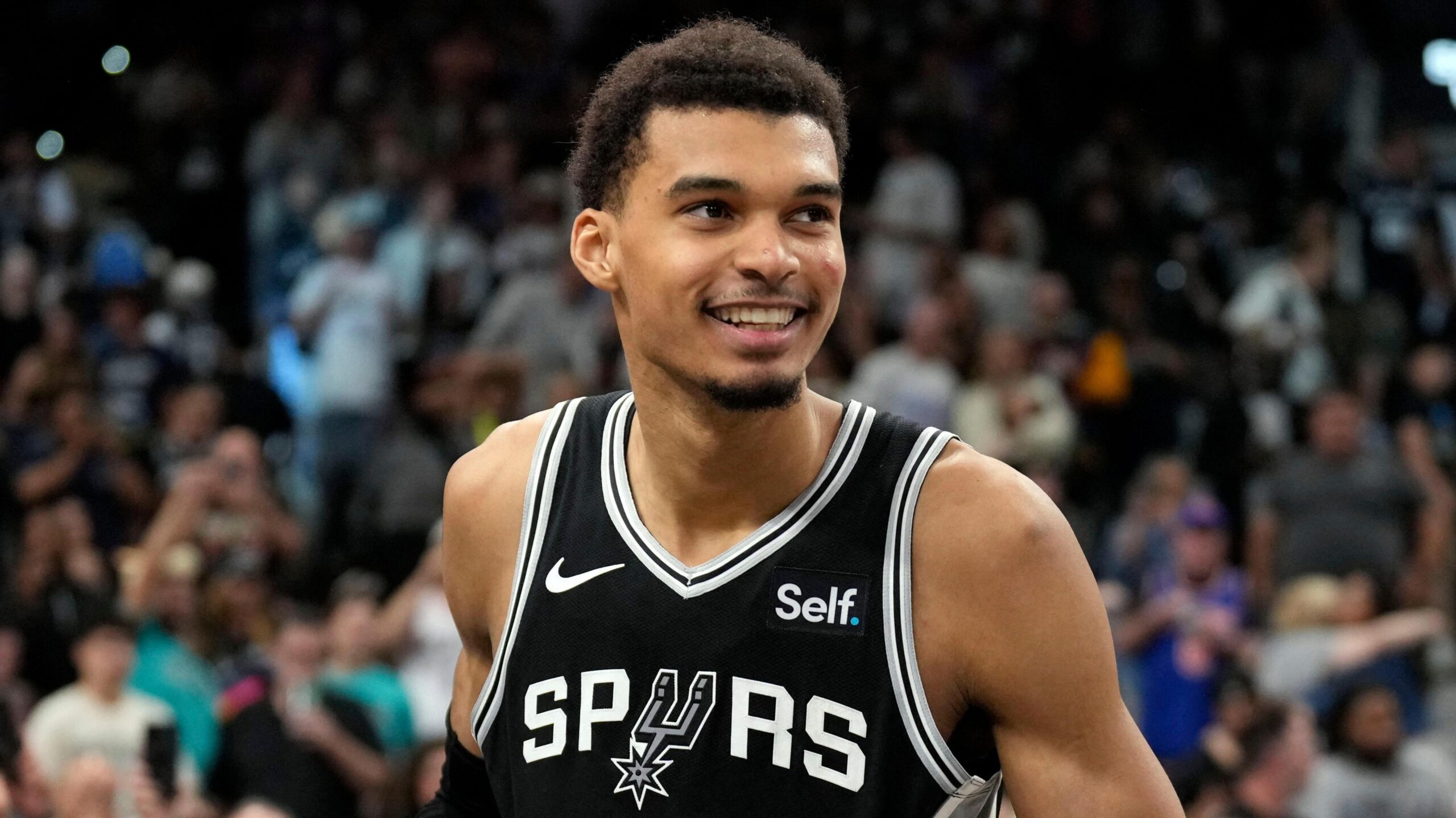
The San Antonio Spurs are preparing to make the biggest financial commitment in franchise history, and all signs point toward Victor Wembanyama becoming the latest NBA superstar to secure a monumental rookie maximum contract extension.
League sources indicate that the Spurs are expected to finalize a five-year rookie max extension with Wembanyama worth at least $251 million, a deal that could ultimately exceed $300 million if performance-based incentives are achieved. The anticipated agreement would not only cement Wembanyama as the centerpiece of San Antonio’s future but also place him among the highest-paid players in league history before reaching his mid-20s.
The expected extension comes as little surprise around the NBA. Since arriving as the No. 1 overall pick in the 2023 NBA Draft, Wembanyama has transformed expectations for the Spurs franchise and quickly established himself as one of basketball’s most influential talents. His combination of size, skill, defensive dominance, and offensive versatility has drawn comparisons to some of the greatest players the game has ever seen.
Yet while the financial framework of the extension appears straightforward, the broader implications surrounding the agreement have become one of the league’s most fascinating storylines. The question facing Wembanyama and his representatives is not whether he deserves every dollar available under the collective bargaining agreement. Few executives around the league would dispute that. Instead, the discussion centers on whether the French phenom will follow the traditional superstar blueprint by accepting the maximum amount possible or whether he will embrace a team-first philosophy similar to the one recently adopted by New York Knicks star Jalen Brunson.
The distinction could have major consequences not only for Wembanyama’s earnings but also for the Spurs’ ability to build a championship contender around him.
Historically, elite NBA players have almost always accepted maximum contract extensions when eligible. The logic is simple. Careers can be shortened by injury, league economics can fluctuate, and players have long fought to maximize earnings during their prime years. For decades, taking less money than available has been viewed as an unnecessary risk, particularly for young stars who have not yet secured multiple long-term contracts.
Wembanyama certainly fits the profile of a player who could command every available dollar. Entering what many believe will be the prime years of his career, the 7-foot-4 superstar has already become one of the NBA’s premier defensive forces while continuing to expand his offensive arsenal. He possesses the rare ability to protect the rim, switch onto guards, stretch defenses with perimeter shooting, and create offense as a primary playmaker.
Those attributes have elevated expectations for San Antonio’s future. After several seasons of rebuilding following the retirement of franchise icons and the conclusion of the team’s championship era, the Spurs suddenly find themselves positioned as one of the league’s most intriguing young teams. Much of that optimism stems directly from Wembanyama’s presence.
The organization has spent the past several years accumulating draft assets, developing young talent, and preserving financial flexibility. The goal has always been to create a sustainable contender around a transformational player. With Wembanyama emerging even faster than many scouts anticipated, that timeline appears to be accelerating.
Still, the realities of the NBA’s modern salary cap system create difficult choices. Under the league’s latest collective bargaining agreement, teams operating above certain spending thresholds face increasingly restrictive penalties. Those restrictions impact roster construction, trades, free-agent signings, and overall flexibility. As a result, front offices across the league are placing a greater emphasis on value contracts and long-term financial planning.
That reality has made Brunson’s contract situation one of the most discussed examples in recent years.
In 2024, Brunson agreed to a below-market extension with the Knicks despite being eligible to pursue significantly larger earnings in future negotiations. The move was widely praised throughout the league because it provided New York with additional salary-cap flexibility. That flexibility helped the Knicks maintain a competitive roster and preserve opportunities to strengthen a team already viewed as a legitimate championship contender.
Brunson’s decision represented a rare departure from the standard superstar playbook. While many players publicly emphasize winning, relatively few choose to sacrifice substantial guaranteed money to improve their team’s roster-building options.
The move instantly sparked conversations around the NBA about whether more stars might eventually consider similar paths.
Now those conversations have shifted toward San Antonio and Wembanyama.
The Spurs find themselves at a critical point in their organizational development. While Wembanyama remains on his rookie contract, the franchise enjoys considerable flexibility. However, as young players develop and extensions begin to stack onto the payroll, maintaining a championship-caliber roster becomes increasingly challenging.
A maximum extension for Wembanyama would still be viewed as an easy decision from San Antonio’s perspective. Franchise players are extraordinarily difficult to find, and once acquired, organizations rarely hesitate to invest heavily in retaining them. The Spurs understand that reality better than most.
Throughout their history, the franchise built around cornerstone talents such as Hall of Fame legends who delivered sustained success over multiple decades. Wembanyama is widely viewed as the next player capable of carrying that legacy forward.
League executives consistently describe him as one of the most valuable assets in professional sports. His impact extends beyond statistics. He has become a global ambassador for basketball, attracting international attention and elevating the Spurs’ profile worldwide. Merchandise sales, television ratings, attendance figures, and overall interest in the franchise have all benefited from his arrival.
From a basketball standpoint, his influence has been even more dramatic.
Opposing coaches routinely alter game plans specifically to account for Wembanyama’s presence. His defensive range changes the geometry of the court, discouraging drives and forcing teams into uncomfortable offensive decisions. On the other end, his unique skill set creates matchup nightmares that few defenders are equipped to handle.
Those qualities explain why many analysts believe he possesses the potential to become the face of the NBA for the next decade.
Such status typically comes with maximum contracts.
Yet the Brunson comparison remains relevant because the Spurs appear to be building something uniquely sustainable. The organization’s reputation for player development, strategic planning, and long-term thinking has long been one of its defining strengths. If Wembanyama were willing to structure a deal that provided even modest financial concessions, the ripple effects could be significant.
Additional cap flexibility could help San Antonio retain emerging young contributors, pursue impact veterans, and maintain roster depth during future championship pursuits. Every dollar saved at the top of a payroll can create opportunities elsewhere on the roster.
Of course, asking a player to sacrifice guaranteed earnings is easier in theory than in practice.
Even for athletes earning hundreds of millions of dollars, contract negotiations involve complex considerations. Players must balance personal security, market value, legacy, competitive aspirations, and future opportunities. Agents have fiduciary responsibilities to maximize value, while organizations naturally seek flexibility whenever possible.
In Wembanyama’s case, the stakes are particularly high because of the unprecedented scale of the potential contract.
A deal beginning at approximately $251 million would already represent one of the richest rookie extensions ever awarded. Incentives tied to awards, All-NBA selections, MVP voting, and other performance benchmarks could push the total value well beyond $300 million. Those figures reflect not only Wembanyama’s current standing but also the league’s belief in his future trajectory.
Few players in NBA history have entered extension discussions with a stronger combination of youth, production, marketability, and upside.
For that reason, many around the league expect Wembanyama ultimately to accept the maximum amount available under league rules. Doing so would align with decades of precedent and establish a financial foundation that could shape the remainder of his career.
At the same time, the very existence of the conversation highlights how highly he is regarded.
Only players viewed as genuine franchise-altering superstars generate debates about whether they might voluntarily leave money on the table to help pursue championships. The fact that Wembanyama’s future is being discussed in those terms underscores the extraordinary expectations surrounding him.
For the Spurs, the preferred outcome is likely straightforward. Secure the extension, continue developing the roster, and trust that their organizational culture can attract the necessary pieces to compete at the highest level.
Whether the final number settles at $251 million or climbs beyond $300 million, San Antonio appears committed to making Wembanyama the cornerstone of its future for years to come.
The franchise believes it has found its next generational superstar. The league believes it may have found its next global icon. And soon, one of the most significant contracts in NBA history could formally reflect that reality.
As negotiations move toward completion, the financial figures will dominate headlines. But the larger story may ultimately center on what kind of superstar Wembanyama chooses to become. Will he follow the traditional path embraced by nearly every elite player before him, maximizing every dollar available? Or will he explore a team-oriented approach that mirrors Brunson’s recent example and potentially provides the Spurs with greater championship-building flexibility?
The answer could shape not only the next chapter of Wembanyama’s career but also the future of a Spurs organization determined to return to the top of the NBA. Either way, the anticipated extension signals one undeniable truth: San Antonio is prepared to bet its future on Victor Wembanyama, and it is prepared to do so at a historic price.