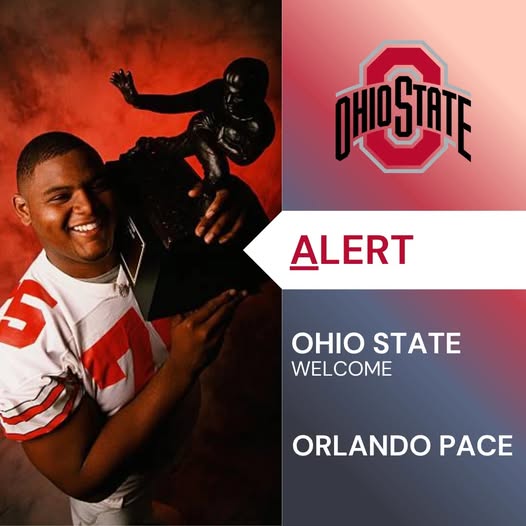
COLUMBUS, Ohio — Just 24 hours after the Ohio State Buckeyes rolled out the red carpet for one of the program’s most revered sons, the machinery of college football’s powerhouse turned once more. Orlando Pace, the former five-star phenom whose name still echoes through the Horseshoe like a thunderclap from the trenches, is coming home. This time, it’s not as the immovable left tackle who pancaked defenders into oblivion and cleared lanes for Heisman winners. It’s in a new role — one that blends legendary pedigree with modern mentorship — and the confirmation came straight from the NFL’s most plugged-in voice, Adam Schefter.
Pace’s return marks another chapter in the Buckeyes’ relentless pursuit of dominance, a program that refuses to let its past gather dust while chasing future glory. For a fanbase that measures success in Big Ten titles, playoff berths, and national championships, welcoming back “The Pancake Man” feels like reclaiming a piece of identity that was forged in the brutal beauty of the offensive line.
To understand the weight of this moment, you have to rewind to the mid-1990s, when a towering kid from Sandusky, Ohio, stepped onto the practice fields in Columbus and rewrote what it meant to play offensive tackle. Orlando Pace arrived as a true freshman in 1994 and did something almost unheard of: he started on opening day. Only the second true freshman to do so for the Buckeyes, Pace didn’t just play — he dominated. By his sophomore season, he was winning the Lombardi Award, the first underclassman ever to claim the honor given to the nation’s top lineman. He helped propel Eddie George to the 1995 Heisman Trophy, stonewalling pass rushers so effectively that the term “pancake block” became synonymous with his game. Opponents didn’t just get blocked; they got buried.
In three seasons from 1994 to 1996, Pace started all 38 games, earned unanimous All-American honors twice, and claimed the Outland Trophy in ’96 as the best interior lineman in college football. He didn’t allow a single sack in his final two years. The Buckeyes went 31-7 during his tenure, capped by a Rose Bowl victory over Arizona State. John Cooper, his coach at the time, didn’t mince words years later: Pace was the best offensive lineman he had ever seen, period. That kind of praise from a Hall of Fame coach carries through decades.
Pace’s legend only grew in the NFL. Selected first overall by the St. Louis Rams in 1997, he anchored the “Greatest Show on Turf” that won Super Bowl XXXIV. A seven-time Pro Bowler, he earned All-Pro nods and eventually a bust in Canton as part of the Pro Football Hall of Fame Class of 2016. But through it all, the scarlet and gray never left his blood. Ohio State fans have watched him return for games, speak at events, and occasionally lend his wisdom to young linemen. Now, it’s official and full-time.
The timing feels poetic, arriving just a day after what sources described as an emotional homecoming celebration involving former teammates, current players, and program brass. Schefter, citing multiple sources close to the situation, broke the news late Wednesday: Pace is returning to Ohio State in a leadership capacity within the offensive line room. Details remain somewhat guarded — titles in college football often evolve — but those familiar with the program describe it as a hybrid role combining on-field coaching, player development, and strategic input on the offensive line. Think veteran sage meets position coach, with the gravitas only a first-overall pick and Hall of Famer can bring.
For Ryan Day and his staff, this is more than nostalgia. Ohio State’s offensive line has been a strength in recent years, but maintaining that edge in an era of transfer portals, NIL deals, and ever-evolving defensive schemes is a constant challenge. Bringing in Pace isn’t just about technique — though his mastery of footwork, hand placement, and leverage remains unmatched — it’s about instilling a mindset. The kind that turns good players into great ones and great ones into legends.
Current Buckeyes offensive linemen are already buzzing. One redshirt sophomore tackle, speaking on condition of anonymity because the hire hasn’t been formally announced by the university, said the news hit like a jolt of energy. “Growing up watching highlights of Pace, you see a guy who didn’t just block people — he owned the line of scrimmage. Having him in the room every day? That’s going to change how we approach everything.”
Pace’s influence extends beyond Xs and Os. At 6-foot-7 and still carrying the frame that made him a nightmare for edge rushers, he commands respect instantly. But those who know him describe a humble, thoughtful leader who understands the pressures these young men face. College football today is a business as much as a sport. Players balance academics, social media scrutiny, NIL opportunities, and the physical toll. Pace navigated the transition from amateur to professional in a very different era, but his core principles — discipline, preparation, accountability — are timeless.
Look back at his college tape and the dominance is visceral. Pancake after pancake, defenders flung aside like rag dolls. In 1995, blocking for George, he helped create one of the most productive rushing attacks in program history. George rushed for nearly 2,000 yards that year. Pace’s presence allowed the offense to dictate terms. Fast-forward to today, and Ohio State offenses under Day emphasize balance, explosiveness, and protecting the quarterback. A voice like Pace’s could be the bridge between the physical mauling style of the past and the schematic sophistication of the present.
The broader context of this move fits into Ohio State’s larger strategy of surrounding its program with Buckeye blood. The coaching staff already boasts several former players in key roles, creating a family atmosphere that resonates in recruiting. When a five-star prospect visits Columbus, seeing icons like Pace walking the halls sends a powerful message: this is where greatness is built and sustained. It’s continuity in a sport that often feels transient.
Fans on social media and message boards have erupted with excitement. “Big O back where he belongs,” one popular post read, accompanied by classic footage of Pace demolishing a defender. Another highlighted the potential ripple effect on the 2026 recruiting class, particularly along the offensive line. Ohio State has long been a factory for NFL talent up front — recent first-rounders and high picks attest to that — and adding Pace could elevate that pipeline even further.
Of course, no homecoming is without its layers. Pace has built a life post-football: entrepreneur, speaker, family man. His son Landon has followed in his footsteps, drawing interest as a tight end prospect. The decision to return to Columbus full-time speaks to the pull of the program and perhaps a desire to give back in a meaningful way. Those close to him say he’s been weighing opportunities for some time, and the fit with Ohio State felt right at this juncture.
As the Buckeyes prepare for another high-stakes season, the addition of Pace arrives at a pivotal time. Recent years have brought both exhilarating highs — College Football Playoff appearances — and stinging disappointments. The offensive line has been a cornerstone of resilience, but depth, development, and adapting to new defensive trends remain priorities. A Hall of Famer rolling up his sleeves in meetings and on the practice field injects not just knowledge, but an intangible winning culture.
Imagine the scenes in the Woody Hayes Athletic Center: young tackles drilling footwork under Pace’s watchful eye, absorbing stories from Super Bowl runs and Heisman campaigns. Veterans sharpening their craft alongside a man who literally defined excellence at the position. It’s the kind of mentorship that transcends stats and highlights.
Pace himself has always been measured in public comments, preferring actions over words. But in past interviews, his love for Ohio State shines through. He once described his time in Columbus as foundational, shaping not just his football career but his character. Returning now, in whatever official capacity the university announces, closes a circle while opening new possibilities.
For ESPN analysts and national observers, this move underscores Ohio State’s resource advantage. While other programs scramble for coordinators and position coaches, the Buckeyes can call upon their pantheon of greats. It’s a reminder that tradition isn’t just celebrated here — it’s weaponized.
As fall approaches and the leaves turn in central Ohio, the energy around the program will only intensify. Practices will be sharper. Expectations higher. And somewhere on the field, Orlando Pace will be there, perhaps not in pads but with the same commanding presence that once made him unblockable in the other direction.
The Buckeyes have added a legend to their ranks. In a sport obsessed with the next big thing, sometimes the best move is bringing back one of the greatest. Just 24 hours after the welcome, the return is official. Ohio State football is stronger for it. And the chase for another national title just gained a Hall of Fame boost.
This isn’t merely a coaching hire or a ceremonial return. It’s a statement. The Pancake Man is back, ready to forge the next generation of Buckeye linemen who will carry the torch he lit decades ago. In Columbus, where football dreams are built in the trenches, few returns could resonate more deeply. The Horseshoe awaits the impact.