Ian Moore Emerging as Favorite to Win Ohio State’s Starting Left Tackle Job
Ohio State entered the offseason knowing its offensive line had to get better. Now, as the Buckeyes move through preseason camp with another national championship chase in view, one of the most important answers may be emerging from an unexpected place.
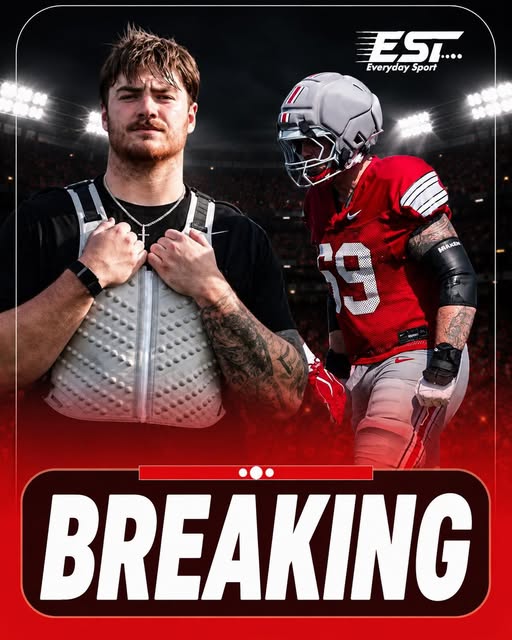
Ian Moore has turned a developmental opportunity into a legitimate starting candidacy, and the redshirt sophomore is increasingly viewed as the favorite to take over at left tackle for Ohio State in 2026.
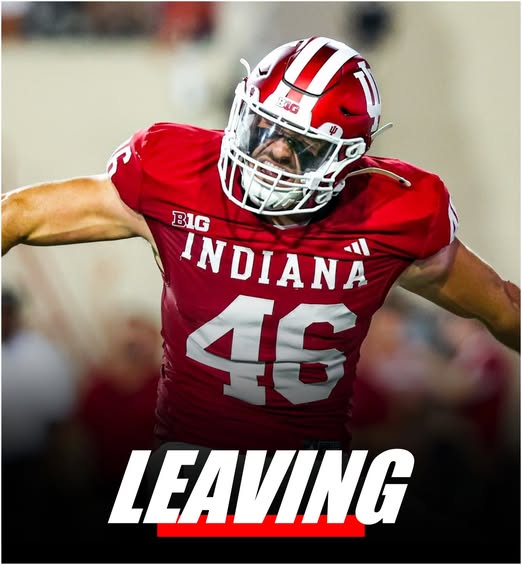
That would represent a significant jump for a player who entered the offseason with only one career start and fewer than 300 offensive snaps. But Moore’s trajectory has changed rapidly. After showing flashes late last season and making a strong impression during spring practice, the 6-foot-6, 312-pound Indiana native has positioned himself at the center of an offensive-line competition that could ultimately determine how high Ohio State’s offense can climb.
The Buckeyes have not officially named their starting five, and coach Ryan Day has continued to experiment with combinations throughout preseason camp. But the direction of the competition is becoming clearer. Moore’s development has given Ohio State another option at tackle while potentially allowing Austin Siereveld, last season’s starting left tackle, to move inside to guard.
That possibility is particularly important because Ohio State is trying to solve more than a single position.
The Buckeyes return four starters from last season’s offensive line, but the group finished 2025 with difficult performances in the Big Ten Championship Game and College Football Playoff. Ohio State lost to Indiana in the conference championship and then fell to Miami in the Cotton Bowl, with protection and offensive-line consistency among the issues that surfaced during the closing stretch.
The unit allowed just six sacks through the regular season before surrendering 10 combined against Indiana and Miami, according to preseason analysis. For a team built around quarterback Julian Sayin and arguably the country’s most dangerous wide receiver in Jeremiah Smith, that late-season regression was impossible to overlook.
Ohio State’s solution may not require replacing experience. It may require putting experienced players in better positions.
That is where Moore comes in.
Moore was the highest-rated offensive lineman in Ohio State’s 2024 recruiting class, according to the Buckeyes’ official roster bio, and arrived in Columbus as a four-star prospect from New Palestine, Indiana. He was ranked No. 7 among interior offensive linemen by 247Sports and was named Indiana’s Mr. Football Offensive Lineman as a high school senior. (Ohio State)
His first two seasons were largely about learning.
As a freshman in 2024, Moore appeared in four games and played 31 snaps. In 2025, he appeared in all 14 games, made one start and logged 230 snaps on offense and special teams. His lone start came at right tackle against Purdue when Phillip Daniels was unavailable. (Ohio State)
The significance of that start went beyond the box score.
Moore had been cross-trained at both tackle spots, an indication that offensive-line coach Tyler Bowen viewed him as more than a developmental player locked into one position. During the 2025 season, Moore was repeatedly asked to prepare for both sides of the line, gaining experience that would become increasingly valuable once Ohio State began reshaping its front five.
Then came the Cotton Bowl.
With Siereveld leaving the Miami game because of an injury, Moore was thrust into action at left tackle in the second half. It was hardly an ideal introduction to one of college football’s most demanding responsibilities. Ohio State’s offensive line was already under pressure, the opponent was attacking aggressively and the Buckeyes needed reliable protection against a talented Miami defense.
Moore’s performance nevertheless strengthened the belief inside and around the program that he could handle the position.
This spring, that belief became more concrete.
After Siereveld was sidelined by lower-body surgery, Moore became Ohio State’s starting left tackle midway through spring practice. He performed well enough against the Buckeyes’ defensive line that the competition changed from simply identifying a replacement to determining whether Moore had done enough to keep the job.
That distinction matters.
Siereveld started all 14 games at left tackle in 2025 and earned second-team All-Big Ten honors from both the coaches and media. He was also the only Ohio State starting offensive lineman who did not surrender a sack last season, according to Pro Football Focus, doing so across 425 pass-blocking reps.
Moving him would therefore not be a decision based on poor performance.
It would be a decision based on optimization.
Ohio State believes it may have a higher ceiling if Moore handles the blind-side tackle position and Siereveld returns to guard. That would allow the Buckeyes to preserve Siereveld’s physicality while placing a naturally long, athletic tackle on the edge.
Moore’s physical development has also become a major part of the conversation.
During an April 2025 media availability, Moore said he had become faster and “a lot twitchier” while continuing to build on his strength. He specifically pointed to improvements in his pass sets and both zone- and gap-scheme footwork.
Those improvements are critical under Bowen, whose offensive-line philosophy emphasizes versatility but also requires tackles to handle increasingly difficult edge matchups.
Moore’s teammates have noticed the progress, too. Luke Montgomery, who remains one of the anchors of the offensive line, praised Moore’s explosiveness, strength and intelligence during spring practice.
The question now is whether that development translates consistently against starting-caliber defensive ends.
Ohio State’s schedule will provide an immediate answer.
The Buckeyes are entering 2026 with national championship expectations, and their offensive line will be tested early. Ohio State’s trip to Texas in September presents an especially significant challenge, with Longhorns edge rusher Colin Simmons among the premier pass rushers in college football.
For Moore, that game could become an early measuring stick.
The job is not officially his. Fall-camp observations have shown Ohio State continuing to rotate combinations, with Siereveld still receiving work at left tackle and Moore taking snaps at both tackle positions. (Buckeye Huddle) But recent projections increasingly have Moore at the top of the depth chart.
One August projection listed Moore as the starting left tackle, followed by freshman Sam Greer and Carter Lowe, with Siereveld moving to right guard and Daniels remaining at right tackle. (Buckeye Huddle)
That alignment would give Ohio State a starting five of Moore, Montgomery, Carson Hinzman, Siereveld and Daniels — a group combining youth at left tackle with considerable experience across the interior.
It also reflects the central philosophy behind Bowen’s evaluation process: find the best five players, then determine where they fit.
Bowen acknowledged during the spring that Ohio State needed to get its linemen working together in their projected positions so the unit could build cohesion and establish contingency plans. (Buckeye Huddle)
That cohesion could prove more important than individual talent.
Ohio State’s offense is expected to become more physical under new offensive coordinator Arthur Smith, with a greater emphasis on the running game. That places additional responsibility on the offensive line to generate movement at the point of attack while maintaining enough protection integrity to give Sayin time to exploit one of the nation’s deepest receiving corps. (Inside NU)
There is no NFL-style salary-cap calculation attached to Moore’s rise. College football’s roster economy is instead shaped by scholarships, NIL resources and transfer-portal decisions. But his emergence could have a financial and roster-management effect all the same.
If Moore establishes himself as a dependable starting tackle, Ohio State gains something every championship contender needs: a young, internally developed player at one of the most valuable positions on the roster. It also reduces the need to search for another veteran tackle through the transfer portal and gives Bowen greater flexibility with his depth chart.
More importantly, it could unlock Siereveld.
A move back inside would potentially strengthen the position that has been unsettled since Tegra Tshabola transferred to Kentucky. Ohio State would not simply be replacing one tackle with another; it would be rearranging the line to maximize the strengths of multiple players.
That is why Moore’s emergence matters beyond one starting job.
Ohio State already has the quarterback, the receivers and the defensive talent to enter the season among the national championship favorites. The unresolved question has been whether the offensive line can become the foundation rather than the vulnerability.
Moore may be the piece that changes that equation.
He is still inexperienced. He has fewer than 300 career snaps and has never started a full season at tackle. There will be difficult pass-rush assignments, communication checks and moments when his technique is tested by elite Big Ten athletes.
But the evidence from his development, his spring performance and his late-season opportunities has created a compelling case.
Ohio State does not need Moore to become a star overnight.
It needs him to become dependable.
If he does, the Buckeyes could enter the season with something they did not have a year ago: the ability to put their most talented five offensive linemen in positions that maximize the entire unit.
And increasingly, that equation appears to begin with Ian Moore at left tackle.