The final score offered little comfort to anyone searching for a breakthrough.
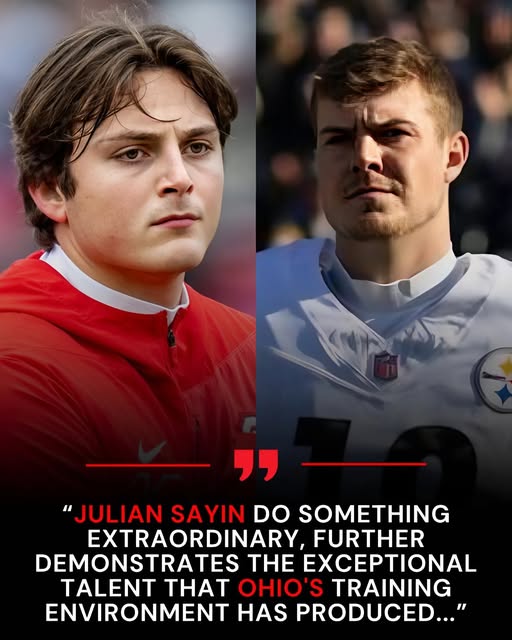
The Pittsburgh Steelers’ 17-0 loss to the New York Jets — a game in which the offense failed to generate a touchdown and former Ohio State quarterback Will Howard endured another difficult introduction to NFL competition — served as a blunt reminder of the gap between college football stardom and professional survival.
For Howard, the performance was not a verdict on his future. It was, however, another illustration of how unforgiving the NFL can be for young quarterbacks, particularly those attempting to establish themselves in crowded depth charts where every preseason snap can become part of a larger evaluation.
And as Howard navigates that reality, the trajectory of his former Ohio State teammate, Julian Sayin, offers a striking counterpoint.
Sayin, now stepping into the spotlight after Howard’s departure, has generated attention with the kind of advanced quarterback play that suggests Ohio State’s developmental environment remains one of the most significant talent pipelines in college football. The two quarterbacks are at different stages of their careers, facing entirely different challenges, but together they illustrate the range of outcomes and demands that come with playing the most scrutinized position in the sport.
Howard’s path to Pittsburgh was never supposed to be easy.
At Ohio State, he arrived with substantial experience after beginning his college career at Kansas State. He brought maturity, physical toughness and an understanding of how to operate an offense under pressure. In Columbus, he joined a roster loaded with NFL-caliber talent and was asked to guide one of the most talented offenses in the country.
The results, particularly during the Buckeyes’ championship run, strengthened his professional profile.
Howard demonstrated improved command at the line of scrimmage, showed the ability to distribute the football within Ohio State’s pro-style concepts and provided enough mobility to create outside structure when protection broke down. His combination of size, experience and postseason success made him an intriguing developmental prospect, even if NFL evaluators understood that his transition would require patience.
That patience is often difficult to find in the NFL.
The professional game compresses everything. Windows close faster. Safeties disguise coverage more effectively. Pass rushers turn minor protection errors into drive-ending plays. A quarterback who can hold the ball for an extra half-second in college may discover that the same hesitation in the NFL produces a sack, a strip or a turnover-worthy throw.
The Steelers’ shutout loss to the Jets underscored that reality.
Pittsburgh’s offensive struggles extended beyond any single quarterback, and placing the outcome entirely on Howard would ignore the broader context of preseason football. Offensive line combinations are constantly changing. Receivers and quarterbacks are often operating without the continuity that defines successful regular-season offenses. Coaches are evaluating individual assignments as much as final scores.
Still, for a young quarterback, the scoreboard and the film both matter.
Howard is attempting to prove that his college success can translate against faster defenders and more complex defensive structures. That process requires mastering progression-based concepts, recognizing post-snap coverage rotations and consistently delivering the football on time.
The difference between an open receiver and a contested throw at the NFL level can be measured in fractions of a second.
That is why early struggles should be interpreted carefully.
History is filled with quarterbacks whose preseason performances did little to predict their eventual careers. Development at the position is rarely linear. Some players enter the league prepared to contribute immediately. Others need multiple seasons to refine footwork, accelerate their processing and learn how to manipulate professional defenses with their eyes and cadence.
For Howard, the immediate challenge is simpler than the long-term evaluation: improve the next rep.
That means eliminating negative plays, protecting the football and demonstrating that he can consistently operate the offense within structure. For a quarterback competing for a roster position, a spectacular throw can attract attention, but coaches often place equal value on avoiding the mistake that puts the entire unit behind schedule.
The NFL is particularly unforgiving in that regard.
A missed protection identification can produce a free rusher. A late throw against Cover 2 can become an interception. Failure to recognize a simulated pressure package can turn a manageable third-and-5 into a sack and a punt.
Those are the details separating established starters from developmental players.
The Steelers, meanwhile, have their own larger questions to answer at quarterback. Any organization evaluating young passers must balance immediate roster needs against long-term development. Carrying a developmental quarterback requires confidence that the player can eventually provide value, whether as a capable backup, a trade asset or a potential future starter.
Salary-cap considerations also shape those decisions.
One of the NFL’s most valuable roster-building advantages is receiving competent quarterback play from a player on an inexpensive rookie contract. Established veteran quarterbacks command significant portions of a team’s cap, making developmental depth at the position strategically important. A young passer who can perform effectively without consuming major financial resources gives a front office greater flexibility to invest in premium positions such as edge rusher, offensive tackle, cornerback and wide receiver.
That economic reality does not guarantee Howard a roster spot, but it explains why teams are willing to invest time in developing quarterbacks who possess the right physical and mental traits.
The challenge is that development must occur while the rest of the league continues moving.
Every preseason rep becomes part of the evaluation. Every practice against an NFL defense tests a quarterback’s ability to process information. And unlike college football, where a talented roster can occasionally compensate for an inexperienced quarterback, NFL margins are far narrower.
Howard’s difficult outing against the Jets should therefore be viewed as a snapshot, not a conclusion.
It also should not discourage young players coming from Ohio State or any other elite college program. If anything, the contrast between Howard’s early NFL growing pains and Sayin’s emergence in college football reinforces a more important truth: quarterback development does not end when a player leaves campus.
It simply enters a more demanding phase.
Sayin represents the next chapter of Ohio State’s quarterback evolution.
The highly regarded passer arrived in Columbus with enormous expectations, but raw talent alone does not guarantee success at a program where the standard is measured in Big Ten championships, College Football Playoff appearances and NFL draft selections.
What has separated Ohio State’s best quarterback situations in recent years has been the environment surrounding the position.
The Buckeyes have consistently recruited elite skill-position talent. They have invested heavily in quarterback development. Their offensive system demands precision while also providing opportunities for quarterbacks to make throws that translate to the next level: layered concepts against split-safety coverage, intermediate timing routes, play-action shots and progression reads from the pocket.
For Sayin, mastering those elements is more valuable than simply producing highlight-reel throws.
That is what makes his recent development so significant.
A young quarterback demonstrating improved anticipation, ball placement and command of the offense is showing traits that matter beyond the college level. The strongest college quarterbacks do not merely possess arm talent; they understand leverage, manipulate defenders and recognize where the football should go before the coverage fully declares itself.
Those are the skills that allow an offense to remain efficient.
For Ohio State, Sayin’s rise also carries major implications for the program’s position in the national championship race.
The Buckeyes have rarely lacked elite athletes. The question in any championship season is whether the quarterback can distribute the football efficiently enough to maximize the roster around him. With Ohio State’s recruiting infrastructure and its continued ability to attract high-level offensive talent, stability at quarterback can transform the offense from dangerous to overwhelming.
Sayin does not need to replicate Howard’s exact style to succeed.
In fact, the most important lesson from Ohio State’s quarterback succession is that elite programs must adapt their systems to the strengths of the player under center. Howard brought experience and physicality. Sayin brings his own profile, including the expectations that accompany his reputation as one of the sport’s premier young quarterbacks.
The transition between them is therefore less about replacing one player with another and more about continuing a developmental cycle.
For the Buckeyes, that cycle has become a crucial part of their identity.
Ohio State’s training environment has placed quarterbacks alongside elite receivers, offensive linemen and coaches while exposing them to the pressure that comes with playing in nationally significant games. That does not eliminate the difficulty of the NFL transition, as Howard’s experience demonstrates. But it gives players a foundation built around competition and preparation.
The professional game ultimately asks for more.
Howard is discovering that in real time.
Sayin is still building toward that opportunity.
And the difference between their current circumstances should not be mistaken for a difference in talent or potential. One quarterback is learning to survive in a league where every defender was once a star. The other is beginning to demonstrate why Ohio State believes its quarterback room remains capable of producing the next elite player.
For Howard, the 17-0 loss to the Jets may become one of many difficult chapters in an NFL development story. The next evaluation will come quickly, and his ability to respond will matter more than the disappointment of a single performance.
For Sayin, every impressive sequence will bring greater attention and higher expectations as Ohio State continues its pursuit of another championship.
Together, their paths offer a reminder that football development is not a straight line.
College dominance does not guarantee immediate NFL success. A difficult professional debut does not eliminate the possibility of future growth. And extraordinary talent at the college level still must be refined through repetition, competition and adversity.
The NFL has a way of exposing weaknesses.
Ohio State, meanwhile, continues to provide an environment designed to develop the talent capable of confronting them.
Howard’s struggle is a reminder of how high the next level stands.
Sayin’s emergence is evidence of how far elite preparation can carry a player before he reaches it.
Neither story is finished.
And for two quarterbacks connected by the same Ohio State locker room but separated now by football’s most demanding transition, the next chapter will be defined not by one score, one game or one viral moment, but by what comes after it.