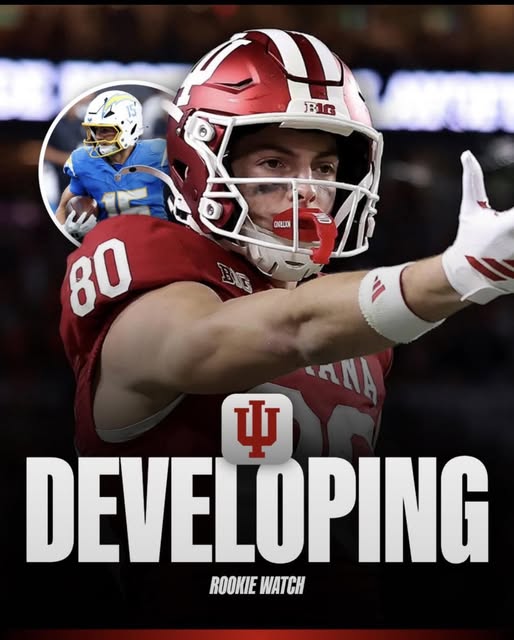
The buzz around Indiana wide receiver Charlie Becker is beginning to move beyond college football circles and into NFL draft rooms.
Multiple scouting evaluations have identified Becker as one of the most intriguing wide receiver prospects in the 2027 NFL draft class, with one reported assessment going as far as projecting him among the class’s top receivers. The most notable comparison is particularly revealing: a hybrid of Los Angeles Chargers receiver Ladd McConkey and Indianapolis Colts deep threat Alec Pierce.
That comparison is not simply about style. It reflects what makes Becker such an unusual prospect at 6-foot-4 and roughly 207-208 pounds: the route-running traits and functional quickness associated with a smaller, polished separator combined with the size, catch radius and vertical explosiveness of a traditional boundary receiver.
The important caveat is that the specific claim that “NFL scouts” universally view Becker as their WR2 has not been independently substantiated by publicly available league reporting. What can be verified is that Becker has generated significant draft attention and is already being discussed as a potential early-round prospect entering his junior season.
And that distinction matters.
Becker is no longer an anonymous developmental receiver who happens to play for the defending national champions. He enters 2026 as one of the central pieces of an Indiana offense attempting to prove that last season’s historic run was the beginning of a sustained national contender rather than a one-year breakthrough.
The numbers from 2025 explain why scouts are paying attention.
Becker caught 34 passes for 679 yards and four touchdowns in 16 games, averaging exactly 20.0 yards per reception. He finished third on Indiana in receiving yardage despite beginning the season behind more established players and making only eight starts. According to available scouting data, he also produced 3.38 yards per route run, averaged 18.4 yards downfield per target and recorded no drops.
Those numbers paint the profile of a receiver who was exceptionally efficient with limited volume.
The 20-yard average is the most obvious number. It demonstrates Becker’s ability to create explosive plays rather than simply accumulate short-area receptions. His 679 receiving yards came on just 34 catches, meaning Indiana consistently generated significant chunks of offense whenever the ball found him downfield.
His contested-catch ability adds another dimension.
Scouting evaluations have credited Becker with winning 13 of 17 contested targets in 2025, while his track background helps explain why his size does not come at the expense of vertical athleticism. Becker won Tennessee state championships in the 110-meter and 300-meter hurdles, giving NFL evaluators another piece of evidence that his athletic profile extends beyond football-specific testing.
That combination is precisely why the McConkey-Pierce comparison has traction.
McConkey, a second-round selection by the Chargers in 2024, entered the NFL without the imposing physical dimensions of Becker. At 6 feet and 185 pounds, McConkey has built his game around route precision, separation, leverage and the ability to uncover quickly. Through his first two NFL seasons, he accumulated 148 receptions for 1,938 yards and 13 touchdowns.
Pierce represents the other end of the equation.
The Colts’ 6-foot-3, 211-pound receiver has established himself as one of the NFL’s premier vertical threats. In 2025, Pierce caught 47 passes for 1,003 yards and six touchdowns while averaging 21.3 yards per reception. He also led the league in yards per catch for the second consecutive season.
Indianapolis rewarded that production in March with a four-year contract worth $114 million, including $84 million in guarantees and $60 million fully guaranteed at signing, according to NFL Network reporting.
For Becker, Pierce’s trajectory offers an interesting lesson.
A receiver does not necessarily need 100 catches to become an offensive centerpiece if he consistently produces explosive plays and forces defenses to account for the entire depth of the field. Becker’s 2025 production came with substantially less volume than Pierce’s breakout NFL season, but the underlying vertical efficiency is already evident.
The challenge now is proving he can do it when defenses know exactly where he is.
That is the biggest question facing Becker in 2026.
Indiana’s receiving room has undergone significant change following the national championship season, while the Hoosiers also must replace Heisman Trophy-winning quarterback Fernando Mendoza. TCU transfer Josh Hoover has taken over at quarterback, giving Becker an important opportunity to establish chemistry with a new passer as Indiana attempts to defend its national title.
Hoover’s performance could have a direct effect on Becker’s draft stock.
A quarterback who consistently pushes the ball vertically can maximize Becker’s greatest strength. But if Indiana’s passing game becomes more conservative, Becker could find himself fighting through reduced explosive opportunities while opposing defenses devote more attention to him.
That is where route versatility becomes critical.
NFL evaluators will want to know whether Becker can consistently win against press coverage, separate on intermediate routes and function as more than a vertical specialist. His 2025 production suggests the tools are there, but the sample remains relatively small.
Thirty-four receptions are impressive when they generate 679 yards. They are also not enough to completely eliminate questions about whether a receiver can handle NFL-level volume.
That is why the 2026 season could be transformative.
If Becker moves from 34 receptions into the 55-to-70 range while maintaining anything close to his previous efficiency, his evaluation could change dramatically. A significant increase in target share would demonstrate that he can remain productive after defensive coordinators have had an offseason to study him.
It would also answer perhaps the most important question surrounding his NFL projection: Can Becker become a complete receiver rather than simply an explosive one?
Indiana needs the answer to be yes.
The Hoosiers enter 2026 after a remarkable 16-0 campaign that culminated in the program’s first national championship. Curt Cignetti has built the program into a legitimate Big Ten power, and Indiana enters the season ranked among the conference’s contenders despite losing several major contributors from last year’s team.
The pressure is different now.
Last season, Indiana could surprise opponents. This season, opponents will be hunting Indiana.
That changes everything for Becker.
Instead of operating as a complementary weapon within an offense loaded with talent, he could become the receiver defensive coordinators identify first on the scouting report. Safeties may rotate toward his side. Cornerbacks may challenge him at the line. Defensive backs will have fewer reasons to gamble against other receivers if Becker becomes Indiana’s most dangerous explosive threat.
How he responds will tell NFL teams considerably more than any preseason ranking.
There are already indications that the league views his physical profile seriously. Public scouting evaluations have placed Becker among the better wide receiver prospects in the 2027 class, with some projections pushing him toward the first round.
But draft position is ultimately determined by what happens between the lines.
There are no NFL contract or salary-cap implications for Becker yet. He remains a college player, and the financial structure of the NFL does not enter the equation until he is drafted and signs a professional contract. If his draft stock eventually rises into the first round, however, his eventual rookie deal would be governed by the NFL’s rookie wage scale, with draft slot determining the financial framework.
For now, the more immediate economic significance belongs to players whose careers resemble Becker’s projected outcome.
Pierce’s $114 million extension illustrates how valuable an elite vertical receiver can become once he proves his production is sustainable. McConkey’s development demonstrates the premium NFL teams place on receivers who can consistently separate and create reliable throwing windows. Becker’s appeal lies in the possibility that he could offer elements of both.
That is the upside.
The downside is equally clear: 2025 was Becker’s breakout, not his finished product.
NFL scouts will be watching his release package, his ability to defeat physical coverage, his success against top Big Ten cornerbacks, his production from multiple alignments and his consistency on third downs and in the red zone. They will also scrutinize whether his separation translates when he cannot simply outrun defenders vertically.
For Indiana, those questions are secondary to the immediate objective.
The Hoosiers are trying to remain in the College Football Playoff conversation, navigate a more demanding Big Ten schedule and demonstrate that their championship season was sustainable. Becker could be one of the players who determines whether they accomplish it.
For the NFL, meanwhile, the intrigue is straightforward.
If Charlie Becker turns last year’s explosive efficiency into sustained volume, the conversation around him will change quickly. The former three-star recruit has already gone from special-teams contributor to national champion to legitimate NFL prospect.
Now comes the hardest step.
He has to prove he can become the receiver everyone is preparing to stop.
And if the McConkey-Pierce comparison proves even partially accurate, NFL teams may soon have a much bigger problem on their hands than they initially expected.