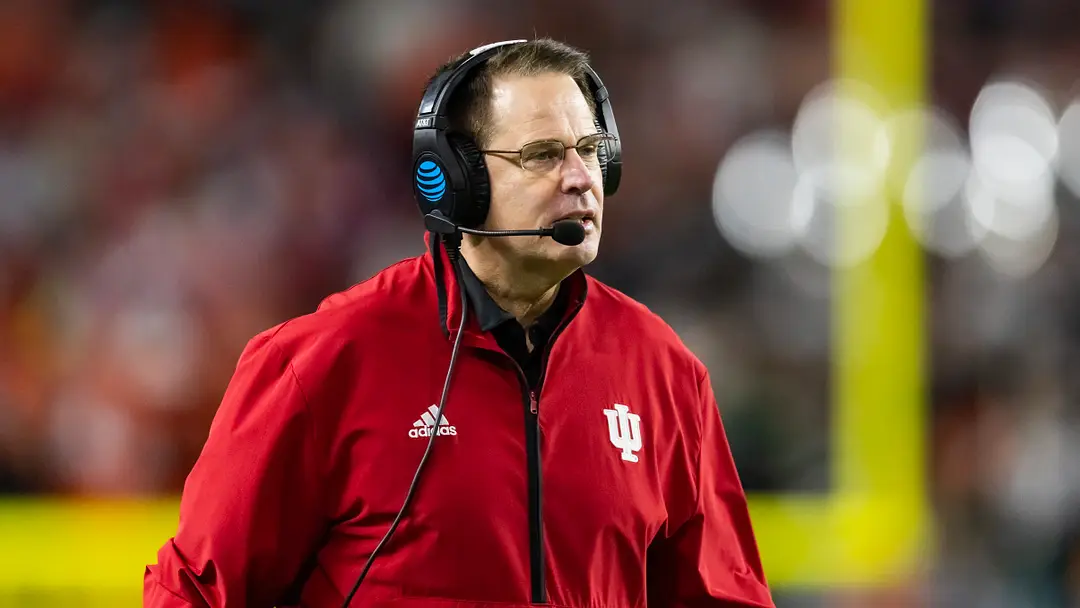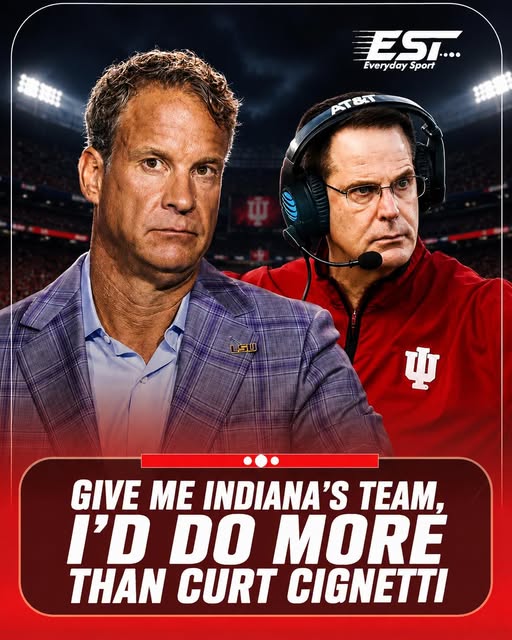
Lane Kiffin has never been one to avoid a microphone, a headline or a debate.
The outspoken college football coach added another potentially explosive chapter to his reputation this week when he made a bold comparison involving Indiana coach Curt Cignetti and one of the nation’s most talented football programs.
“I feel like I could do a lot more than Curt Cignetti if I were coaching a great team like Indiana,” Kiffin said during an interview, offering a striking assessment of what he believes he could accomplish with the Hoosiers’ roster.
The comment immediately created discussion across college football.
Indiana is no longer viewed as the program fighting simply to earn respectability in the Big Ten. Under Cignetti, the Hoosiers have undergone a dramatic transformation, building one of the most competitive and confident teams in the country. With a talented roster, established coaching staff and star quarterback Josh Hoover leading the offense, Indiana has entered a different category of expectations.
That is precisely what makes Kiffin’s statement so provocative.
His argument was simple: Give him Indiana’s talent, resources and current roster, and he believes he could take the program even further.
But the obvious question is equally compelling.
Further than what?
For years, Indiana football represented one of college football’s most difficult rebuilding projects. The Hoosiers have historically operated in the shadow of traditional Big Ten powers, often facing enormous challenges in recruiting, depth and national perception.
Cignetti changed that conversation.
Since arriving in Bloomington, he has brought an unmistakable edge to the program. His confidence, discipline and demanding approach have helped create a culture in which Indiana players no longer enter major games simply hoping to compete.
They expect to win.
That mentality has been one of the defining characteristics of Cignetti’s tenure. He inherited a program with limited national expectations and quickly established a standard that demanded accountability from everyone involved.
The results have transformed the perception of Indiana football.
Now, Kiffin’s comments have added another layer to the discussion surrounding the Hoosiers’ rise.
Could another elite coach take Indiana’s current roster and produce even more?
Kiffin clearly believes the answer is yes.
Few coaches in modern college football have generated as much attention as Kiffin. Whether discussing his offensive philosophy, criticizing the sport’s rapidly changing landscape or engaging in the latest social media conversation, Kiffin has consistently demonstrated an ability to remain at the center of the college football world.
He has also built a reputation as one of the game’s most creative offensive minds.
Kiffin’s offenses have regularly featured aggressive passing attacks, innovative formations and an ability to adapt to the strengths of his personnel. His success has helped establish him as one of the most recognizable coaches in the sport.
That offensive reputation is important when examining his comments about Indiana.
The Hoosiers have one of the most intriguing quarterbacks in college football in Hoover, a player whose talent and experience have positioned him as a central figure in Indiana’s ambitions.
Hoover brings a combination of arm strength, experience and confidence to the position. His ability to attack defenses and operate an offense makes him exactly the type of quarterback who could intrigue a coach such as Kiffin.
And Kiffin appeared to make that clear.
A roster featuring a proven quarterback, experienced contributors and the confidence of a program that has already demonstrated it can compete at a high level would represent an appealing situation for virtually any coach.
For Kiffin, however, the suggestion was bigger than admiration.
It was a challenge.
The implication behind his statement was that Indiana’s current success is not simply the ceiling of the program.
Kiffin believes there is more to unlock.
That is where the conversation becomes particularly interesting for Cignetti and Indiana.
Because the Hoosiers are already attempting to prove exactly that.
Indiana’s transformation under Cignetti did not happen because the program suddenly received the reputation of an Alabama, Ohio State or Georgia. It happened because the coaching staff identified players, developed them and created a system capable of maximizing their abilities.
That distinction cannot be ignored.
It is easy to look at Indiana’s current roster and see talent.
It is more difficult to remember how that talent became part of a winning environment.
Cignetti deserves significant credit for that process.
His approach has been built around belief and preparation. From the beginning of his tenure, he projected confidence that Indiana could compete with anyone.
That confidence has spread throughout the program.
Players have embraced higher expectations. The coaching staff has recruited and developed with greater urgency. And the Hoosiers have increasingly become a team opponents must take seriously.
Kiffin’s comments, therefore, may have been intended as a compliment to Indiana’s roster.
But they also create an unavoidable debate about the coach responsible for helping build the program into its current position.
Could Kiffin do more with Indiana?
Perhaps.
Could another elite coach install a different offensive system, attract different players and produce another level of success?
That is possible.
But hypothetical coaching comparisons often overlook the importance of fit.
Cignetti fits Indiana.
His personality, approach and confidence have connected with the program at a crucial time. He has understood the challenge of changing expectations at a school that has historically faced significant obstacles on the football field.
And perhaps most importantly, he has convinced his players that the past does not have to define the future.
That may be his greatest accomplishment.
Kiffin’s confidence is nothing new. Throughout his career, he has demonstrated an extraordinary belief in his ability to build offenses and lead teams.
His statement about Indiana reflects that same confidence.
Still, confidence can become motivation for opponents.
Cignetti has developed a reputation for being direct and unapologetically competitive. Indiana’s players are unlikely to view Kiffin’s remarks as meaningless background noise.
Instead, comments questioning whether another coach could achieve more with their roster could provide additional motivation.
For Hoover and the Hoosiers, the answer will ultimately be determined on the field.
The quarterback enters the season carrying significant responsibility. Indiana’s offense will depend heavily on his ability to make decisions, deliver accurate throws and lead in critical moments.
He has the talent to become one of the defining players in the program’s continued rise.
And if Indiana reaches another level with Hoover leading the way, the conversation surrounding Kiffin’s comments could take an entirely different direction.
Because success changes every debate.
If Indiana continues winning under Cignetti, it becomes increasingly difficult to argue that the program needs someone else to unlock its potential.
Cignetti will have already done it.
That is the reality behind Kiffin’s bold statement.
College football is filled with talented coaches who believe they could succeed in different situations. But building a winning program requires more than calling creative plays or managing a talented quarterback.
It requires culture.
It requires relationships.
It requires players believing in a vision.
Indiana has found that vision under Cignetti.
Kiffin’s comments may generate headlines because of the comparison, but they also highlight how dramatically Indiana football has changed.
Not long ago, few major coaches would have publicly discussed the possibility of taking over Indiana and doing more with the roster.
Now the Hoosiers are talented enough to become part of a national coaching debate.
That alone demonstrates the program’s progress.
The debate over whether Kiffin could accomplish more than Cignetti will remain hypothetical unless circumstances ever create such an opportunity.
For now, Cignetti remains in charge of Indiana’s future.
And Hoover remains one of the key figures in determining how far that future can go.
Kiffin may believe he could take Indiana to an even greater level.
Cignetti and the Hoosiers now have the opportunity to deliver the strongest possible response.
They can keep winning.
In college football, that is the only answer that truly matters.