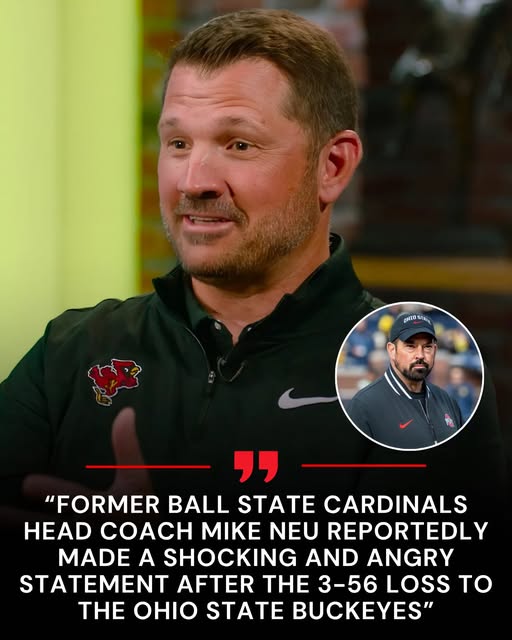
Former Ball State Coach Mike Neu Reportedly Speaks Out After Ohio State Rout, Sparking Controversy
The scoreboard told one story. The reaction afterward may have created another.
Ohio State’s 56-3 dismantling of Ball State was supposed to be a straightforward reminder of the enormous gap separating one of college football’s perennial powers from a Mid-American Conference opponent. Instead, the aftermath has reportedly generated a new storyline surrounding the Buckeyes, with former Ball State head coach Mike Neu said to have expressed anger over what he witnessed during the lopsided contest.
Neu’s reported reaction, which has begun circulating in the aftermath of the September 5 matchup, has added an unexpected layer of controversy to a game that was effectively decided long before the final whistle.
Ohio State entered the contest as the No. 1 team in the country and played like it.
The Buckeyes overwhelmed Ball State from the opening stages, controlling the game on both sides of the football and never allowing the Cardinals to establish meaningful momentum. Ohio State ultimately finished with a 56-3 victory, moving to the next stage of its schedule with the kind of dominant performance expected from a national championship contender.
But according to the report surrounding Neu’s comments, the former Ball State coach was not simply frustrated by the result.
He was reportedly angry about how the game unfolded.
That distinction matters.
Lopsided games are common in college football, particularly when elite programs schedule teams from smaller conferences. The financial realities of the sport make those matchups attractive to both sides. Power-conference programs gain a tune-up opportunity, while visiting teams receive significant compensation and the chance to compete on one of the sport’s biggest stages.
What happened against Ohio State, however, was never much of a contest.
The Buckeyes established control early and maintained it throughout the afternoon. Ball State struggled to generate sustained offense, while Ohio State continued to find opportunities to extend its advantage. By the time the game reached its later stages, the outcome was no longer in question.
That is where Neu’s reported criticism becomes significant.
If accurately characterized, his reaction appears to center not on the fact that Ball State lost, but on decisions made by Ohio State during a game in which the Buckeyes had already built a commanding advantage.
Those questions are likely to fuel debate because there are two competing philosophies when a heavily favored team faces an overmatched opponent.
One is to continue playing aggressively until the game is unquestionably secure.
The other is to recognize the circumstances, reduce the risk of injury and allow younger players and reserves to gain experience without unnecessarily pursuing additional points.
Ohio State’s supporters are likely to argue that the Buckeyes were simply doing their job. Coaches cannot ask players to stop competing, and backups need meaningful repetitions. In a season where every game can influence playoff positioning, there is also little incentive for a championship contender to become complacent.
From Ball State’s perspective, however, the optics can be different.
There is an inherent frustration in watching a game become increasingly one-sided while trying to maintain competitiveness and protect the confidence of a roster. For programs operating outside the sport’s wealthiest conferences, these games can already represent an enormous physical and organizational challenge.
Neu knows that environment better than most.
He spent years leading Ball State and understands the realities facing MAC programs when they step into games against national powers. The difference in roster depth, recruiting resources, facilities and financial investment can be substantial.
That makes his reported reaction particularly notable.
Still, there is an important distinction between criticism and verified fact.
The reported comments should not be treated as established fact unless they are confirmed by Neu himself or through a reliable primary source. In the immediate aftermath of a game, social media can amplify statements, paraphrase reactions and remove comments from their original context. What begins as an observation can quickly become a controversy once it spreads across multiple platforms.
That is especially true when the subject is Ohio State.
Few programs in college football attract the level of attention surrounding the Buckeyes. Every victory is dissected. Every coaching decision receives scrutiny. And every controversy, no matter how small, can quickly become a national discussion.
The timing only adds to the intrigue.
Ohio State entered the season with enormous expectations and had little margin for error. The Buckeyes’ ultimate objective is not merely to win games against opponents such as Ball State. It is to compete for the Big Ten championship and position itself for another run at the College Football Playoff.
That means performances in September are often judged through a larger lens.
Was the offense efficient?
Did the defense create pressure?
Did the coaching staff manage the roster properly?
Did young players receive valuable experience?
And perhaps most importantly, did the team avoid unnecessary injuries before the schedule becomes significantly more difficult?
Those questions will become even more important now that Ohio State’s attention turns toward its next major test.
The Buckeyes are scheduled to travel to face No. 5 Texas in what promises to be one of the most consequential games of the early season. Unlike the Ball State matchup, there will be little room for error against a fellow highly ranked opponent.
That reality provides context for the controversy.
Ohio State’s coaching staff had to balance preparation, development and competition against Ball State with the understanding that a much more demanding challenge was approaching.
For Ball State, meanwhile, the loss represents a difficult but potentially instructive experience. Playing against the No. 1 team in the country exposes weaknesses that may not appear against comparable opponents. The Cardinals can use those lessons throughout their season.
Yet the final score will remain difficult to ignore.
Fifty-six points for Ohio State.
Three for Ball State.
A 53-point margin.
And now, reportedly, criticism from a former Cardinals coach that has pushed the conversation beyond the field.
Whether the controversy ultimately develops into anything more remains to be seen. Ohio State has no reason to dwell on a game it controlled from beginning to end. The Buckeyes’ focus has already shifted toward a far more important assignment.
But the episode illustrates how quickly a routine blowout can become a national storyline.
In college football, winning is rarely the only thing being evaluated.
How a team wins can matter, too.
And if Neu’s reported comments accurately reflect his frustration, they have ensured that Ohio State’s latest dominant performance will be remembered for more than just the final score.
For now, the Buckeyes remain unbeaten and firmly positioned among the teams with national championship aspirations.
Ball State, meanwhile, is left to regroup.
And the questions surrounding Neu’s reported reaction are likely to linger until the former coach—or another credible source—provides greater clarity about exactly what was said and what prompted it.
Until then, the scoreboard is definitive.
The controversy is not.