INDIANA 2026 OUTLOOK: Former Hoosiers coach Tom Allen praises the direction of the program entering a pivotal new season
Indiana football enters the 2026 season carrying expectations that once would have seemed almost unimaginable in Bloomington, and one of the men who helped lay the foundation for the program’s rise believes the Hoosiers are positioned to continue moving forward.
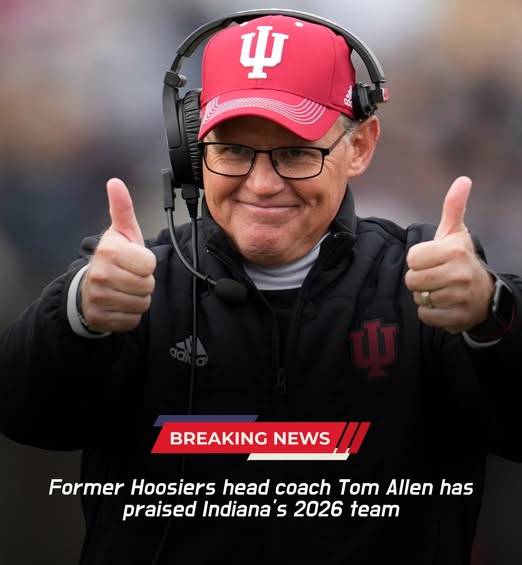
Former Indiana head coach Tom Allen has offered praise for the Hoosiers’ 2026 team, recognizing both the growth of the program and the direction Indiana has taken as it prepares for another season in the increasingly demanding landscape of college football.
For Allen, the admiration carries additional significance.
Few people understand the challenges associated with building a winning football culture at Indiana better than the former Hoosiers coach. Allen spent years working to establish stability, belief and competitiveness within a program that had historically struggled to find consistent success in the Big Ten.
Now, as Indiana continues its evolution into one of college football’s most compelling stories, Allen’s praise represents another acknowledgment of how dramatically the expectations surrounding the program have changed.
The Hoosiers are no longer entering a season simply hoping to become bowl eligible or pull off an occasional upset against one of the conference’s traditional powers. The conversation surrounding Indiana football has changed. Expectations have changed. The standard inside the program has changed.
And entering 2026, the Hoosiers once again find themselves under a national spotlight.
Indiana’s recent success has transformed the perception of the program across the country. What was once viewed as one of the Big Ten’s most difficult rebuilding jobs has become a destination capable of attracting talent, generating national attention and competing with programs that historically held significant advantages in recruiting, resources and tradition.
Allen’s appreciation for the 2026 Hoosiers speaks to that transformation.
Building a football program is rarely about one season. It requires years of recruiting, player development, organizational growth and the creation of a culture capable of surviving adversity. Indiana’s current position is the result of a longer process, one that includes contributions from coaches, players and administrators who worked to change what was possible in Bloomington.
Allen was an important part of that journey.
During his time leading Indiana, Allen became known for his emphasis on culture, accountability and player development. His approach centered on building strong relationships inside the locker room and convincing players that Indiana could compete with anyone when it operated with discipline and confidence.
That message helped change the mindset surrounding the program.
Indiana produced memorable moments during Allen’s tenure and demonstrated that the Hoosiers were capable of challenging established powers. Those seasons created belief among players and fans while also proving that success at Indiana was not impossible.
The program’s current momentum has taken that foundation to another level.
As the Hoosiers prepare for 2026, they do so with expectations that reflect the progress made in recent years. Indiana has become a program discussed in connection with major conference races, College Football Playoff implications and high-level recruiting battles.
That represents a remarkable shift.
College football has changed dramatically during the past several years. Conference realignment, the transfer portal, NIL opportunities and the expansion of the postseason have created a sport in which programs must adapt quickly or risk being left behind.
Indiana has embraced that new environment.
The Hoosiers have worked to build a roster capable of competing in one of the nation’s toughest conferences while continuing to develop players already inside the program. That balance has become increasingly important as college football evolves into a year-round competition involving recruiting, roster management and player retention.
The challenge entering 2026 will be maintaining the standard.
Success creates a different kind of pressure.
For decades, Indiana entered many seasons with relatively modest expectations from outside the program. The Hoosiers could operate as an underdog, playing with the freedom that comes from having little to lose.
That is no longer necessarily the case.
Indiana now has a reputation to protect.
Opponents understand that games against the Hoosiers carry greater importance. Coaches spend more time preparing for Indiana. Players recognize that beating the Hoosiers can provide a statement victory. The program is no longer operating in the shadows.
Every week will bring another challenge.
That is one reason Allen’s praise for the 2026 team is noteworthy. The former Indiana coach understands that talent alone does not determine whether a program can handle elevated expectations. Leadership, maturity and chemistry often become even more important when the pressure increases.
The Hoosiers will need all three.
A successful season in the modern Big Ten requires depth across the roster and consistency at the most important positions. Quarterback play remains critical. Offensive line development can determine whether an offense controls games or struggles to establish rhythm. Defensively, teams must be capable of generating pressure while also defending explosive passing attacks.
Indiana will face those same questions throughout 2026.
But the Hoosiers also enter the season with something that Indiana teams of the past often lacked: confidence built through success.
Players understand what winning at a high level requires. The coaching staff understands the pressure associated with major games. The program’s leadership understands the importance of maintaining momentum rather than treating previous accomplishments as a final destination.
That mentality could determine Indiana’s ceiling.
The most successful programs in college football are capable of replacing talent without lowering expectations. They develop younger players before those players become starters. They recruit with future needs in mind. They create systems that allow the program to withstand injuries, departures and the constant movement associated with the transfer portal.
Indiana’s ability to continue developing in those areas will be among the biggest storylines of the 2026 season.
Recruiting also remains essential.
The Hoosiers have generated increased attention from prospects who might not have previously considered Indiana a realistic destination. Winning changes recruiting conversations. National exposure changes recruiting conversations. A program capable of competing for championships changes recruiting conversations.
Indiana has benefited from that momentum.
The challenge now is sustaining it.
Every major program experiences moments when expectations rise faster than infrastructure. The teams that survive those moments are the ones capable of turning a successful season into a sustainable model.
Indiana appears determined to do exactly that.
Allen’s praise of the 2026 Hoosiers reflects more than simple appreciation for a talented roster. It also represents recognition of the work that has gone into transforming Indiana football into a program capable of generating legitimate excitement entering a new season.
For the players, however, praise from outside the locker room will not win games.
The Hoosiers still have to prove themselves on Saturdays.
They will face opponents eager to slow their momentum. They will encounter difficult road environments and games that test their composure. They will have to handle injuries, adversity and the inevitable stretches when execution is not perfect.
Those challenges come with the territory.
But Indiana enters 2026 from a position of strength.
The program has confidence. It has momentum. It has a growing national profile and a fan base that has witnessed a dramatic change in what Indiana football can be.
That is why the upcoming season carries such significance.
The Hoosiers are no longer trying to convince the college football world that they belong in the conversation. They have already forced their way into it.
Now comes the next challenge: staying there.
For Tom Allen, watching Indiana continue to grow offers a unique perspective. He knows the difficult work required to build belief inside the program. He understands the obstacles Indiana has historically faced. And he recognizes what it means when the Hoosiers enter a season with genuine expectations.
His praise for Indiana’s 2026 team serves as another reminder of how far the program has come.
The journey is not finished.
In many ways, it may just be entering its most important chapter.
Indiana has spent recent years changing perceptions, building confidence and demonstrating that the Hoosiers can compete on a much larger stage. The 2026 season will provide another opportunity to prove that the program’s rise is not temporary.
Expectations are higher now.
The spotlight is brighter.
And according to one former Hoosiers coach who understands the program as well as anyone, Indiana appears to be heading into the new season with plenty of reason for optimism.
For the Hoosiers, however, optimism is only the beginning.
The real test starts when the games begin.