COLUMBUS, Ohio — In the modern ecosystem of elite college football, the distance between national championship aspirations and complete fan meltdown is measured in single possessions, key play calls, and social media timelines. Few programs illustrate this razor-thin margin quite like Ohio State.
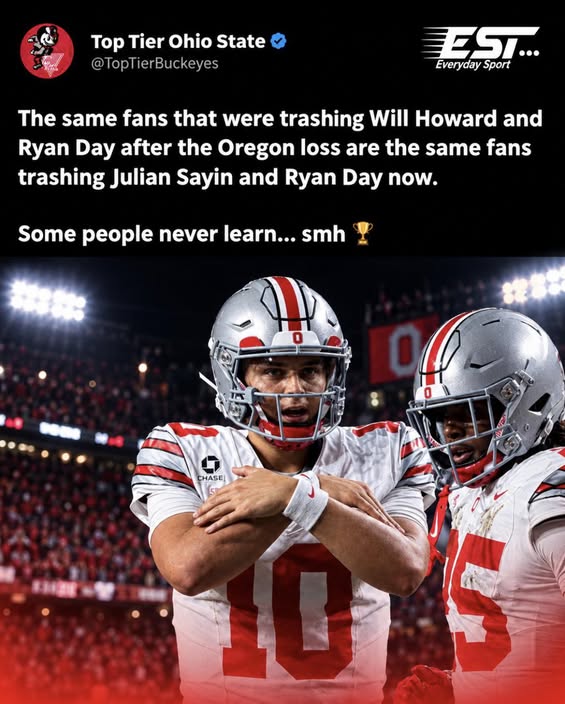
A post recently circulating from @TopTierBuckeyes captured the prevailing sentiment surrounding Buckeye Nation’s most vocal critics: “The same fans that were trashing Will Howard and Ryan Day after the Oregon loss are the same fans trashing Julian Sayin and Ryan Day now. Some people never learn…”
The post hits directly at a dynamic that has defined Columbus in recent years—a relentless cycle of reactionary criticism where context is routinely discarded in favor of immediate outrage. Whether evaluating a seasoned transfer starter like Will Howard or analyzing the growing pains of a young blueprint passer like Julian Sayin, the scapegoats remain remarkably consistent: the quarterback and head coach Ryan Day.
The Anatomy of Buckeye Expectation
To understand the friction within the fanbase, one must first understand the environment Ryan Day operates in every single Saturday. At Ohio State, winning ten or eleven games isn’t considered a baseline of success; it’s treated as an absolute baseline requirement. The standard is national titles, Big Ten dominance, and beating rival programs.
When the Buckeyes stumbled in a tight contest against Oregon, the fallout was instantaneous. Primary targets for fan frustration immediately centered on Will Howard’s late-game management and Ryan Day’s situational play-calling. Forget the reality of playing a top-five opponent in one of the most hostile road environments in the country; the post-game discourse focused heavily on personnel limitations and coaching shortfalls.
Fast forward through the developmental timeline, and as freshman quarterback Julian Sayin steps further into the spotlight, the script hasn’t changed—only the name on the back of the jersey.
The Will Howard Parallel: Context Lost in Translation
When Will Howard arrived in Columbus via the transfer portal, he brought veteran poise, physical toughness, and multi-year starting experience. Yet, after the heartbreaking loss to Oregon, criticism surged across social media platforms and sports talk radio. Every missed check-down, every read, and every tight-window throw was put under a microscope.
Lost in that immediate emotional backlash was the macro view: Howard was navigating a complex offensive scheme in high-pressure situations against elite defensive units. The fan reaction demanded instant perfection rather than recognizing the natural progression of a quarterback building chemistry within a new system.
When fans label a veteran quarterback as “not enough” after a single high-profile setback, it creates a dangerous precedent—one that inevitably leaks into how young talent is treated the moment they take the field.
The Pressure Cooker on Julian Sayin
Enter Julian Sayin, one of the most highly-touted quarterback prospects in recent recruiting classes. Possessing elite arm talent, quick release mechanics, and exceptional processing speed, Sayin represents the future of the Ohio State passing attack.
Yet, as pointed out by @TopTierBuckeyes, the moment Sayin experiences a freshman moment—a delayed read, an interception, or a missed protection call—the same subset of the fanbase immediately levies the same sharp critiques previously aimed at Howard.
Expecting a young quarterback to operate with flawless execution from day one ignores the steep learning curve of Big Ten football. Defensive coordinators in this conference feast on inexperienced signal-callers, throwing pre-snap disguises and complex coverage rotations at them specifically to force mistakes. The developmental path for a young passer requires patience, reps, and the latitude to make errors without being written off by the crowd in the stands.
The Ryan Day Narrative Dilemma
At the center of both quarterback narratives sits head coach Ryan Day. Day boasts one of the highest winning percentages in modern college football history, consistently produces NFL first-round draft picks, and recruits at an elite level year in and year out.
Despite these achievements, Day finds himself in a unique coaching vacuum where every loss is treated as systemic failure and every win is viewed merely as fulfilling an baseline expectation. When Howard struggled against Oregon, critics questioned Day’s big-game management. When Sayin experiences growing pains, critics question Day’s quarterback development and game-planning.
This circular logic creates an environment where long-term program stability is routinely overshadowed by short-term emotional reactions. Coaching elite quarterbacks requires balancing immediate game goals with long-term player confidence. Constantly altering schemes or pulling players at the first sign of struggle to appease fan sentiment is a recipe for roster turnover and portal instability.
The Need for Perspective in Buckeye Nation
Constructive criticism is a natural part of sports journalism and fandom. Questioning clock management, scheme adjustments, or positional execution is valid when analyzing a program with championship ambitions. However, there is a clear distinction between constructive evaluation and hyper-reactive scapegoating.
The post from @TopTierBuckeyes serves as a mirror to a fanbase that sometimes struggles to appreciate the process behind elite college football. Success at the highest level isn’t linear:
-
Development takes time: Even five-star recruits like Julian Sayin require live game reps to adapt to college speed.
-
Opponents are elite: Losses against top-tier programs like Oregon are decided by micro-margins, not structural incompetence.
-
Stability wins titles: High-level programs thrive on continuity at head coach and deliberate QB development, not constant calls for benchings and coaching changes.
Moving Forward: Trusting the Process
As Ohio State continues its pursuit of national honors, the internal focus within the Woody Hayes Athletic Center remains on steady improvement. Ryan Day and his staff understand that outside noise is simply part of the territory in Columbus.
For the fanbase, the choice is clear: continue the cycle of trashing quarterbacks and coaches at the first sign of adversity, or back the development process as veteran leaders pass the torch to the next generation of stars.
Will Howard played his role in pushing the program forward, and Julian Sayin represents the next evolution of Ohio State’s offensive explosive potential. Learning to support the growth of both—and trusting the coach who built the roster—might just be the final adjustment Buckeye fans need to make.