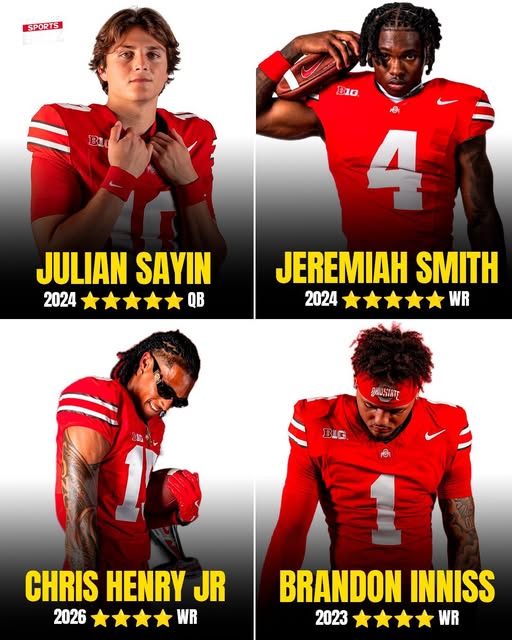
The balance of power in college football often shifts in cycles, but every so often, a roster emerges that feels less like a product of recruiting success and more like a carefully assembled superteam. That’s the conversation quietly building around Ohio State Buckeyes football as they prepare for the upcoming season, with one particular storyline capturing the imagination of analysts and fans alike: the possibility that Julian Sayin could be the only quarterback in the nation operating with three legitimate WR1-caliber targets at the same time.
It sounds like hyperbole at first glance, the kind of offseason exaggeration that tends to fade once the games begin. But the more one examines the personnel involved—Jeremiah Smith, Brandon Inniss, and Chris Henry Jr.—the more that claim begins to feel less like a stretch and more like a looming reality that could redefine offensive expectations in Columbus.
Quarterback situations are typically defined by stability, experience, and decision-making. Rarely are they framed by sheer embarrassment of riches at the skill positions, but that is exactly the scenario unfolding here. Sayin, already one of the most talked-about young quarterbacks in the country, finds himself at the center of a potentially historic convergence of talent. His development will be scrutinized, no doubt, but the surrounding cast raises the ceiling of what this offense can achieve to levels few programs can realistically match.
Jeremiah Smith, widely regarded as one of the most physically gifted receivers to enter the college ranks in recent memory, brings a blend of size, speed, and ball-tracking ability that instantly commands defensive attention. His presence alone would typically define a passing attack. Defensive coordinators would game-plan around him, roll coverage his way, and force a quarterback to find secondary options. But this is not a typical situation. Smith is not the only problem opposing defenses must solve—he is simply the first.
On the other side, Brandon Inniss offers a contrasting but equally dangerous skill set. Where Smith overwhelms with physical dominance, Inniss thrives on precision, route-running, and explosiveness in space. He is the kind of receiver who turns short completions into chunk plays and punishes even the slightest lapse in coverage discipline. In many programs, Inniss would comfortably sit atop the depth chart as the unquestioned WR1, the focal point of the offense and the primary read in critical situations. At Ohio State, he may not even be the most discussed option on a given week.
Then there is Chris Henry Jr., a name that carries legacy weight but is quickly building its own identity. His emergence adds a third layer of complexity to an already overwhelming receiving corps. Henry Jr. combines length, athleticism, and a natural feel for the game that allows him to exploit mismatches across the field. Slot him outside, move him into the slot, or use him in motion—his versatility ensures that defenses cannot simply key in on one area of the field. Like his counterparts, he possesses the traits of a true No. 1 receiver, yet he operates within a system where touches must be distributed among multiple elite options.
For Sayin, the challenge is both a blessing and a responsibility. Quarterbacks often speak about developing chemistry with their receivers, building trust through repetitions and shared understanding. In this case, Sayin must establish that chemistry with not just one or two primary targets, but three players who each demand the ball and have the ability to change a game with a single touch. Managing that dynamic requires maturity beyond his years, an ability to read defenses quickly, and the confidence to make decisive throws without hesitation.
There is also the psychological component. Receivers of this caliber are accustomed to being the centerpiece of an offense. They have dominated at previous levels, commanded targets, and thrived under the spotlight. Balancing those expectations within a single system can be delicate. It falls on both the coaching staff and Sayin to ensure that the offense flows in a way that maximizes collective success while keeping individual players engaged and impactful.
Historically, even the most potent offenses have featured a clear hierarchy at the receiver position. One alpha target, a reliable secondary option, and a complementary third piece. What Ohio State appears to be assembling challenges that conventional structure. Instead of hierarchy, there is parity—three players who could each lead a team in receptions, yards, and touchdowns. That changes not only how the offense operates, but how defenses must respond.
Defensive coordinators are forced into uncomfortable decisions. Double-team Smith, and Inniss finds favorable matchups underneath or along the boundary. Shift attention to Inniss, and Henry Jr. exploits single coverage downfield. Attempt to play balanced coverage, and all three receivers become viable threats on any given snap. There is no obvious solution, no clear weak point to attack. The margin for error shrinks dramatically, and even well-executed defensive schemes can be undone by the sheer talent on the field.
For Sayin, this environment could accelerate his development in ways that are difficult to replicate. Having multiple elite targets provides a safety net—misreads or imperfect throws can still result in positive plays because of the receivers’ ability to adjust and make contested catches. At the same time, it raises the standard. With weapons like these, expectations will be sky-high. Efficiency, production, and consistency will not just be desired—they will be demanded.
The broader implication for college football is significant. If this trio performs to its potential, it could influence recruiting trends and offensive philosophies across the country. Programs may place even greater emphasis on stockpiling elite skill talent, recognizing the stress it places on opposing defenses. Quarterbacks, in turn, may prioritize destinations where they can operate within similarly loaded systems, knowing the impact it can have on their development and visibility.
Of course, potential does not guarantee production. Chemistry must be built, roles must be defined, and the inevitable challenges of a long season must be navigated. Injuries, defensive adjustments, and the pressure of expectations can all shape the trajectory of an offense. But the foundation is undeniably compelling. The idea that one quarterback could distribute the ball to three WR1-caliber targets on a consistent basis is rare, if not unprecedented, in the modern college game.
There is also the matter of legacy. Ohio State has long been known for producing elite receivers, a pipeline that has sent numerous players to the professional ranks. This trio has the opportunity to elevate that reputation even further. If they can coexist, complement one another, and produce at a high level simultaneously, they could redefine what it means to be part of a receiving corps at the collegiate level.
For fans, the appeal is obvious. Explosive plays, highlight-reel catches, and an offense capable of scoring from anywhere on the field. For analysts, it presents a fascinating case study in roster construction and offensive design. For opponents, it represents a weekly challenge that demands near-perfect execution to contain.
And for Julian Sayin, it is the opportunity of a lifetime. Quarterbacks are often judged by their ability to elevate those around them, but in this case, the equation is more nuanced. Sayin must harness the talent surrounding him, distribute the ball effectively, and make the kinds of decisions that turn potential into production. If he succeeds, the narrative will not just be about a talented receiving trio—it will be about a quarterback who maximized one of the most dynamic offensive arsenals the sport has seen.
As the season approaches, the spotlight will only intensify. Every practice report, every scrimmage highlight, every early-season performance will be dissected for clues about how this offense will function when it matters most. The hype is undeniable, but so is the intrigue. Three WR1-caliber receivers on the same field, at the same time, catching passes from a quarterback poised to make his mark—it is the kind of storyline that captures the essence of college football’s unpredictability and excitement.
Whether it ultimately lives up to the billing remains to be seen. But one thing is certain: the idea alone has already reshaped expectations. And if the reality matches the vision, Ohio State’s offense may not just be one of the best in the nation—it could be something far more rare, a unit that forces the sport to reconsider what is possible when elite talent converges in perfect alignment.