The possibility feels almost surreal, the kind of projection that typically belongs in barbershop debates or late-night message board speculation rather than serious draft analysis. Yet as the next NFL Draft cycle comes into sharper focus, a compelling narrative is emerging around the Ohio State Buckeyes—one that could place this current roster in rare, almost untouchable historical territory.
There is growing belief among scouts, executives, and analysts that Ohio State could produce four Top 10 selections in a single draft class, a feat not accomplished since Michigan State Spartans stunned the football world nearly six decades ago in 1967. That team became a benchmark for elite collegiate talent translating almost seamlessly into professional promise. Now, Ohio State stands on the brink of matching—or even redefining—that legacy.
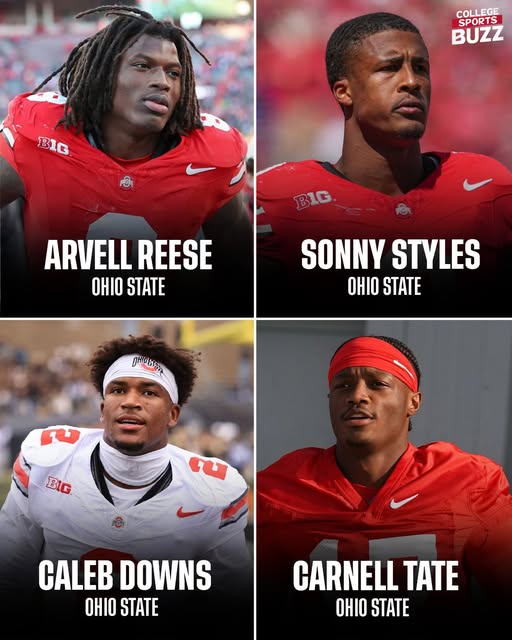
At the center of this conversation is linebacker Arvell Reese, a defensive force whose rise has been as rapid as it has been undeniable. Projected as high as the No. 2 overall pick, Reese embodies the modern linebacker prototype—long, explosive, instinctive, and versatile enough to impact every phase of the game. His sideline-to-sideline range has become a defining trait, allowing him to erase plays before they develop while also serving as a disruptive presence in coverage. NFL evaluators have pointed to his football IQ as a separator, noting how quickly he diagnoses offensive schemes and reacts with precision.
Reese’s projected draft position is not simply a reflection of physical gifts, though those are abundant. It speaks to a level of polish rarely seen at his stage, a readiness that suggests he could anchor a professional defense from day one. For Ohio State, his emergence has been both a cornerstone of defensive identity and a signal to the broader football world that the program continues to produce elite, NFL-ready talent at an extraordinary rate.
If Reese represents the cerebral enforcer, Sonny Styles offers a different—but equally compelling—profile. Projected to go No. 5 overall, Styles has carved out a reputation as one of the most dynamic defenders in college football. His hybrid skill set blurs positional lines, allowing him to operate effectively as both a linebacker and a defensive back. In an era where offensive schemes are increasingly designed to create mismatches, Styles has become the antidote—a player capable of neutralizing tight ends, tracking running backs in space, and delivering punishing hits in the open field.
What sets Styles apart is not just versatility, but impact. He is the type of defender who changes the rhythm of a game, whose presence alone forces offensive coordinators to adjust their approach. His closing speed and physicality make him a threat behind the line of scrimmage, while his awareness in coverage ensures he remains a liability for opposing quarterbacks. For NFL teams seeking defensive flexibility, Styles represents a rare commodity, one that justifies his place firmly within the Top 5 conversation.
Further reinforcing Ohio State’s defensive dominance is safety Caleb Downs, widely projected as the No. 8 overall selection. Downs has been described by scouts as a “complete” safety—a label that is often overused but, in his case, entirely appropriate. His ability to read plays from the back end, combined with elite ball skills and tackling efficiency, makes him one of the most reliable defensive prospects in recent memory.
Downs excels in both deep coverage and in-the-box responsibilities, a dual-threat capability that modern defenses covet. His instincts allow him to anticipate routes and jump passing lanes, turning defensive stands into momentum-shifting turnovers. At the same time, he is unafraid to step into the box and engage physically, providing run support that rivals that of many linebackers. His composure under pressure and consistency from game to game have elevated his draft stock, positioning him as a foundational piece for whichever franchise selects him.
While the defensive trio alone would be enough to generate headlines, Ohio State’s potential Top 10 quartet is completed by wide receiver Carnell Tate, projected to go No. 10 overall. Tate’s inclusion underscores the program’s offensive firepower and its ability to develop playmakers capable of thriving at the next level. As a receiver, Tate combines technical precision with natural athleticism, creating separation through crisp route-running and finishing plays with reliable hands.
Tate’s game is built on nuance as much as explosiveness. He understands leverage, exploits defensive weaknesses, and consistently finds ways to create space even against top-tier coverage. His ability to stretch the field vertically adds another dimension, forcing defenses to respect his deep threat while also leaving them vulnerable underneath. For NFL offenses increasingly centered around dynamic passing attacks, Tate represents a plug-and-play weapon with immediate impact potential.
The convergence of these four players—Reese, Styles, Downs, and Tate—within a single draft class is what makes this moment so extraordinary. It is not merely about individual excellence, but about collective dominance, a reflection of a program operating at peak efficiency in talent acquisition, development, and deployment. Ohio State has long been a pipeline to the NFL, but even by its lofty standards, this scenario feels different.
To fully appreciate the significance, one must consider the historical context. The 1967 Michigan State team that produced four Top 10 picks did so in an era vastly different from today’s game. Scouting was less advanced, the talent pool more regionally concentrated, and the financial stakes considerably lower. Replicating such an achievement in the modern landscape—where the competition is global and the margin for error razor-thin—would represent a remarkable accomplishment.
It also speaks to the evolution of college football as a developmental platform. Programs like Ohio State have effectively become incubators for professional talent, blending high-level coaching with resources that mirror those of NFL organizations. Strength and conditioning programs, film study, analytics, and exposure to pro-style systems have all contributed to narrowing the gap between college and professional play. As a result, prospects are entering the draft more prepared than ever, capable of contributing immediately rather than requiring extended development.
For NFL franchises, the presence of multiple elite prospects from a single program can be both a blessing and a challenge. On one hand, it offers a level of familiarity and reliability—teams know they are getting players who have competed at the highest level and thrived within a demanding system. On the other hand, it creates intense competition among franchises vying for top picks, driving up the stakes and amplifying the pressure to make the right selection.
The implications extend beyond draft night. Should all four players be selected within the Top 10, it would not only cement Ohio State’s place in history but also influence recruiting, perception, and program prestige for years to come. High school prospects pay attention to these trends, often viewing them as indicators of which programs can best prepare them for the next level. A record-setting draft performance would serve as a powerful recruiting tool, reinforcing Ohio State’s reputation as a destination for elite talent.
There is also an element of legacy at play. College football is a sport deeply rooted in tradition, where achievements are measured not just in wins and championships but in the players who pass through a program and leave their mark on the professional game. For Ohio State, producing four Top 10 picks would add another chapter to a storied history, one that includes countless NFL stars and Hall of Fame careers.
Of course, projections are just that—projections. The path from college standout to Top 10 pick is rarely linear, often influenced by factors such as injuries, team needs, combine performances, and pre-draft evaluations. Even the most highly touted prospects are not immune to shifts in perception as the draft approaches. However, the consistency with which Reese, Styles, Downs, and Tate have been mentioned among the top prospects suggests that this is more than just hype; it is a reflection of sustained excellence.
As the draft draws closer, the spotlight will only intensify. Every game, every practice, every measurable will be scrutinized, analyzed, and debated. For the players, it is both an opportunity and a challenge—to maintain focus amid the noise, to continue performing at a high level while navigating the expectations that come with being labeled elite.
For fans and analysts, it is a rare moment of anticipation, the chance to witness history in the making. Whether Ohio State ultimately achieves this milestone remains to be seen, but the mere possibility has already sparked conversations that extend far beyond Columbus. It is a testament to the power of talent, development, and timing—a convergence that, when aligned, can produce something truly extraordinary.
In the end, what stands out most is not just the potential record, but the caliber of players driving it. Reese’s dominance, Styles’ versatility, Downs’ reliability, and Tate’s playmaking ability each tell a story of dedication, growth, and excellence. Together, they form a narrative that transcends individual accolades, capturing the essence of what makes college football compelling: the emergence of talent, the pursuit of greatness, and the ever-present possibility of witnessing history unfold.