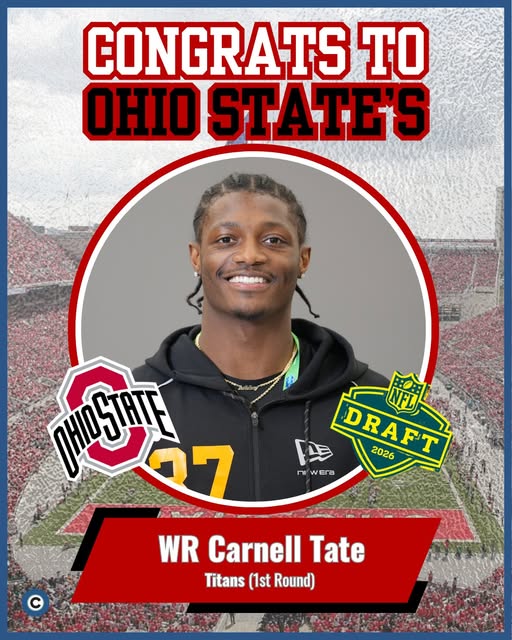
Carnell Tate’s long-anticipated leap to the professional ranks became official on a night that carried both expectation and inevitability, as the Tennessee Titans selected the Ohio State wide receiver with the No. 4 overall pick in the 2026 NFL Draft. In doing so, the Titans not only secured one of the most polished pass-catching prospects in the class but also made Tate the first Buckeye off the board, reinforcing Ohio State’s continued reputation as a premier pipeline for elite NFL talent.
The selection was met with a wave of reaction across the football world, not because Tate’s rise was surprising, but because of how quickly he had evolved from a highly touted recruit into a top-five NFL draft pick. From his early days in Columbus, Tate had been viewed as a receiver with rare polish for his age, combining technical refinement with an advanced understanding of route spacing that separated him from many of his peers. By the time he declared for the draft, scouts were already describing him as one of the safest high-upside receivers in the class.
For Tennessee, the decision to invest such a valuable pick in a wide receiver underscores a clear organizational shift. The Titans entered the 2026 offseason searching for offensive identity and stability, particularly in the passing game, where inconsistency and injuries had stalled their progress in recent seasons. Drafting Tate signals a commitment to building around young offensive talent, and more specifically, to giving their quarterback a reliable, high-ceiling target capable of transforming the structure of their passing attack.
Tate’s journey to this moment began in the highly competitive environment of Ohio State’s wide receiver room, a unit widely regarded as one of the most demanding in college football. Year after year, the Buckeyes recruit some of the nation’s top receiver prospects, and playing time is never guaranteed. For Tate, earning snaps as a freshman required rapid adaptation, disciplined preparation, and an ability to translate natural talent into consistent production. Coaches quickly noticed his attention to detail, particularly in his route running and his ability to adjust mid-play based on defensive leverage.
By his second season, Tate had carved out a significant role in Ohio State’s offense, emerging as a dependable option on the outside. His combination of fluid movement, strong hands, and situational awareness made him a frequent target in critical downs. While he was never defined solely by highlight-reel plays, his consistency became his trademark. Quarterbacks trusted him in contested situations, and offensive coordinators increasingly designed concepts that leveraged his ability to manipulate defensive backs.
Scouts evaluating Tate ahead of the draft consistently pointed to his maturity as one of his defining traits. At a position often dominated by volatility and boom-or-bust prospects, Tate stood out for his steadiness. He did not rely purely on speed or athletic bursts to separate, though he possessed both in sufficient measure. Instead, his game was built on timing, precision, and leverage—qualities that tend to translate well to the professional level.
The Titans’ front office had been monitoring Tate for months leading into the draft, with internal evaluations reportedly placing him among the top non-quarterback players available. With a top-five selection in hand, Tennessee faced a pivotal decision: address immediate needs along the offensive line or invest in a skill position player capable of reshaping their passing game for years to come. Ultimately, the franchise chose the latter, believing Tate’s presence would elevate the entire offensive structure rather than simply fill a single positional gap.
Draft night itself reflected the magnitude of Tate’s selection. As names were called ahead of him, anticipation built steadily among analysts and fans who projected him as a near-lock for the top five. When the Titans finally stepped to the podium and announced his name at No. 4 overall, the reaction was swift, with analysts praising both the player and the fit. Tennessee’s offensive coordinator was reportedly instrumental in advocating for the pick, emphasizing Tate’s ability to operate both outside and in the slot when needed, a versatility that modern NFL offenses increasingly demand.
For Ohio State, Tate’s selection continued a long-standing tradition of elite receivers transitioning successfully to the NFL at high draft positions. The program has built a national reputation for producing polished wideouts who enter the league ready to contribute immediately, and Tate’s draft slot only reinforces that perception. Within the Buckeyes organization, his development was often cited as a model of patience meeting preparation. He arrived in Columbus as a high-profile recruit, but it was his commitment to refining his craft that ultimately elevated him into a top-five pick.
Former teammates and coaches described Tate as a quiet leader, someone who rarely sought attention but consistently set a standard in practice. His work ethic was frequently highlighted in offseason training sessions, where he was known for spending extra time refining release techniques and studying defensive tendencies. That behind-the-scenes dedication, according to those close to the program, played a major role in his rapid ascent.
For the Titans, Tate’s arrival brings immediate intrigue to an offense in transition. His skill set aligns with modern passing concepts that emphasize spacing, timing, and quick decision-making. Tennessee is expected to incorporate him early, potentially positioning him as a starting receiver from Week 1 depending on training camp performance. His ability to win intermediate routes could provide stability to a passing game that has struggled to sustain drives in recent seasons.
Analysts have already begun drawing comparisons between Tate and several established NFL receivers known for their technical precision rather than pure athletic dominance. While such comparisons are always speculative, they reflect the league-wide belief that Tate’s game is built for longevity. His physical profile suggests he can withstand the rigors of an NFL season, while his mental approach indicates a player capable of continual growth.
The broader context of the 2026 NFL Draft also amplifies Tate’s selection. This year’s class was considered particularly strong at the top, with multiple franchises seeking franchise-altering talent rather than developmental prospects. For a receiver to go No. 4 overall in such a class speaks to the level of confidence evaluators have in his ability to impact games immediately.
Inside the Titans organization, expectations are already being tempered with realism, even as excitement builds. While Tate’s talent is undeniable, the transition from college to the NFL remains one of the most challenging leaps in professional sports. Defenses are faster, schemes are more complex, and the margin for error is significantly smaller. Still, Tennessee’s coaching staff believes Tate’s disciplined approach will ease that transition.
As the draft concluded, the narrative surrounding Tate was less about surprise and more about confirmation. For months, he had been projected as a top-tier receiver prospect, and on draft night, that projection became reality. The Buckeye product now enters a new phase of his career, one defined not by potential but by production.
For Titans fans, the hope is that Carnell Tate becomes more than just a high draft pick—that he evolves into a foundational piece of a revitalized offense. For Ohio State, his selection is yet another affirmation of the program’s ability to develop NFL-ready talent. And for Tate himself, the journey from Columbus standout to No. 4 overall selection marks the beginning of a challenge far greater than any he has faced before.
What remains now is execution. The expectations in Tennessee will be immediate, the spotlight unrelenting, and the margin for patience limited. But if Tate’s college career offered any indication, he has already demonstrated the traits that matter most: discipline, adaptability, and an understanding that success at the highest level is earned one route, one rep, and one game at a time.