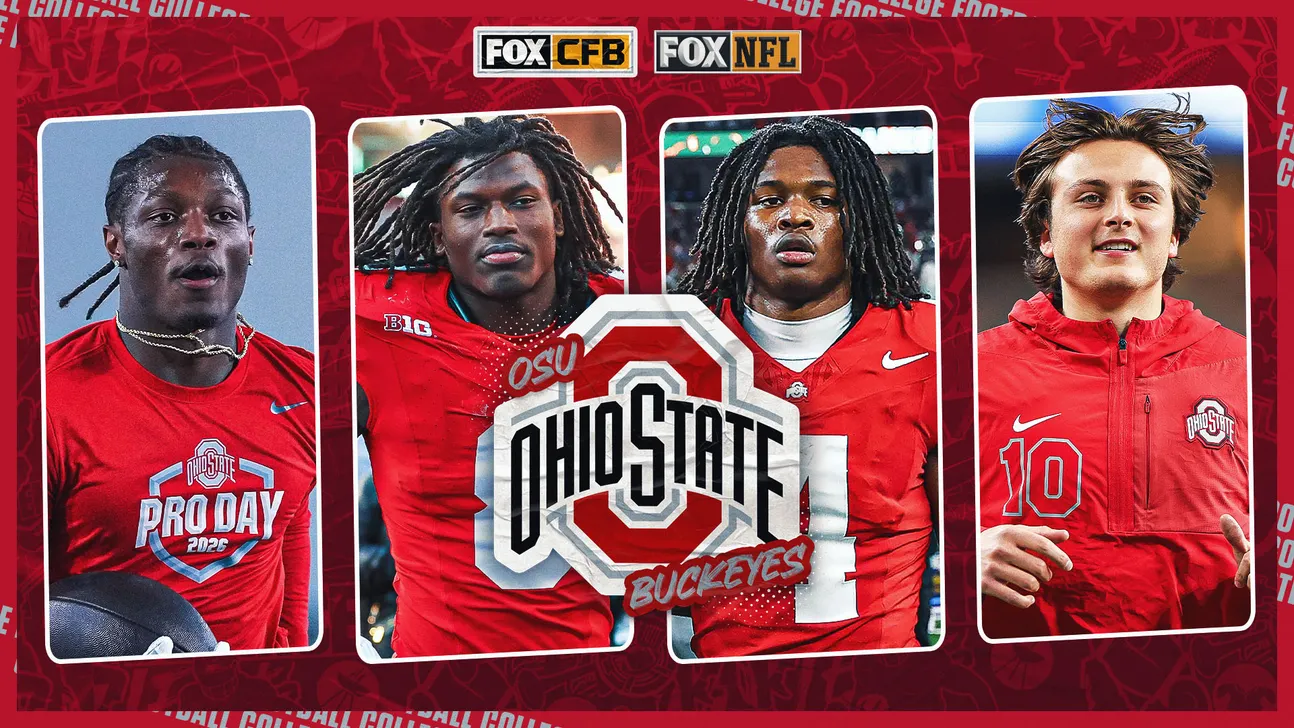
For years, college football programs across the country have leaned into branding slogans that attempt to capture identity, culture, and recruiting appeal. Some come and go with coaching changes, others fade after a single marketing cycle. But at Ohio State, one message has continued to grow legs far beyond the walls of a recruiting office or the banners hanging inside Ohio Stadium. “Developed Here” is no longer just a phrase used to sell a vision to high school prospects. It has become a measurable, draft-day reality that the entire football world now recognizes.
The evidence is not subtle. It is visible every April when the NFL Draft arrives and the names called in the first round frequently trace back to Columbus. It is reinforced every Sunday in the NFL season when former Buckeyes line up across professional fields as starters, Pro Bowlers, and franchise cornerstones. And it is underscored by the consistency of Ohio State’s ability to not only recruit elite talent but to refine it into NFL-ready players at multiple positions, year after year.
At the heart of this pipeline is a program that has turned development into an expectation rather than a hope. Under head coach Ryan Day and continuing the foundational work built across previous regimes, the Ohio State Buckeyes have maintained one of the most reliable production lines in college football. The modern era of the NFL Draft has only amplified that reputation, with Ohio State routinely sending wave after wave of high selections into the league.
What separates Ohio State is not just the volume of players drafted, but the diversity of positions and the speed at which those players translate at the next level. Wide receivers, defensive backs, offensive linemen, quarterbacks, edge rushers—the Buckeyes have produced impact talent across the board. The program has essentially become a national case study in how to recruit five-star prospects and refine them into professional-ready contributors in three to four years.
In recent drafts, the Buckeyes’ receiver pipeline alone has become a defining storyline. Players such as Garrett Wilson and Chris Olave entered the NFL with immediate expectations and quickly validated the hype that followed them out of Columbus. Both were first-round selections, both became focal points for their respective NFL teams, and both reinforced the perception that Ohio State wide receivers arrive in the league with a rare combination of polish, explosiveness, and readiness to contribute immediately.
That trend has only expanded with the next generation. Jaxon Smith-Njigba entered the league as another highly touted Buckeye receiver, adding to what has become a conveyor belt of elite pass-catching talent. Each player carries the same label when they leave the program: refined route runners, prepared for NFL concepts, and capable of handling complex offensive systems from day one.
The success is not limited to skill positions. Ohio State’s offensive line development has become one of the most important pillars of its draft reputation. Paris Johnson Jr. is a prime example, transitioning from a highly recruited high school prospect into a first-round NFL selection after his development in Columbus. His rise reflected the coaching staff’s ability to mold raw athletic traits into technical consistency, footwork discipline, and NFL-level protection skills.
Across the defensive side of the ball, Ohio State has continued to produce impact players who step into the league with immediate responsibility. Defensive backs from the program have become especially notable. The Buckeyes’ secondary training system has consistently produced players who understand modern coverage demands, pattern recognition, and the speed required to compete against elite NFL receivers.
Even within the current roster pipeline, expectations remain high for the next wave. Players like Caleb Downs, one of the most talked-about defensive standouts in college football, represent the continuation of Ohio State’s reputation for attracting and developing elite defensive talent. Downs’ presence in the program reflects not just recruiting success, but the broader belief that Ohio State is one of the few collegiate environments capable of preparing defensive backs for the complexity of modern NFL offenses.
The quarterback position, long scrutinized at Ohio State due to the program’s history of producing more system-oriented passers, has also evolved in the public perception. The rise of C.J. Stroud shifted the narrative significantly. Stroud entered the league as a high draft pick and immediately demonstrated poise, accuracy, and command at the professional level. His early NFL success reinforced the idea that Ohio State quarterbacks are no longer developmental projects—they are increasingly viewed as NFL-ready operators who have been exposed to sophisticated passing concepts and high-pressure environments.
That shift is important because it reflects a broader transformation in how NFL scouts evaluate Ohio State players. For years, critics suggested that the Buckeyes benefited primarily from athletic superiority in college competition. But the NFL Draft outcomes of the last several cycles have challenged that assumption. Scouts now point to Ohio State’s offensive structure, defensive complexity, and practice environments as key reasons why its players adapt quickly at the next level.
What “Developed Here” truly captures is the alignment between recruiting, coaching, and professional projection. Ohio State does not simply accumulate talent. It identifies elite athletes, places them in competitive internal depth charts, and forces them to compete daily against NFL-caliber peers in practice. By the time they reach game day, and eventually draft night, they have already been tested in ways that mirror professional demands.
That internal competition is one of the most overlooked aspects of the program’s success. Ohio State’s roster is often stacked with multiple future NFL players at the same position group. That means every practice rep carries weight. A freshman receiver is not just learning a playbook; he is competing against future second-round picks for snaps. A defensive back is not just covering college quarterbacks; he is being tested by receivers who will soon be playing on Sundays.
That environment accelerates development in ways that show up clearly during the NFL Combine and Pro Day circuit. Ohio State athletes consistently post strong testing numbers, but more importantly, they arrive with refined technique that complements their athletic traits. NFL teams often describe Buckeye prospects as “NFL-ready” not just because of their physical tools, but because of their exposure to pro-style systems and high-pressure competition.
The coaching infrastructure also plays a central role. Position coaches at Ohio State have built reputations as elite developers, particularly in receiver and secondary rooms. The emphasis is not only on scheme execution but on football intelligence—understanding leverage, reading defensive rotations, adjusting routes on the fly, and recognizing disguises in coverage. Those are the details that separate college success from NFL longevity.
Another major factor in Ohio State’s draft pipeline is its ability to evolve with the modern game. As NFL offenses have shifted toward spread concepts, tempo, and versatile personnel groupings, Ohio State has mirrored those trends at the collegiate level. That alignment has made its players more familiar with NFL terminology and structure before they even enter the league.
The result is a steady presence at the top of draft boards. Year after year, Ohio State players are projected as first-round picks, early-round contributors, and long-term NFL starters. That consistency is what separates the Buckeyes from programs that may produce occasional elite draft classes but struggle to maintain sustained output.
NFL general managers and scouts have taken notice. There is a growing level of trust associated with Ohio State prospects. When a Buckeye name appears on a draft board, it often comes with an assumed baseline of readiness. That reputation does not come from branding—it comes from repeated evidence across multiple draft cycles and multiple position groups.
It is also worth noting that the success feeds itself. High school recruits now view Ohio State as one of the most direct pathways to the NFL. The “Developed Here” message resonates not just as a slogan but as a promise. Elite prospects know that if they perform at Ohio State, they will be seen on draft night. That perception strengthens recruiting classes, which in turn strengthens roster depth, which continues the cycle of NFL production.
Even in moments where Ohio State falls short of national championship expectations, the NFL pipeline remains a constant source of validation. Championships define seasons, but draft success defines programs in the eyes of professional football. And in that category, Ohio State remains among the most dominant in the country.
The broader significance of this trend is that it reshapes how college football programs are evaluated. In an era where player development, NIL opportunities, and transfer movement all influence roster construction, Ohio State has managed to maintain stability in its identity as an NFL factory. It is not simply about recruiting stars—it is about turning them into professionals.
As the next NFL Draft approaches, the Buckeyes are once again expected to feature prominently. Scouts will once again gather in Columbus, evaluate film, study practice habits, and project futures. And once again, Ohio State will likely hear its name called early and often.
In the end, “Developed Here” is no longer a recruiting slogan waiting to be validated. It is a living résumé, updated every draft cycle, reinforced every Sunday in the NFL, and built on a foundation of structure, coaching, and competition that continues to set Ohio State apart.