The latest NFL Draft cycle has once again reinforced a familiar truth in college football: few programs in America manufacture professional talent at the scale of the Ohio State Buckeyes. Year after year, the Buckeyes turn roster depth into draft capital, sending wave after wave of athletes into the NFL Draft with a consistency that has become both a recruiting weapon and a measuring stick for every other program in the country.
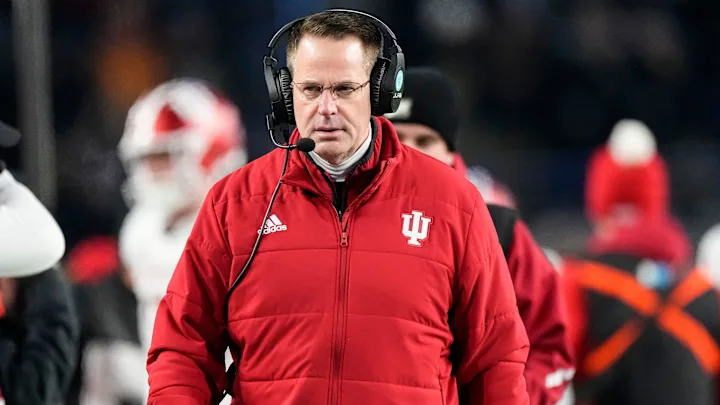
But this year, the conversation around Ohio State’s draft dominance has carried an unexpected secondary storyline—one that reaches beyond Columbus and into Bloomington, where Indiana head coach Curt Cignetti has rapidly become one of college football’s most closely watched program builders. As Ohio State continues to dominate the draft boards, it is inadvertently amplifying the perception, profile, and urgency surrounding Cignetti’s own project at Indiana, sharpening comparisons between established blueblood production lines and rising culture-driven turnarounds.
Ohio State’s latest draft haul only deepens the perception that the Buckeyes operate as one of the sport’s most reliable NFL pipelines. First-round selections have become routine rather than remarkable. Defensive linemen, wide receivers, offensive tackles, and secondary stars all continue to transition seamlessly from Columbus to the professional level. The program’s ability to reload rather than rebuild has created a self-sustaining cycle: elite recruits arrive knowing they will be developed for Sundays, and NFL success feeds back into even stronger recruiting classes.
What stands out most is not just the volume of players selected, but the readiness of those players when their names are called. NFL evaluators consistently note that Ohio State prospects arrive with refined technique, pro-style schematics already embedded in their football DNA, and experience competing against elite talent on a weekly basis. That reputation has turned the Buckeyes into a benchmark program—one against which emerging teams are inevitably measured.
And that is where Cignetti enters the broader narrative.
Since arriving at Indiana, Cignetti has built a reputation on directness, accountability, and rapid cultural overhaul. His messaging has never been subtle: he expects winning, he expects discipline, and he expects his program to close the gap between itself and the Big Ten elite. That includes Ohio State, Michigan, and Penn State—the traditional heavyweights who routinely populate early rounds of the draft.
But Ohio State’s continued dominance in the NFL Draft conversation underscores the magnitude of that challenge. The Buckeyes are not just winning games; they are producing professionals at a rate that suggests structural advantages in recruiting, development, and roster depth. For programs like Indiana, the gap is not merely about Saturday performance—it is about pipeline credibility.
In that sense, Ohio State’s draft success has become an indirect measuring stick for Cignetti’s progress. Every Buckeye selected reinforces the standard he is chasing. Every first-round announcement highlights the talent disparity he must overcome. Yet paradoxically, it also strengthens his message inside his own locker room: the bar for success in the Big Ten is not theoretical. It is visible, measurable, and annually reinforced on draft night.
Cignetti has never been shy about acknowledging the realities of the landscape. His coaching philosophy is rooted in efficiency—maximizing player development, identifying overlooked talent, and building cohesion faster than traditional power programs assume is possible. While Ohio State stacks recruiting classes filled with five-star prospects, Indiana under Cignetti has leaned into evaluation, development, and system fit.
That contrast has become more pronounced as Ohio State continues to turn recruiting rankings into NFL outcomes. The Buckeyes’ draft success validates their model: recruit at the top, develop at scale, and send players to the league ready to contribute immediately. For Cignetti, it reinforces the urgency of building an identity strong enough to compete against that machine.
Yet there is another layer to the conversation that makes Ohio State’s dominance particularly relevant to Cignetti’s rise: perception versus trajectory. The Buckeyes represent stability at the top of the sport. Indiana, under Cignetti, represents motion—an attempt to climb into relevance in a conference where draft output is often correlated with competitive legitimacy.
In the modern college football ecosystem, NFL Draft numbers have become more than a reflection of individual talent. They are a branding tool. They influence recruiting battles months before prospects set foot on campus. When Ohio State can point to double-digit selections in a single draft, it is not just celebrating past success—it is advertising future opportunity.
That reality places added pressure on programs like Indiana. Cignetti’s task is not only to win games but to change perception. And perception, in this case, is reinforced annually by the NFL Draft itself. Every Ohio State selection becomes a reminder of what elite program infrastructure looks like.
Still, Cignetti’s early tenure has shown why he is viewed as one of the more intriguing coaching figures in the sport. His teams tend to reflect his personality: structured, physical, and highly disciplined. Even when talent gaps exist, his programs are rarely disorganized or outworked. That foundation is essential for any attempt to close the gap with programs like Ohio State.
The Buckeyes, meanwhile, continue to operate in a different stratosphere of roster construction. Their ability to lose first-round talent and immediately replace it with similarly ranked recruits is the defining feature of their program. Wide receiver rooms are rebuilt rather than replenished. Defensive lines are rotated without drop-off. Quarterbacks enter systems already designed to highlight their strengths against top-tier competition.
That continuity is what makes Ohio State’s draft dominance so impactful. It is not a one-off cycle of talent; it is a sustained production line that reinforces itself every year. And it is that consistency that magnifies the challenge facing coaches like Cignetti, who must build upward without the same recruiting foundation.
Yet it would be a mistake to view the gap as static. College football history is filled with programs that climbed from the margins into competitiveness through coaching stability, developmental success, and strategic recruiting. Cignetti’s presence at Indiana signals an intent to disrupt expectations rather than accept them.
What Ohio State’s draft success does, however, is clarify the scale of that ambition. Competing in the Big Ten is one thing. Matching Ohio State’s NFL output is another entirely. The Buckeyes are not just winning games; they are defining what elite roster development looks like in the modern era.
For Cignetti, that definition serves both as a challenge and a blueprint. If Ohio State’s success proves anything, it is that sustained excellence in college football is built on alignment—between recruiting, coaching, and development. It is not enough to identify talent; that talent must be refined into NFL-ready execution.
Indiana’s path forward under Cignetti will likely not mirror Ohio State’s. The recruiting pools are different, the institutional history is different, and the expectations are fundamentally different. But the comparison remains unavoidable, especially as the Buckeyes continue to dominate draft weekend headlines.
Each Ohio State selection reinforces the hierarchy of the sport. Each draft board appearance becomes a reminder of where the standard sits. And for coaches like Cignetti, that standard is both a target and a test.
The question that lingers beyond every draft cycle is not whether Ohio State will continue to produce NFL talent—it is whether anyone in the Big Ten can build a model that meaningfully challenges that pipeline. Until that happens, programs like Indiana will continue to operate in the long shadow of Columbus.
But Cignetti’s rise suggests that shadow may not remain as fixed as it once seemed. His approach is built on disruption, on compressing timelines, and on refusing to accept developmental ceilings. Whether that translates into NFL Draft production remains to be seen, but the intent is clear: close the gap wherever it exists.
For now, Ohio State’s dominance in the NFL Draft stands as both a celebration of sustained excellence and a measuring stick for everyone else in the conference. And in that reflection, Curt Cignetti’s Indiana project becomes even more compelling—not because it matches the Buckeyes, but because it exists in direct contrast to them.
The Buckeyes are the benchmark. Cignetti is one of the coaches trying to redefine what chasing that benchmark looks like. And as long as Ohio State continues to dominate draft weekend, that pursuit will only grow more visible, more scrutinized, and more significant in the broader story of college football’s evolving power structure.