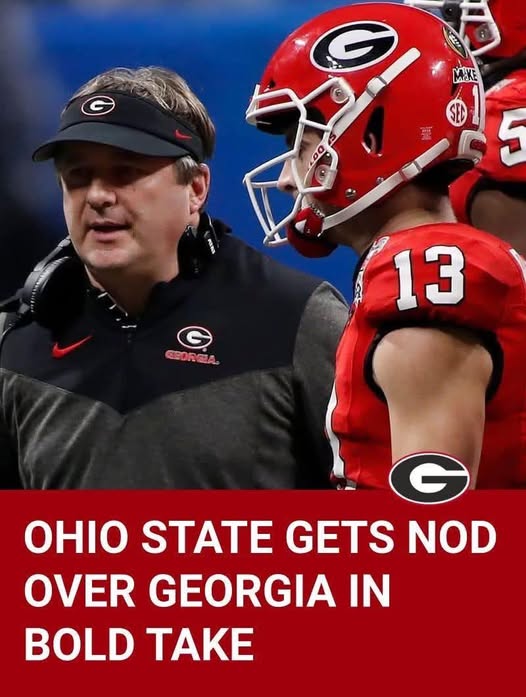
In a college football landscape increasingly defined by roster churn, playoff expansion, and razor-thin margins between elite programs, one bold projection has begun circulating through analyst circles and fan debates alike: the idea that the Ohio State Buckeyes are more likely to win another national championship before the Georgia Bulldogs do. It is a statement that carries both statistical intrigue and emotional weight, especially given how both programs have dominated the sport in recent years while setting the standard for sustained excellence in the modern era.
The assertion, while provocative on its surface, is rooted in a broader evaluation of roster continuity, quarterback development, recruiting cycles, and the evolving structure of the College Football Playoff. Ohio State’s pathway back to the top of the sport is increasingly being framed as a matter of “when” rather than “if,” while Georgia’s trajectory, though still elite, is now being measured against the historic efficiency it displayed during its championship peak earlier in the decade.
For Ohio State, the narrative centers on talent accumulation and offensive ceiling. Few programs in the country can match the Buckeyes’ consistent pipeline of NFL-ready receivers, explosive skill position athletes, and top-five recruiting classes. Even in seasons where the final push falls short, the foundation remains intact. The program’s ability to reload rather than rebuild has become its defining trait, and analysts argue that such structural stability gives Ohio State a shorter path back to championship form compared to its peers.
What has made this discussion particularly relevant is the perception that Ohio State’s current roster construction aligns more naturally with the modern playoff era. With expanded postseason access, the importance of peak performance over sustained perfection has increased. Teams no longer need to go undefeated or dominate every week; instead, they must peak at the right time and survive two or three high-level matchups in December and January. That shift, analysts say, plays directly into Ohio State’s strengths—elite speed, explosive offense, and depth across skill positions.
Quarterback development remains central to that argument. Ohio State’s recent history at the position has included both consistency and flashes of brilliance, and the program continues to attract some of the nation’s most highly regarded passers. The expectation is that elite quarterback play, combined with a stable offensive system, can elevate the Buckeyes into national title contention in any given season. In this view, Ohio State does not need a perfect roster; it needs a peak quarterback performance at the right moment in the playoff bracket.
On the defensive side, Ohio State has also made significant strides in closing the gap with the sport’s most physical teams. While earlier iterations of the Buckeyes were often criticized for struggling against power-run offenses in high-stakes games, recent recruiting emphasis has shifted toward defensive line strength and versatility at linebacker. The result is a more balanced roster profile, one that is better equipped to handle the variety of styles encountered in a playoff run.
Georgia, by contrast, remains the benchmark for defensive dominance. Under its current championship-era identity, the Bulldogs have redefined what elite defense looks like in the modern college game. Physicality, depth, and NFL-caliber talent at nearly every position group have become hallmarks of the program. Even in transition years, Georgia’s defensive structure keeps it competitive in nearly every matchup, and its recruiting footprint ensures that reload cycles rarely result in significant drop-offs.
However, the argument favoring Ohio State’s earlier return to the national summit hinges not on Georgia’s decline, but on timing and roster cycles. The Bulldogs’ championship window over the past several seasons has been historically efficient, producing multiple titles and near-title appearances. But sustaining that level of dominance requires continuous recalibration, particularly as assistant coaching turnover and NFL draft departures reshape the roster annually.
Georgia’s identity under head coach Kirby Smart has been defined by adaptability, yet even the most stable programs face inevitable roster inflection points. As key defensive leaders cycle out and younger players step into expanded roles, there is often a transitional period where performance dips slightly below championship standard before stabilizing again. Analysts argue that even a small dip at the wrong time can be decisive in the playoff era, where one loss ends a title pursuit.
Ohio State, meanwhile, is viewed as being in a slightly different phase of its cycle. The Buckeyes have maintained elite recruiting momentum without fully converting recent playoff appearances into championships, creating what some describe as “compressed urgency.” That urgency often translates into roster retention strategies, coaching adjustments, and schematic evolution designed specifically to break through in the postseason.
The Big Ten’s shifting competitive landscape also plays a role in this projection. With the conference expanding and traditional power structures evolving, Ohio State’s path to the playoff has become more predictable compared to the increasingly physical weekly battles in the SEC. Fewer regular-season landmines allow for a more controlled buildup toward postseason form, which can be critical in preserving health and momentum.
Georgia, operating within the SEC, continues to face what many consider the nation’s most demanding weekly schedule. Even in dominant seasons, the physical toll of conference play often accumulates by the time the postseason arrives. While Georgia has proven capable of navigating that challenge at the highest level, the margin for error is slimmer, and the path to an undefeated or one-loss season is considerably more complex.
Recruiting trends further complicate the comparison. Both programs consistently rank among the top destinations for five-star talent, but their roster identities differ. Ohio State tends to attract elite offensive skill players and high-ceiling defensive athletes who thrive in space and speed-based systems. Georgia, on the other hand, has built its dominance through trench play, physical defensive personnel, and a pro-style balance that translates directly to NFL readiness.
This stylistic contrast shapes how each program is evaluated in championship projections. Ohio State is often seen as having a higher offensive ceiling in any given matchup, capable of overwhelming opponents with explosive plays and tempo. Georgia is viewed as having a higher baseline of consistency, capable of controlling games through defense and physical dominance even when offensive production fluctuates.
In playoff scenarios, those distinctions become magnified. Single-elimination formats reward peak performance and explosive variance as much as consistency. A team that can score quickly and adapt offensively in high-pressure environments often holds an edge in unpredictable postseason games. That is where Ohio State’s profile becomes particularly compelling in this debate.
Coaching stability also factors into the discussion. Ohio State head coach Ryan Day has remained under intense scrutiny following playoff near-misses, yet his regular-season record and recruiting consistency keep the Buckeyes in perennial contention. His offensive background continues to shape Ohio State’s identity, emphasizing quarterback development and vertical passing concepts that stress opposing defenses.
Kirby Smart, meanwhile, has established himself as one of the sport’s premier program builders, transforming Georgia into a defensive powerhouse with sustained national relevance. His ability to maintain elite standards year after year has placed Georgia in rare historical company. However, with sustained success comes heightened expectations, and the pressure to convert deep playoff runs into additional championships remains constant.
The broader college football environment also plays a role in shaping this projection. With expanded playoffs reducing the importance of perfection and increasing the importance of depth and momentum, teams with elite offensive firepower may have more pathways to championships than in previous eras. Ohio State’s roster composition aligns naturally with that evolution, while Georgia’s model remains rooted in a more traditional balance of dominance across all phases.
Still, it would be misleading to interpret this projection as a decline in Georgia’s stature. The Bulldogs remain one of the most complete programs in the country, capable of winning national championships in any given season. Their recruiting consistency, defensive identity, and coaching stability ensure they remain a constant threat at the highest level.
The debate, rather, is about probability windows and timing. College football dynasties are often measured not only by total championships but by the sequence in which they arrive. Momentum, roster cycles, and conference dynamics all intersect to create windows of opportunity that can open and close quickly.
For Ohio State, that window is viewed as imminently accessible. For Georgia, it remains open but subject to the natural ebb and flow of roster transition and competitive recalibration. That subtle distinction is what fuels the growing sentiment that the Buckeyes are better positioned to reach the national summit again first.
Ultimately, the discussion underscores a broader truth about modern college football: dominance is no longer linear. It is cyclical, situational, and increasingly dependent on timing as much as talent. Both Ohio State and Georgia are firmly embedded in the sport’s elite tier, and both will almost certainly remain in championship conversations for the foreseeable future.
But in a sport defined by fleeting opportunities and razor-thin margins, the belief that Ohio State may strike first in the next national title race is gaining traction. Whether that projection proves accurate will depend on variables that no analyst can fully predict—health, quarterback play, playoff seeding, and the unpredictable chaos of December football.
What remains certain is that the rivalry of perception between these two programs is now as compelling as any matchup on the field. And in that narrative, every season becomes a referendum not just on who is best, but on who is next.