As the Indiana Hoosiers inch closer to their annual spring game, the tone inside the program has shifted from offseason optimism to a more sober assessment of where things currently stand. For all the energy and expectations surrounding a pivotal spring under new leadership, head coach Curt Cignetti has made it clear that the progress he is seeing on the field is still uneven at best, and in some areas, concerningly inconsistent.
That honesty has defined the early phases of spring practice for the Indiana Hoosiers football, a program attempting to reset its identity and competitive standards heading into a critical season. While spring football is traditionally a time for experimentation, development, and evaluation, Cignetti’s evaluation of his roster has not been dressed up with optimism or softened with coach-speak. Instead, he has consistently pointed to a lack of steadiness across the board, from execution and discipline to situational awareness and consistency in effort.
“Too much inconsistency across the board” has become the underlying theme of Indiana’s spring narrative, and it is not a phrase the program is brushing aside. It reflects both the growing pains of installation under a relatively new system and the reality that the Hoosiers are still searching for a reliable baseline of performance on both sides of the football. For a program looking to establish credibility in a demanding Big Ten landscape, inconsistency is more than just an annoyance—it is a barrier to progress.
Cignetti, known for his direct communication style and uncompromising expectations, has not shied away from pointing out that inconsistency has shown up in nearly every phase of practice. One day, the offense might show flashes of rhythm, efficient tempo, and clean execution. The next, it can stall with miscommunications, missed reads, and breakdowns in protection. The defense, meanwhile, has mirrored that unpredictability, alternating between moments of physical dominance and lapses in assignment discipline that lead to explosive plays.
The spring game, which is typically framed as a celebratory preview of the upcoming season, has taken on a different tone this year. Rather than serving purely as a showcase, it has become an evaluation checkpoint for a roster still trying to define its identity. Cignetti’s concern is not rooted in panic, but in urgency—the kind that comes from understanding how quickly inconsistency can derail a season before it ever fully takes shape.
For Indiana, the problem is not necessarily a lack of talent. Instead, it is the inability to stack quality reps consistently. That distinction matters deeply in a program undergoing development, because isolated flashes of success do not translate into wins without repeatable execution. Cignetti has emphasized that point repeatedly, underscoring that the standard is not occasional excellence, but sustained reliability.
A major area of focus has been offensive consistency. Indiana’s offense has shown moments of promise during spring drills, particularly in tempo-driven segments and scripted sequences. However, those moments have often been followed by drives that stall due to penalties, protection breakdowns, or missed opportunities in the passing game. The lack of continuity has made it difficult for the coaching staff to gauge exactly where the unit stands heading into summer preparation.
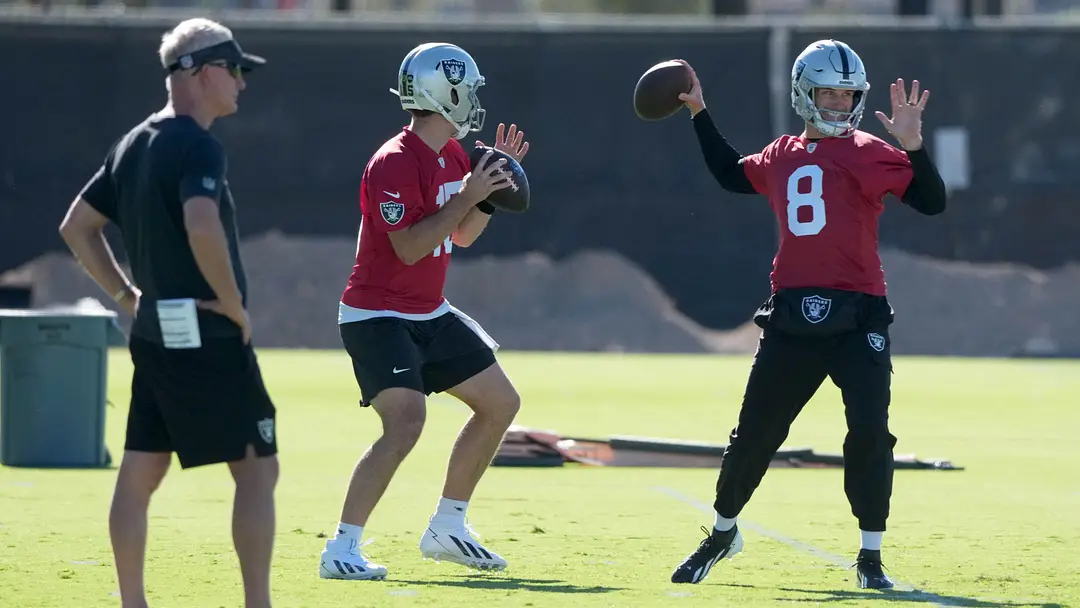
Quarterback play, as expected, has been under the microscope. While competition remains ongoing, the issue has not been solely about decision-making or arm talent. Instead, the inconsistency has been tied to timing, chemistry with receivers, and comfort within the evolving system. One rep might demonstrate command and precision, while the next reveals hesitation or misalignment with route concepts. That kind of volatility has prevented any clear separation in the competition and has added to the broader concern about offensive stability.
The receiving corps has also experienced uneven production. There are moments when separation and route execution create easy throwing windows, but those opportunities have not been consistently capitalized on. At times, drops and miscommunications have stalled drives that otherwise showed promise. The coaching staff has been particularly attentive to these issues, recognizing that reliability in the passing game is essential for offensive cohesion.
Up front, the offensive line has had its own struggles with consistency in protection schemes and run blocking assignments. There have been sequences where the unit controls the line of scrimmage and opens clear rushing lanes, only to follow with breakdowns that disrupt timing and rhythm. For Cignetti, this fluctuation is unacceptable at a foundational level, as offensive stability often begins with the ability to trust protection on a down-to-down basis.
Defensively, Indiana has shown flashes of aggression and physicality, particularly in front-seven play. However, inconsistency has appeared in coverage communication and gap discipline. Explosive plays have occasionally been allowed due to missed assignments or delayed reactions, undermining otherwise strong defensive series. The defense’s ability to generate stops has often been offset by self-inflicted breakdowns, something Cignetti has repeatedly identified as a key concern.
Part of the challenge lies in adaptation. With new schemes being installed and personnel still adjusting to expectations, inconsistency is not entirely unexpected. Spring practice often exposes the growing pains that remain hidden during offseason workouts. Still, Cignetti’s message has been clear: while mistakes are part of development, repeated inconsistency is not something the program can afford to normalize.
In many ways, spring football serves as a diagnostic tool, and Indiana’s diagnosis has been straightforward. The talent is present, but the execution gap between potential and performance remains too wide. That gap is what Cignetti is attempting to close before it becomes a defining trait of the season.
Beyond the X’s and O’s, inconsistency has also surfaced in intangible areas such as effort level and practice discipline. Coaches have noted that energy levels can fluctuate during sessions, with some periods of sharp intensity followed by stretches of mental lapses or reduced urgency. For a program attempting to build a new culture, those inconsistencies are just as significant as missed assignments or blown coverages.
Leadership within the locker room is another area under evaluation. While several players have stepped into vocal roles, Cignetti is still looking for consistent voices who can stabilize the team during adversity. Inconsistent leadership can mirror inconsistent play, and the coaching staff understands that culture is reinforced as much through player accountability as it is through coaching directives.
As the spring game approaches, Indiana’s staff is focused less on scoreboard results and more on measurable improvement in consistency. The scrimmage environment will serve as a final opportunity this spring to evaluate how far the team has come in translating practice corrections into live execution. It will also provide another data point in identifying which players can be trusted in high-pressure situations.
Cignetti’s coaching philosophy has always centered on accountability and detail. He is not interested in masking issues with optimism or downplaying inefficiencies. Instead, his approach emphasizes confronting problems directly and using them as teaching tools. In that context, his public concern about inconsistency is not a warning of collapse, but a reflection of standards that have yet to be met.
Still, there is an understanding within the program that transformation does not happen instantly. New systems require repetition, and repetition requires patience. The challenge for Indiana is balancing that developmental patience with the urgency of competing in one of the most demanding conferences in college football. The Big Ten does not offer much margin for prolonged inconsistency, and Cignetti is well aware of that reality.
What happens next in spring practice will likely shape the narrative heading into summer workouts. If Indiana can stabilize its execution, reduce mental errors, and find greater cohesion on both sides of the ball, the current concerns may evolve into early-season growing pains rather than structural issues. If inconsistency persists, however, it could signal deeper challenges that extend beyond spring evaluation.
For now, the message from the program is clear and unfiltered. Indiana is not where it needs to be, but it is aware of what is missing. The inconsistency that Cignetti has identified is not being ignored or excused—it is being placed directly at the center of the team’s developmental focus.
As the Hoosiers prepare for their spring game, the spotlight will not just be on individual performances or highlight plays. It will be on whether Indiana can begin to establish something far more important: a standard of consistency that can carry beyond April, into summer, and eventually into the grind of the regular season.