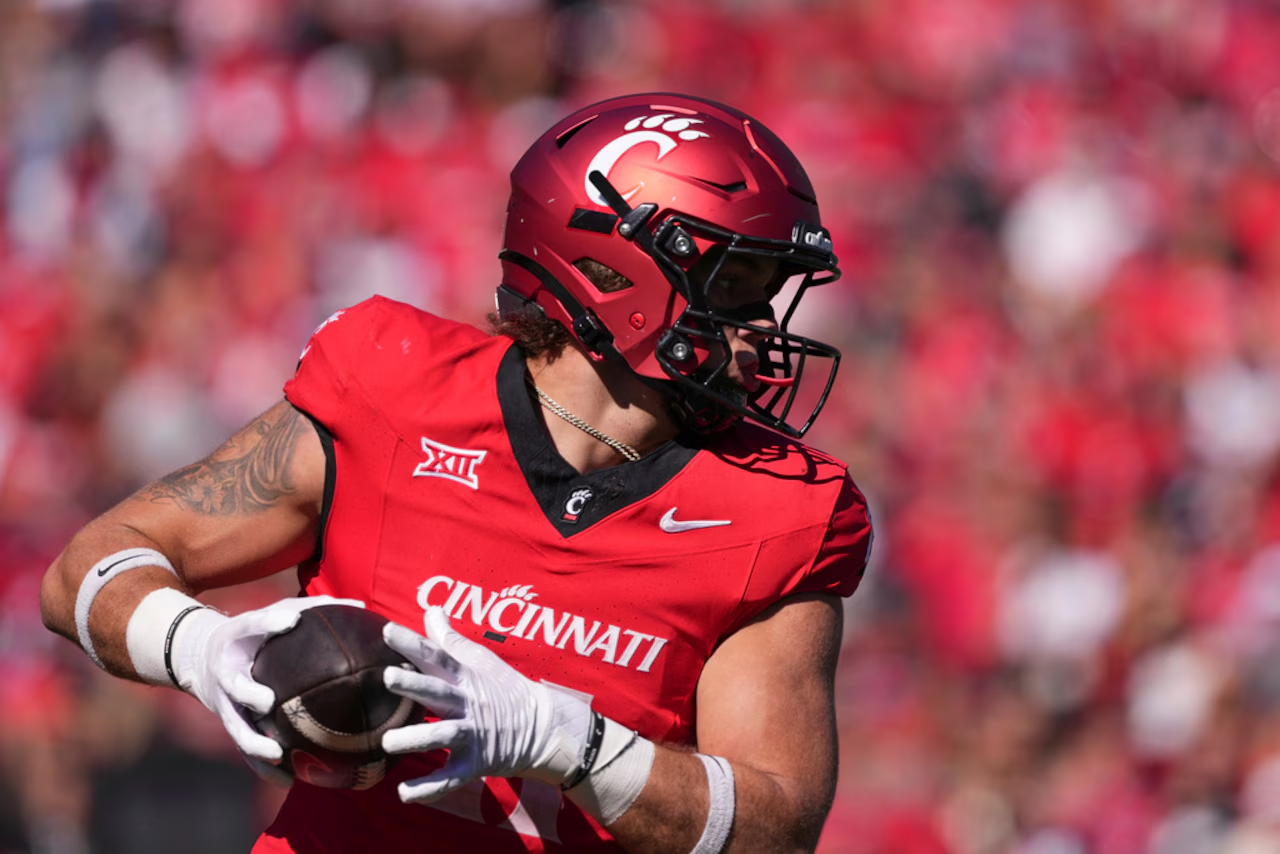
CINCINNATI — In a football world where tight ends are increasingly asked to be everything at once—blockers, receivers, matchup nightmares, and sometimes even emergency ball-handlers—Joe Royer has quietly been building a profile that refuses to be overlooked. The former Cincinnati Elder standout has taken a winding but increasingly intriguing path through college football, one that now carries an unexpected but fascinating narrative thread: a developmental connection, inspiration, and stylistic comparison to Kansas City Chiefs superstar Travis Kelce.
Royer’s story does not begin under the brightest of national spotlights, but rather in the gritty, tradition-rich football culture of Cincinnati Elder High School, where toughness is not a slogan but an expectation. Elder, one of Ohio’s most storied programs, has produced its fair share of Division I talent, and Royer entered that system with the physical tools and raw upside that immediately drew attention from college scouts. Standing out in a program that values discipline, blocking grit, and physical dominance at the line of scrimmage, Royer quickly established himself as more than just another local prospect. He was a mismatch waiting to happen.
At Elder, Royer’s game was built on fundamentals that don’t always show up in highlight reels but win football games in November and December. He was a reliable target in the passing game, a physical presence in the red zone, and a willing blocker who embraced contact rather than avoided it. That combination made him one of the more intriguing tight end prospects in the Midwest, eventually earning him a path to one of college football’s most competitive environments: Ohio State.
Arriving in Columbus meant stepping into a program loaded with elite wide receivers, high expectations, and a depth chart that rarely offers patience. At Ohio State, Royer found himself surrounded by future NFL talent but also faced the reality of limited opportunities. The Buckeyes’ offensive system, heavily reliant on wide receiver production and explosive perimeter play, meant that tight ends often had to wait their turn or carve out specialized roles. For Royer, it was a period of adjustment, learning, and, at times, frustration.
Still, those years at Ohio State were not without value. Behind the scenes, Royer refined his route running, improved his hand placement in blocking schemes, and absorbed the nuances of high-level defensive reads. He trained against some of the best athletes in the country on a daily basis, sharpening his physicality and mental processing speed. Coaches noted his willingness to adapt, even when the depth chart did not immediately favor him. And perhaps most importantly, he stayed committed to becoming a more complete tight end, rather than a one-dimensional contributor.
Eventually, the search for a more prominent role led Royer back closer to home, transferring to Cincinnati. The move was not simply about geography; it was about opportunity. At Cincinnati, he found a system more willing to utilize tight ends in versatile ways, allowing him to expand his role in both the passing and running game. The transition marked a turning point in his college career, giving him the chance to finally translate potential into production.
It was in this environment that the narrative around Royer began to shift. Coaches and analysts started to see a player who was not just physically gifted, but increasingly polished. His hands became more reliable in traffic, his route breaks sharper, and his understanding of leverage in contested situations more advanced. In many ways, his development mirrored the trajectory of modern NFL tight ends who thrive not just on size, but on adaptability.
What has made Royer’s story particularly compelling in recent months is the growing comparison—both stylistically and in developmental philosophy—to Travis Kelce. While the Kansas City Chiefs star is a future Hall of Famer known for redefining the position, the connection between the two is less about direct mentorship and more about influence, inspiration, and shared football DNA.
Kelce’s rise from an overlooked college prospect to one of the most dominant offensive weapons in professional football has become a blueprint for tight ends who do not fit a single mold. Royer, observing that trajectory, has spoken in general terms about studying elite NFL tight ends to understand how they create separation, manipulate defenders, and maintain consistency in high-pressure moments. Among those influences, Kelce stands out as the standard.
What makes Kelce such a compelling reference point is not just his production, but his style of play. He thrives in space, finds soft spots in zone coverage, and uses body control rather than sheer speed to dominate defenders. Royer, while still developing, has shown flashes of similar instincts—particularly in short-to-intermediate routes where timing and awareness are critical. Coaches have noted that his ability to settle into coverage gaps and present a reliable target on third down is one of his most promising traits.
The phrase “direct line to Travis Kelce,” often used in discussions around Royer’s development, is less about formal mentorship and more about aspirational alignment. In football circles, that kind of comparison carries weight. Kelce has become the modern archetype of the move tight end, and any young player showing flashes of that versatility naturally draws attention.
For Royer, however, the focus remains grounded. Those close to him emphasize that his progression has been built on incremental improvement rather than dramatic transformation. His blocking has become more consistent, his route pacing more deliberate, and his understanding of defensive disguises more sophisticated. It is the kind of growth that does not always dominate headlines but often determines whether a college tight end earns a legitimate shot at the next level.
One of the most notable aspects of Royer’s journey has been his resilience through role changes and system transitions. Moving from a high-profile program like Ohio State to Cincinnati required humility and patience. It also required a willingness to re-establish himself in a new offensive identity. That adaptability has become one of his defining characteristics.
At Cincinnati, offensive coordinators have used Royer in multiple alignments—inline tight end sets, slot formations, and occasional motion packages designed to exploit mismatches against linebackers and safeties. His size allows him to function as a traditional in-line blocker, but his athletic profile opens the door to more creative usage. That dual capability is exactly what NFL evaluators look for in modern tight end prospects.
While comparisons to elite NFL players can sometimes be premature, they also serve as benchmarks for development. In Royer’s case, the Kelce comparison is less about declaring equivalence and more about outlining a ceiling. Kelce’s success has redefined expectations for the position, proving that tight ends can be primary offensive engines rather than secondary options. For young players like Royer, that shift has expanded both opportunity and pressure.
NFL scouts evaluating Royer have pointed to several key strengths. His frame allows him to absorb contact and maintain balance through tackles. His hands, particularly in contested situations, have shown reliability. His route running continues to evolve, especially in timing-based concepts. Perhaps most importantly, his football IQ appears to be trending upward, as he becomes more comfortable reading coverages and adjusting routes on the fly.
There are still areas of refinement. Consistency in blocking technique, particularly against elite edge rushers, remains a work in progress. Explosiveness off the line of scrimmage is another area where continued development could elevate his profile. But these are not uncommon traits for tight ends still transitioning from college systems to professional expectations.
What stands out most is the trajectory rather than the snapshot. Royer is not a finished product, but he is clearly trending in a direction that keeps him on NFL radars. In a league that increasingly values hybrid tight ends capable of shifting formations and dictating matchups, his skill set aligns with current offensive philosophies.
Beyond the field, Royer’s journey also reflects a broader truth about modern college football: development is rarely linear. Transfers, system changes, and evolving roles have become part of the landscape. Players are no longer defined solely by where they begin, but by how they adapt. Royer’s path from Elder High School to Ohio State and then Cincinnati embodies that reality.
As he continues to refine his game, the conversation around him will likely grow louder. Whether he ultimately reaches the level of influence associated with players like Travis Kelce remains to be seen, but the framework for that kind of progression is present. The physical tools are there. The mental growth is evident. And the opportunity, as always in football, will depend on continued execution.
For now, Joe Royer remains one of those quietly compelling names in college football—an athlete whose story is still being written, whose ceiling is still being debated, and whose connection to one of the game’s greats serves not as a conclusion, but as a reminder of what is possible when development meets opportunity.