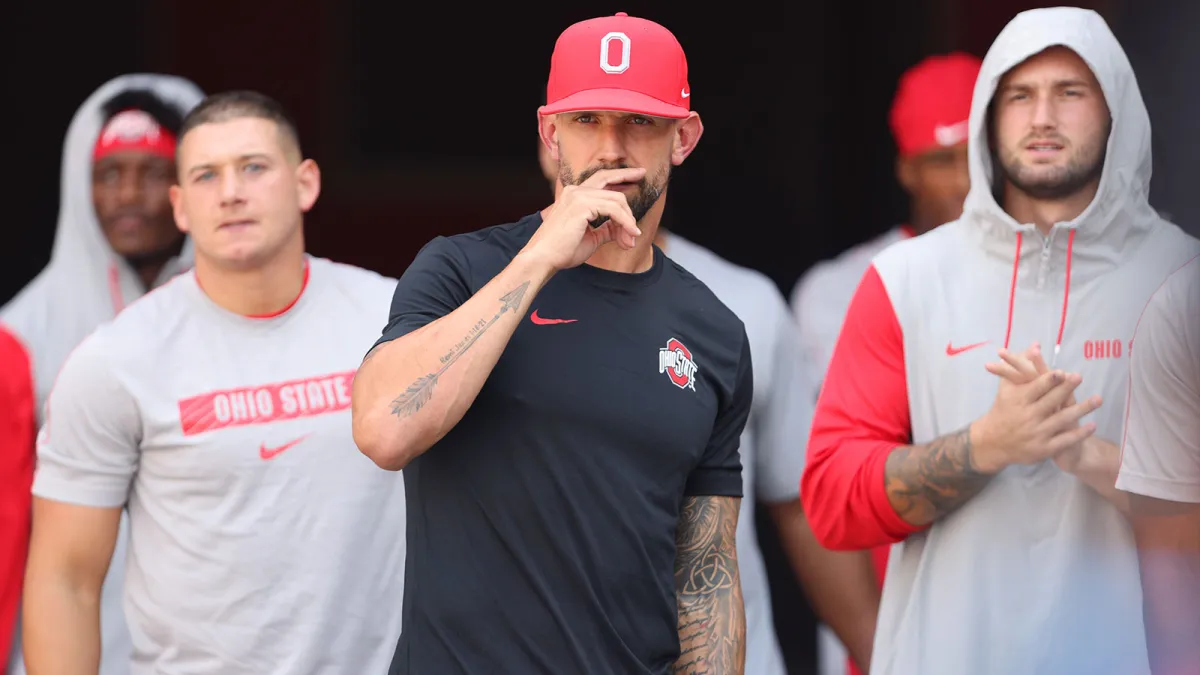
The recruiting trail around elite college football programs is rarely quiet, but every so often a message cuts through the noise with enough force to reshape how prospects view their options. That appears to be the case after comments attributed to Ohio State linebackers coach James Laurinaitis, who has reportedly delivered a blunt reminder to high school recruits considering the grind of playing for the Ohio State Buckeyes: the standard is not just high, it is relentless, and there is no easing into it.
Laurinaitis, a former All-American linebacker at Ohio State and a long-time NFL veteran with the St. Louis Rams and New Orleans Saints, has quickly built a reputation in coaching circles for carrying the same intensity that defined his playing career. That intensity has now bled into his recruiting approach, where he has emphasized honesty over comfort and competition over promise. According to those familiar with his messaging, the tone has been direct enough to be described by some recruits and observers as a “warning” rather than a pitch.
The core of Laurinaitis’ message is simple: Ohio State is not a developmental comfort zone where players are eased into stardom. It is a performance-driven ecosystem where talent is abundant, patience is limited, and playing time is earned every single day. In an era of college football defined by transfer portal movement, Name, Image, and Likeness (NIL) opportunities, and constant roster turnover, Laurinaitis is leaning into an old-school philosophy that prioritizes competition above all else.
For recruits used to polished recruiting presentations filled with highlight promises and carefully curated visions of early playing time, Laurinaitis’ approach reportedly stands out. Rather than guaranteeing opportunities, he has emphasized the reality of depth charts stacked with former five-star prospects, returning starters, and NFL-caliber athletes who are all fighting for the same limited roles. The message, as it has been described, is not meant to discourage players but to filter out those unwilling to embrace the challenge.
Those who have followed Laurinaitis’ coaching trajectory say this approach should not come as a surprise. During his playing days, he was known for film-room obsession, physical discipline, and a relentless motor that made him one of the most productive linebackers in Ohio State history. Transitioning into coaching, he has carried those traits into his expectations for the position group he now oversees, setting a standard that mirrors his own career path.
Recruiting in modern college football is often described as a marketing battle. Programs compete not only with each other but with social media narratives, transfer portal opportunities, and NIL-driven decision-making. Against that backdrop, Laurinaitis’ blunt messaging represents a countercultural stance. Instead of selling ease or immediate stardom, he is selling difficulty, competition, and the possibility of failure as part of the journey.
For some recruits, that message can be jarring. High school standouts accustomed to being the focal point of their teams often arrive at elite programs expecting incremental adjustment periods. Laurinaitis, however, appears to be eliminating that expectation early. His stance suggests that at Ohio State, adjustment is immediate and optional comfort does not exist. Either players adapt quickly or they risk being buried in one of the deepest rosters in college football.
Within the broader context of the program, this approach aligns with Ohio State’s longstanding identity. The Buckeyes have consistently recruited at a top-five national level, assembling rosters filled with NFL-bound talent year after year. That level of talent naturally creates internal competition that can overwhelm players who are unprepared for it. Laurinaitis’ messaging seems designed to prevent that shock from arriving after signing day.
At linebacker specifically, the stakes are even higher. Ohio State has invested heavily in building one of the nation’s most physically and technically demanding defensive systems, where linebackers are expected to not only defend the run but also operate in space against modern pass-heavy offenses. That dual responsibility requires a level of preparation that many high school schemes do not fully replicate. Laurinaitis, having played the position at the highest level, understands that transition better than most.
His message reportedly underscores that reality. Recruits are told, in essence, that talent alone will not secure them a role. Instead, mastery of assignments, consistency in execution, and willingness to compete every day are non-negotiable. That philosophy reflects the broader defensive culture Ohio State continues to build under its coaching structure, where versatility and reliability are valued as highly as raw athletic ability.
The timing of this messaging is also significant. College football recruiting has become increasingly transactional, with prospects weighing multiple programs based on playing time projections, NIL opportunities, and transfer flexibility. In that environment, Laurinaitis’ candid approach may serve a dual purpose: attracting players who thrive under pressure while filtering out those who might struggle in a highly competitive locker room.
There is also an element of long-term roster stability embedded in the approach. Programs that oversell immediate opportunity often face higher transfer rates when expectations are not met. By contrast, a more honest, even harsh recruiting pitch can help align expectations early, potentially reducing attrition and increasing internal cohesion once players arrive on campus.
For Laurinaitis himself, this is also a defining moment in his early coaching career. As a former star at Ohio State, he carries both credibility and responsibility. Players recognize his résumé, which includes national recognition at the college level and a long NFL career. That credibility gives weight to his words in a way that many position coaches may not be able to replicate. When he speaks about what it takes to succeed in Columbus, recruits understand it comes from lived experience, not theory.
Within recruiting circles, such messaging often sparks debate. Some argue that modern prospects require more encouragement and positive reinforcement, while others believe honesty about difficulty is the most effective long-term strategy. Laurinaitis’ approach clearly falls into the latter category. It is less about convincing every recruit and more about identifying the ones who are mentally prepared for what awaits them.
That distinction matters, especially at a program like Ohio State, where expectations are national championship or bust. There is little room for developmental hesitation. Every season brings pressure not just to win, but to dominate. That environment naturally demands a roster composed of players who are not only physically gifted but psychologically prepared for constant scrutiny.
The reaction from recruits, while not universally documented, is likely mixed. Some will see Laurinaitis’ honesty as refreshing, a sign that they are being told the truth rather than sold a dream. Others may interpret it as a deterrent, especially if they are seeking immediate playing time or a smoother developmental path. In either case, the message serves its intended purpose: clarity.
It also reflects a broader trend in elite college football programs, where coaching staffs are increasingly transparent about competition levels. With the transfer portal offering an immediate exit option, programs are less inclined to soften expectations during recruitment. Instead, many coaches now prioritize alignment over persuasion, seeking players whose mindset matches the program’s demands from day one.
At Ohio State, that alignment is critical. The program’s defensive identity has evolved significantly over the years, blending traditional toughness with modern schematic flexibility. Linebackers, in particular, are required to be hybrid defenders capable of covering receivers, blitzing effectively, and reading complex offensive structures in real time. Laurinaitis’ insistence on readiness reflects those evolving demands.
For high school recruits considering the Buckeyes, the message is ultimately one of choice. They are being told, directly or indirectly, that Ohio State will not lower its standard to accommodate comfort. Instead, the program expects recruits to elevate themselves to meet it. That distinction is what separates elite programs from the rest of the college football landscape.
As recruiting continues to evolve under the influence of NIL and transfer mobility, voices like Laurinaitis’ may become more prominent. Programs are increasingly recognizing that long-term success depends not just on attracting talent, but on attracting the right mindset. Talent alone, in a system as competitive as Ohio State’s, is no longer sufficient.
In that sense, Laurinaitis’ reported warning is less about deterrence and more about calibration. It sets a clear expectation: those who choose Ohio State must be prepared for an environment where nothing is guaranteed, everything is earned, and competition never stops. For some recruits, that may be too much. For others, it is exactly the challenge they are seeking.
What remains to be seen is how this approach will shape future recruiting classes and whether it will influence other position coaches across the country. But within Columbus, the message is already clear. The standard is set, the competition is constant, and as Laurinaitis continues to build his coaching identity, he is making sure every recruit understands exactly what they are stepping into before they ever sign.