COLUMBUS, Ohio — What was supposed to be another defining step in Ohio State’s championship pursuit instead ended in frustration, missed opportunities and a late-season unraveling that still lingers inside the program’s locker room. And few voices have captured the sting of it more bluntly than sophomore star wide receiver Jeremiah Smith, who didn’t hold back when reflecting on how the Buckeyes’ 2025 campaign collapsed down the stretch.
In a candid post-season conversation that quickly circulated through college football circles, Smith delivered what teammates and analysts have called a “truth bomb,” describing Ohio State’s finish to the year as a series of “epic fails” that turned a promising playoff-caliber season into one defined by self-inflicted wounds and missed execution in critical moments.
For a program as tradition-rich and expectation-heavy as the Buckeyes, the words landed with force.
“We didn’t get beat because we weren’t good enough,” Smith said. “We got beat because we kept failing at the worst possible times. Red zone, third down, late-game execution—those are the moments that decide seasons. And we failed too many of them.”
The blunt assessment came after a 2025 campaign that began with national championship aspirations but ended far short of that standard. The Buckeyes entered the season ranked among the top contenders in the country, powered by a loaded roster, a veteran quarterback, and one of the most dynamic young receiving corps in college football, headlined by Smith, who had quickly established himself as one of the sport’s most dangerous playmakers.
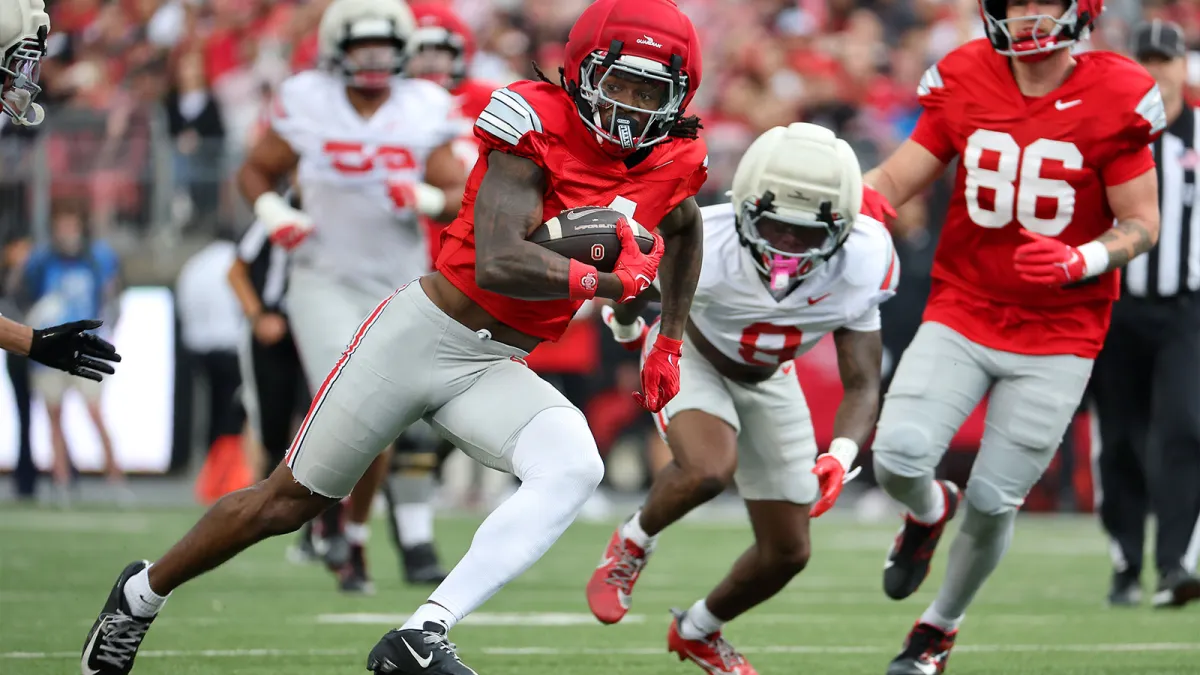
Early in the season, everything appeared to align with expectations. Ohio State rolled through its nonconference schedule with relative ease, stacking explosive offensive performances and showcasing a defense that looked capable of matching up with anyone in the country. Smith, in particular, was a mismatch nightmare, using his combination of size, speed and ball skills to routinely stretch defenses vertically while also thriving on intermediate routes that kept chains moving.
But as Big Ten play intensified, so did the inconsistencies.
What began as minor execution issues gradually became defining flaws. Drives that should have ended in touchdowns stalled out. Defensive stops were followed by sudden breakdowns. Special teams errors crept in at inopportune times. And in the games that mattered most, Ohio State repeatedly failed to close.
By mid-November, the narrative around the Buckeyes had shifted from playoff lock to playoff question. Two key conference losses—both in games where Ohio State held second-half leads—exposed the same recurring issues Smith later pointed to: red-zone inefficiency, penalties in critical moments, and breakdowns in situational football.
Those losses ultimately cost Ohio State control of its postseason destiny.
Smith’s frustration, according to those close to the program, had been building for weeks. Teammates describe a young star who remained locked in competitively but increasingly vocal behind the scenes about the team’s inability to finish drives and close games.
The final stretch of the season only intensified that sentiment.
In Ohio State’s season finale—a game that was expected to stabilize momentum heading into bowl preparation—the Buckeyes once again found themselves in control early, only to see the game slip away in the second half. Turnovers flipped field position, defensive miscommunication led to explosive plays, and a late offensive possession that could have sealed the game ended in a three-and-out that epitomized the season’s frustrations.
For Smith, who finished the game with strong individual numbers but limited fourth-quarter touches, the ending was a fitting but painful summary of a year defined by unfulfilled potential.
“We had answers all season,” he said. “We just didn’t execute when it mattered. That’s the truth nobody wants to hear, but it’s the reality.”
Inside the Ohio State locker room, the tone following the season finale was reportedly subdued rather than volatile. Players understood what had gone wrong, even if the emotional weight of it still lingered. Coaches addressed the team with a focus on accountability, emphasizing that the difference between championship teams and near-misses often comes down to situational precision.
Head coach Ryan Day, while not directly responding to Smith’s comments in detail, acknowledged after the season that the Buckeyes “did not meet the standard in critical moments” and that “ownership across the board” would be required moving forward.
Still, Smith’s remarks have added another layer to the offseason conversation, particularly because of who he is becoming within the program. As one of the most highly touted recruits in recent Ohio State history, Smith entered college with immense expectations. By his sophomore season, he was not only meeting them statistically but also emerging as a vocal presence in the locker room.
That leadership role is part of why his comments resonated so strongly.
“He’s not just talking as a young guy anymore,” one team source said. “He’s talking like someone who expects to win championships. And when you don’t meet that standard, he’s going to say it.”
Smith’s breakout 2025 season statistically reinforced his importance to the Buckeyes’ offense. He consistently led the team in receiving production, drawing double coverage in nearly every Big Ten matchup and still finding ways to produce explosive plays. His ability to win contested catches and stretch defenses vertically made him the focal point of opposing game plans, often opening opportunities for other receivers and the running game.
But even his standout individual performances could not mask the broader issues.
Ohio State’s offense, while explosive at times, struggled with consistency in rhythm. Drive-killing penalties and stalled red-zone sequences became recurring themes. In several games, the Buckeyes moved the ball efficiently between the 20-yard lines but failed to convert that production into touchdowns. Those inefficiencies became increasingly costly as the season progressed.
Defensively, similar patterns emerged. While the unit showed flashes of dominance, particularly early in games, second-half lapses allowed opponents to stay within striking distance. In at least two of Ohio State’s losses, late defensive breakdowns directly led to game-changing touchdowns.
The combination of those issues ultimately defined the Buckeyes’ downfall.
For Smith, the takeaway is not just about disappointment, but urgency.
“This can’t be something we just talk about,” he said. “It has to change. Because if we’re serious about being great, those moments we failed in this year—those are the moments that decide whether you’re remembered or forgotten.”
The comment has already circulated widely among fans and analysts, sparking debate about whether Smith’s bluntness is a sign of leadership maturity or a reflection of deeper frustration within the program. Some see it as a positive—an emerging star refusing to accept mediocrity. Others view it as a warning sign that expectations inside the locker room may be outpacing execution on the field.
Either way, it underscores the pressure that comes with wearing an Ohio State uniform.
In Columbus, seasons are not judged by wins alone but by how far they go. A missed playoff appearance or early bowl disappointment is not simply a down year—it is a failure of expectation. That standard, while sustaining the program’s elite status for decades, also creates an environment where anything short of perfection is dissected relentlessly.
Smith appears to understand that reality more than most.
As the Buckeyes turn their attention to the offseason, roster evaluation, and potential transfer portal movement, his comments may serve as both critique and catalyst. Within the program, there is already an acknowledgment that adjustments will be necessary, particularly in situational offense and late-game decision-making.
For Smith, the focus now shifts toward growth—both individually and collectively.
“I’m not worried about stats,” he said. “I’m worried about winning the last game of the season. That’s what matters here.”
It is the kind of statement that resonates in a program built on championships, not consolation prizes.
And while the 2025 season will be remembered in Columbus as one of missed opportunities and late-season breakdowns, Jeremiah Smith’s candid reflection may end up being one of its most defining moments—a reminder that talent alone is never enough, and that in elite college football, execution in the smallest moments determines everything.