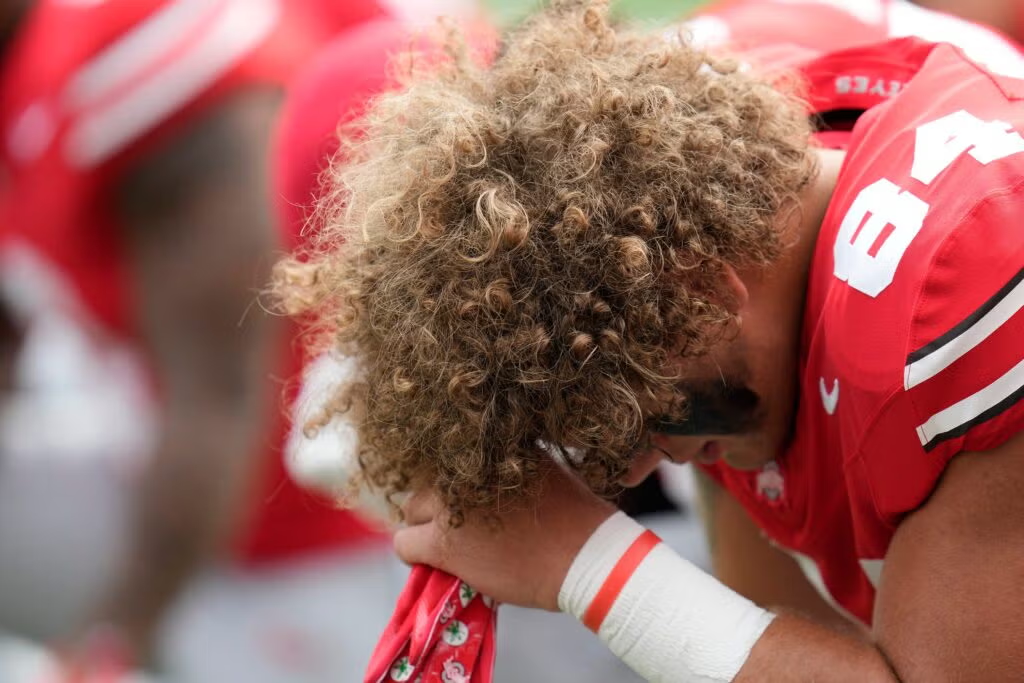
The idea that Arvell Reese emerged “out of nowhere” has made for a convenient storyline in college football circles, but inside Ohio State’s program, that narrative has long been viewed as a misread of both development and preparation. According to the Buckeyes’ coaching staff, Reese’s rise is not a sudden burst onto the scene, but the natural culmination of years of deliberate work, patience, and trust in a system designed to bring players along at the right pace.
In recent weeks, as Reese’s name has gained traction among analysts and fans alike, the phrase “out of nowhere” has been attached to his emergence with increasing frequency. It’s the kind of label that often follows players who were not heavily hyped recruits or who spent time outside the spotlight before delivering impactful performances on the field. But Ohio State’s head coach pushed back firmly against that framing, making it clear that Reese’s development has been anything but accidental.
From the moment Reese arrived in Columbus, there were internal indicators that he possessed the tools to become a key contributor. While he may not have commanded national headlines as a recruit, those within the program saw a player with a rare blend of instincts, athleticism, and coachability. The adjustment from high school to a program with championship expectations is rarely immediate, and Reese’s early time with the Buckeyes followed a familiar trajectory—learning, refining, and waiting.
The coaching staff emphasized that development within elite programs is rarely linear or visible to outsiders. Players often spend months, if not years, sharpening their understanding of schemes, improving their physical readiness, and earning trust in practice settings that never make it to public view. Reese’s path mirrored that reality. While others may have overlooked him during that period, the Buckeyes’ staff consistently noted incremental growth in his performance.
What has stood out most about Reese, according to those closest to the program, is his approach to preparation. Teammates describe him as detail-oriented, someone who absorbs coaching points and applies them quickly. Position coaches have pointed to his film study habits, noting that his ability to anticipate plays has improved dramatically since his arrival. That growth has translated directly to his on-field impact, where he now plays with a level of confidence that reflects both understanding and repetition.
The “out of nowhere” narrative often stems from a lack of visibility rather than a lack of progress. In Reese’s case, much of his early development occurred behind the scenes, away from game-day attention. Injuries, depth chart competition, and the natural rotation of talent within a powerhouse program all contributed to limiting his early opportunities. But rather than stagnating, Reese used that time to build a foundation that is now paying dividends.
Ohio State’s head coach made it clear that Reese’s emergence was anticipated internally, even if it surprised those outside the program. He pointed out that the coaching staff tracks player development closely, evaluating not just game performance but also practice consistency, physical metrics, and mental readiness. Reese consistently checked those boxes, positioning himself for a breakout once the opportunity presented itself.
That opportunity, when it came, was seized decisively. Reese’s performances have been marked by a combination of physicality and awareness, traits that are often difficult to teach but can be refined through repetition and experience. His ability to read plays, react quickly, and execute assignments has made him a reliable presence on the field, earning him increased responsibility within the defensive unit.
Teammates have also played a significant role in Reese’s growth. Veteran leaders within the program have taken note of his work ethic, often citing his willingness to learn and his openness to feedback. In a locker room culture that values accountability, Reese’s mindset has helped him integrate seamlessly and earn the respect of those around him.
The coaching staff has highlighted another key factor in Reese’s development: resilience. Like many players navigating a competitive roster, Reese faced moments of uncertainty early in his career. Limited playing time and the challenge of breaking into the rotation can test a player’s confidence. However, Reese responded by doubling down on his preparation rather than becoming discouraged. That response, according to coaches, is a defining trait that separates those who eventually break through from those who do not.
In addressing the broader narrative, Ohio State’s head coach also pointed to a common misconception in college football coverage. The tendency to label players as “overnight successes” often overlooks the infrastructure and processes that underpin their growth. Strength and conditioning programs, position-specific coaching, and daily practice environments all contribute to shaping players over time. Reese’s journey is a case study in how those elements come together to produce results that may appear sudden but are, in reality, carefully constructed.
Reese’s rise also underscores the importance of depth within elite programs. At Ohio State, competition is constant, and players must earn every opportunity. While that environment can delay immediate playing time, it also ensures that those who eventually step onto the field are well-prepared. Reese’s readiness is a reflection of that system, as he has been able to transition into a larger role without the growing pains that often accompany increased responsibility.
As his profile continues to grow, Reese has remained focused on maintaining the habits that brought him to this point. Coaches have noted that he has not allowed external attention to alter his approach, continuing to prioritize preparation and execution over recognition. That consistency is seen as crucial in sustaining his performance level moving forward.
The dismantling of the “out of nowhere” narrative is not just about correcting a misconception; it also serves as a reminder of the realities of player development at the collegiate level. Reese’s story illustrates that progress is often incremental and that patience, both from players and observers, is essential. For every breakout performance that captures attention, there are countless hours of unseen work that make it possible.
Looking ahead, Reese’s role within the Buckeyes’ defense is expected to expand further. His ability to adapt and his growing confidence suggest that his recent performances are not a peak but rather a baseline for what he can achieve. Coaches believe that he is still developing, with additional layers to his game yet to be fully realized.
The attention surrounding Reese also highlights a broader trend in college football, where the spotlight often shifts quickly and narratives can form rapidly. In such an environment, it becomes easy to simplify complex developmental journeys into catchy phrases. However, as Ohio State’s coaching staff has made clear, those narratives rarely capture the full picture.
Reese’s emergence should instead be viewed through the lens of preparation meeting opportunity. His journey reflects the cumulative effect of consistent effort, structured development, and a willingness to embrace the challenges of a competitive program. It is a testament to both the player and the system that supported his growth.
For Ohio State, Reese’s rise is a validation of their developmental approach. It reinforces the belief that talent, when combined with the right environment and mindset, will eventually surface. The coaching staff’s confidence in Reese long before his breakout performances suggests that they saw this trajectory as inevitable, even if its timing remained uncertain.
As the season progresses, Reese will likely continue to attract attention, both for his on-field contributions and for the narrative surrounding his ascent. However, within the program, there is little concern about external perceptions. The focus remains on continued improvement and collective success, with Reese playing a key role in that pursuit.
In the end, the dismantling of the “out of nowhere” label serves as a broader lesson about how success is perceived in sports. It challenges the tendency to equate visibility with development and highlights the importance of recognizing the processes that occur behind the scenes. Arvell Reese’s story is not one of sudden emergence, but of steady, deliberate growth—an evolution that, while perhaps unseen by many, was always unfolding within the walls of Ohio State’s program.