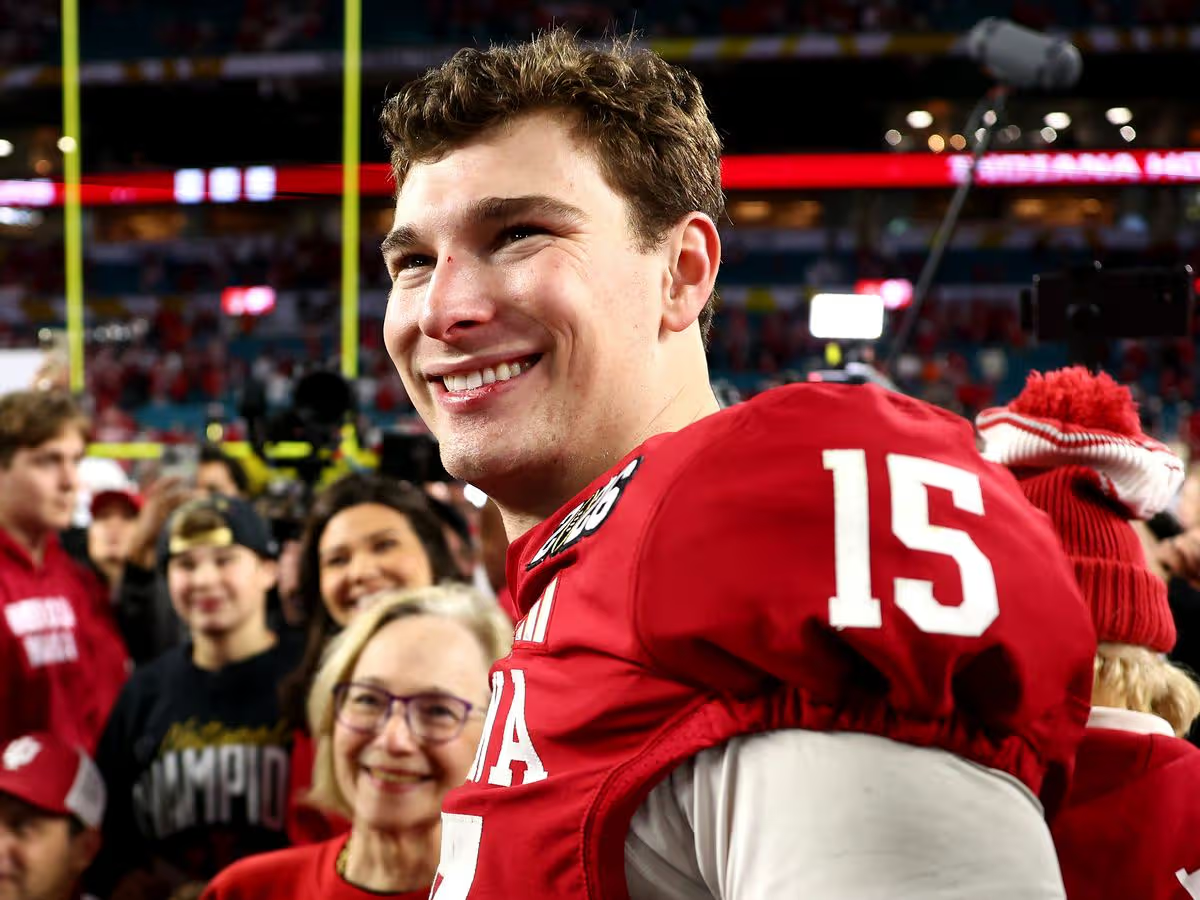
The economics of the National Football League rookie contract system have long been a subject of intrigue, debate, and strategic maneuvering, but few draft cycles in recent memory have spotlighted the financial trajectory of incoming talent quite like the latest class featuring standout prospects from Indiana Hoosiers football. At the center of that conversation is quarterback Fernando Mendoza, whose reported $57.2 million rookie deal has immediately positioned him among the most closely watched first-year players—not only for what he can deliver on the field, but for what his contract signals about the evolving valuation of collegiate production transitioning into professional opportunity.
The rookie wage scale, implemented as part of the 2011 Collective Bargaining Agreement, was designed to bring financial order to a draft system that once allowed unproven players to command massive, franchise-altering deals before taking a single snap. Under the current structure, contracts are largely predetermined by draft position, with limited room for negotiation outside of bonus structure, guarantees, and payment timing. Yet even within those parameters, deals like Mendoza’s illustrate how high draft placement, positional importance, and projected upside converge to create headline-grabbing figures that ripple across front offices and locker rooms alike.
Mendoza’s ascent to a projected $57.2 million contract did not occur in a vacuum. His collegiate career at Indiana was marked by a combination of statistical excellence, composure under pressure, and a leadership profile that resonated with scouts and executives across the league. In an era where quarterback play is not just a premium but the defining currency of success, franchises are increasingly willing to invest heavily—within the confines of the rookie scale—to secure what they believe could be a long-term solution under center. Mendoza’s deal reflects that reality, aligning him with the upper echelon of recent quarterback draftees whose contracts, while structured, still carry immense financial and symbolic weight.
Across the broader spectrum of Indiana draft picks, Mendoza’s contract serves as both a benchmark and a contrast. Other Hoosiers entering the league will sign deals significantly smaller in total value, a reminder of how sharply compensation declines outside the first round. A second-round selection, for instance, might secure a contract worth a fraction of Mendoza’s total, with fewer guarantees and less long-term security. By the time the draft reaches its later rounds, players are often competing not just for roster spots but for financial stability, with contracts that include minimal guarantees and require immediate performance to justify continued investment.
This disparity underscores one of the defining characteristics of the NFL’s rookie pay system: it is as much about hierarchy as it is about opportunity. Draft position dictates not only salary but also expectations, patience from coaching staffs, and the margin for error afforded to a player. Mendoza, by virtue of his contract and presumed draft status, will enter his rookie season with the implicit understanding that he is expected to contribute early and often. His financial commitment from the franchise will translate into opportunities on the field, whether that means starting immediately or being groomed as the heir apparent behind a veteran quarterback.
For teams, the value proposition of a rookie contract—especially at the quarterback position—cannot be overstated. The ability to secure a potential franchise player at a controlled cost for up to five years creates a window of competitive flexibility that savvy organizations exploit aggressively. With Mendoza’s $57.2 million deal likely including a significant portion in guaranteed money, his team will still benefit from a cap structure that allows for roster building around him, investing in offensive weapons, defensive reinforcements, and veteran leadership to accelerate the team’s trajectory.
This dynamic has reshaped team-building strategies across the league. Franchises are increasingly aligning their competitive timelines with the duration of a quarterback’s rookie contract, aiming to maximize success before the inevitable—and often massive—second contract reshapes the salary cap landscape. For Mendoza, this means that his early years in the league will be critical not just for his individual development, but for the broader ambitions of the organization that selected him.
The spotlight on Indiana’s draft class also highlights the growing credibility of programs outside the traditional powerhouses. While schools like Alabama, Ohio State, and Georgia have long dominated draft headlines, Indiana’s emergence as a source of NFL-ready talent speaks to the shifting dynamics of college football development. Mendoza’s contract, in this context, is not just a personal milestone but a reflection of a program that has successfully positioned its players for professional success.
Yet with financial opportunity comes scrutiny. Rookie contracts, particularly those of Mendoza’s magnitude, often become measuring sticks against which performance is judged. Fair or not, the size of a deal can shape public perception, with fans and analysts expecting immediate returns on investment. For quarterbacks, this pressure is magnified, as every throw, decision, and result is dissected in real time. Mendoza will enter the league not only as a promising talent but as a financial commitment that demands validation.
Historically, the transition from college stardom to NFL success has been anything but guaranteed. For every highly paid rookie who fulfills expectations, there are others who struggle to adapt to the speed, complexity, and physical demands of the professional game. The structured nature of rookie contracts mitigates some of the financial risk for teams, but it does not eliminate the competitive consequences of a missed evaluation. Mendoza’s journey will be closely monitored as both a football story and a case study in draft investment.
Beyond Mendoza, the financial breakdown of Indiana’s draft picks offers insight into the broader realities facing incoming players. Signing bonuses, guaranteed money, and contract length vary widely depending on draft slot, but all rookies share a common challenge: proving their worth quickly. Training camp battles, preseason performances, and early regular-season opportunities will determine not only playing time but also long-term security within their respective organizations.
For agents and player representatives, navigating the rookie contract landscape requires a balance of maximizing immediate value and positioning clients for future earnings. While the rookie wage scale limits negotiation, strategic decisions around offset language, bonus structures, and endorsement opportunities can significantly impact a player’s financial outlook. Mendoza’s representation, in securing a deal of $57.2 million, will have focused on optimizing these elements within the league’s framework.
The league itself continues to benefit from the predictability of the rookie pay system. By capping initial contracts, the NFL has created a more stable financial environment, reducing the likelihood of outsized deals for unproven players while ensuring that veterans—who have demonstrated their value—remain the primary recipients of major contracts. This balance has contributed to the league’s overall parity, allowing teams to rebuild more efficiently and maintain competitive balance across markets.
Still, debates persist about whether the rookie wage scale fairly compensates players, particularly those who enter the league as immediate stars. A player like Mendoza, if he performs at a Pro Bowl level early in his career, will be vastly underpaid relative to his market value during the initial years of his contract. This reality has led to increased emphasis on second contracts, extensions, and, in some cases, early renegotiations as teams seek to retain talent while managing cap implications.
For fans of Indiana football, the success of their draft class represents both pride and anticipation. Seeing players transition to the NFL with significant contracts reinforces the program’s credibility and inspires future recruits. Mendoza’s deal, in particular, will serve as a benchmark for what is possible, potentially influencing the decisions of high school prospects evaluating their collegiate options.
As the season approaches, all eyes will be on how these contracts translate into on-field performance. Preseason narratives will quickly give way to regular-season realities, where statistics, wins, and losses ultimately define success. Mendoza’s $57.2 million deal ensures that his progress will be tracked with heightened attention, every milestone and setback analyzed through the lens of expectation.
In the end, rookie contracts are more than just numbers; they are investments in potential, reflections of organizational philosophy, and, for players, the first step in a professional journey that can redefine careers and franchises alike. For Fernando Mendoza and his fellow Indiana draftees, the transition from college standouts to NFL professionals is now framed not only by opportunity but by the financial commitments that signal belief in their ability to succeed at the highest level.