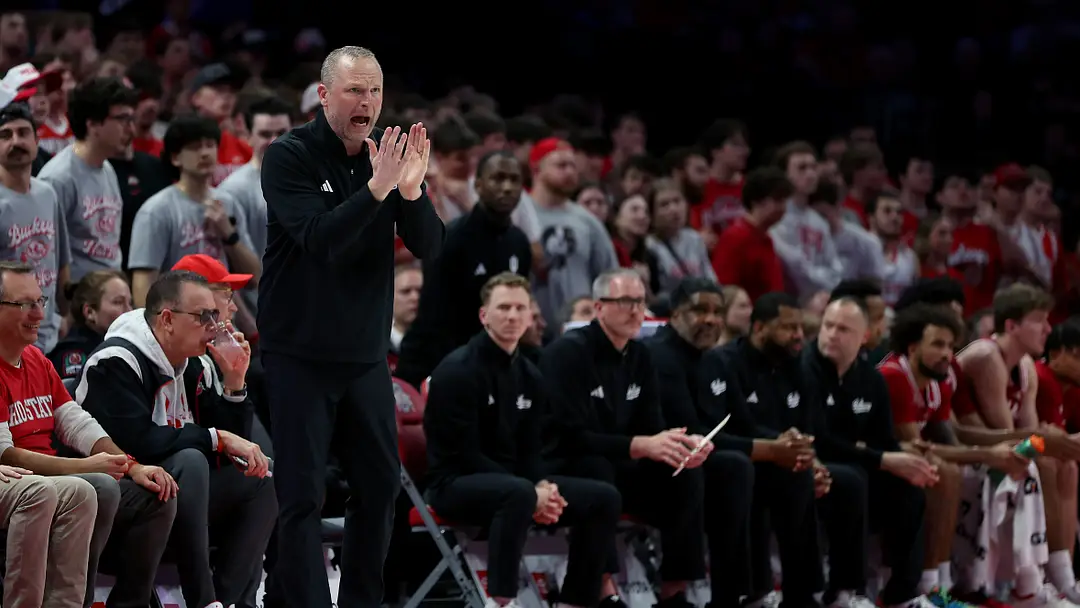
The NCAA Division I Men’s Basketball Tournament is entering a new era of transformation, with officials confirming a long-anticipated expansion that is already sending ripple effects through college basketball. The move, aimed at increasing inclusivity, revenue opportunities, and competitive balance, has sparked widespread debate across the sport. While traditionalists continue to question whether the tournament’s identity could be diluted, many coaches see it as a long-overdue evolution of a product that has become one of the most valuable spectacles in American sports. Among those embracing the change is Indiana University head coach Darian DeVries, who views the expansion not as a disruption but as a door opening wider for programs striving to break through on the national stage.
For DeVries, the timing of the expansion aligns with his broader vision for Indiana basketball. Since taking over the program, he has emphasized rebuilding a culture rooted in discipline, defensive identity, and sustained competitiveness in March. The Hoosiers, a program with one of the richest traditions in college basketball history, have been working to reestablish themselves as a consistent tournament force after years of uneven postseason results. The expanded field, in DeVries’ view, is not simply about more teams getting invited; it is about more opportunities for programs like Indiana to prove their legitimacy on the biggest stage in college basketball.
The NCAA’s decision to expand the tournament field has been driven by a combination of financial incentives, growing demand for postseason participation, and increasing pressure from conferences seeking broader representation. As college basketball continues to evolve in the era of conference realignment and Name, Image, and Likeness (NIL) dynamics, the postseason landscape has become more competitive than ever. Administrators have argued that expansion better reflects the depth of talent across Division I basketball, where deserving teams often find themselves on the outside looking in under the traditional 68-team format.
While the exact structure of the expansion has been the subject of ongoing discussion, the general direction signals more at-large opportunities and additional play-in style matchups designed to accommodate the larger field. For mid-major programs, this could mean a lifeline that was previously unavailable. For power conference teams hovering around the bubble, it could mean fewer season-ending disappointments. And for coaches like DeVries, it represents another variable in the already complex calculus of building a tournament-ready team.
DeVries has not shied away from expressing optimism about what this means for his program. In his view, Indiana’s path back to national relevance is not solely dependent on recruiting rankings or preseason projections, but on the ability to consistently compete for postseason positioning. The expanded tournament, he believes, rewards depth, resilience, and teams that improve over the course of a long season rather than those who rely solely on early-season reputation.
There is also a strategic dimension to how DeVries approaches the change. Known for his analytical coaching style and emphasis on efficiency, he has long studied the margins that determine tournament selection. With expansion potentially altering the threshold for entry, DeVries sees an opportunity to recalibrate how his team approaches non-conference scheduling, conference play, and late-season momentum. Every game, in his framework, carries added weight not just for seeding purposes but for positioning in an increasingly layered selection process.
Indiana’s fan base, among the most passionate in college basketball, has responded with a mix of curiosity and cautious optimism. For a program that measures success in banners and deep March runs, any structural change to the tournament is naturally scrutinized. Yet there is also an understanding that college basketball itself is changing, and that adaptation may be necessary for sustained relevance. DeVries’ steady demeanor and methodical approach have helped stabilize expectations, even as the broader landscape continues to shift beneath him.
Around the Big Ten, reactions have been similarly mixed. Some coaches welcome the possibility of additional tournament representation, particularly in a conference that routinely produces multiple high-quality teams each season. Others worry that expansion could diminish the regular season’s intensity or introduce more variability into postseason qualification. But even among skeptics, there is recognition that the sport is moving in a direction where resistance may be less effective than adaptation.
For players, the expansion adds another layer of motivation. The possibility of extended postseason access can influence everything from team morale to player development trajectories. Veterans on Indiana’s roster have expressed excitement about the chance to extend their seasons deeper into March and potentially April, while younger players see it as an opportunity to experience the pressure of tournament basketball earlier in their careers. DeVries has emphasized that while the field may be larger, the standard of preparation remains unchanged. The expectation at Indiana is not simply to qualify, but to compete with the best programs in the country once there.
National analysts have pointed out that expansion could reshape how bubble teams are evaluated in the final weeks of the regular season. Metrics such as strength of schedule, quadrant wins, and road performance may take on even greater significance as selection committees adjust to the larger field. In this environment, consistency becomes a premium asset. Teams that avoid prolonged losing streaks and demonstrate the ability to win away from home are expected to benefit most.
DeVries’ coaching philosophy aligns closely with those priorities. At previous stops, he built a reputation for producing disciplined teams that maximize possessions and minimize defensive breakdowns. His emphasis on structured offense and adaptable defense has translated into sustained success, even in seasons where talent disparities existed. At Indiana, he is attempting to scale that blueprint within the expectations of a blue-blood program that demands both style and substance.
Recruiting is also expected to be influenced by the expanded tournament. Prospective players often cite NCAA Tournament exposure as a key factor in their decisions, and a larger field could increase the appeal of programs on the rise. DeVries has already leveraged this narrative in recruiting conversations, emphasizing that Indiana is positioning itself not just as a participant in the new era of college basketball, but as a program capable of thriving within it.
Behind the scenes, Indiana’s staff has been evaluating how expansion might affect roster construction. Depth becomes even more critical in a longer postseason structure, where additional games could place greater physical demands on players. Rotational balance, injury management, and late-season conditioning are all areas of increased focus. DeVries has stressed the importance of building a roster that can withstand the grind of both the Big Ten schedule and an extended postseason run.
There is also a broader philosophical question at play: what does the NCAA Tournament represent in its expanded form? For decades, the event has been defined by its exclusivity, where the tension of selection Sunday and the drama of bubble decisions were integral to its identity. Expansion inevitably alters that dynamic. More teams will hear their names called, more fan bases will experience postseason basketball, and more players will have the opportunity to compete on the national stage. But the challenge, according to many within the sport, will be preserving the urgency and unpredictability that have made March Madness a cultural phenomenon.
DeVries acknowledges that tension but remains focused on the competitive realities rather than the nostalgia. In his view, the essence of the tournament is not defined by its size but by its stakes. Whether the field includes 68 teams or more, the objective remains unchanged: survive and advance. That mentality, he believes, is what ultimately separates programs that merely participate from those that contend.
As Indiana continues its preparation for the upcoming season under this evolving framework, the message from its head coach remains consistent. Adaptation is necessary, opportunity is expanding, but expectations remain high. The Hoosiers are not approaching the new tournament structure as a safety net but as a platform. For DeVries, the excitement is not about easier access to March, but about the possibility of proving Indiana’s place within it.
In the broader context of college basketball, the expansion of the NCAA Tournament marks another chapter in a sport undergoing rapid transformation. Between shifting conference landscapes, the rise of NIL-driven recruiting dynamics, and now an enlarged postseason field, the traditional boundaries of the game are being redrawn. Coaches like Darian DeVries find themselves not just managing teams, but navigating an era of structural change that demands both adaptability and vision.
For Indiana, the path forward is clear even if the landscape is not. Compete at a high level, embrace the opportunities created by change, and position the program to take advantage of every additional opening the new system provides. In that sense, the expansion is not an endpoint but a beginning. And for DeVries, it is a beginning he appears more than ready to embrace.