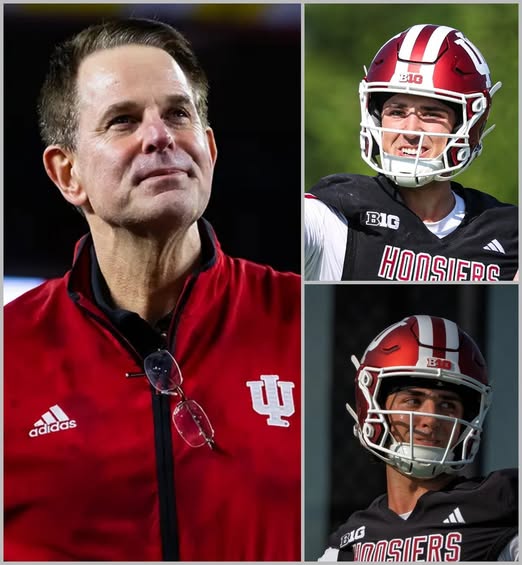
Indiana’s football program is continuing to make noticeable waves on the recruiting trail, and the latest development only strengthens the perception that the Hoosiers are becoming a more serious player in national recruiting battles under head coach Curt Cignetti. The program has reportedly pushed itself into the thick of a competitive race for a coveted four-star linebacker whose recruitment has attracted attention from several established Power Five programs, signaling a shift in how Indiana is being viewed by elite high school prospects.
For years, Indiana has struggled to consistently compete against traditional Big Ten heavyweights when it comes to landing top-tier defensive talent. But the energy around the program has changed significantly since Cignetti took over, with a renewed emphasis on aggressive recruiting, player development, and building a defensive identity that can stand up to the physical demands of Big Ten football. That shift is now showing up in real time, as the Hoosiers find themselves firmly in contention for one of the more highly sought-after linebackers in the 2026 recruiting cycle.
The four-star linebacker at the center of the current recruiting race has become a priority target for multiple programs due to his combination of athleticism, field awareness, and versatility. Evaluators have consistently praised his ability to read offensive formations quickly, shed blocks in space, and cover ground laterally, making him an ideal fit for modern defensive schemes that require linebackers to be both physical and mobile. His skill set has naturally drawn attention from programs with established defensive reputations, but Indiana’s rising involvement has added an unexpected twist to the recruitment.
Sources close to the situation suggest that Indiana’s coaching staff has made significant progress in building a relationship with the prospect and his family, positioning the Hoosiers as more than just an outside contender. That progress is not accidental. Since Cignetti’s arrival, Indiana has made a concerted effort to expand its recruiting footprint beyond traditional regional pipelines, targeting athletes who may have previously overlooked the program in favor of more nationally recognized schools.
What stands out in Indiana’s pursuit is not just the fact that they are in the conversation, but how quickly they have entered it. Recruiting analysts note that the Hoosiers were not initially seen as a major threat in this particular recruitment, but consistent communication, an emphasis on defensive development, and the promise of early playing time have elevated their status. That combination has proven effective in other recent recruiting battles as well, suggesting a broader pattern rather than an isolated case.
The linebacker’s recruitment is expected to come down to a handful of key factors, including defensive scheme fit, player development track record, and the opportunity to contribute early in his college career. Indiana has leaned heavily into all three areas. Under Cignetti’s leadership, the program has emphasized accountability and physicality on defense, aiming to build units that can compete with the upper tier of the Big Ten. That message appears to be resonating with recruits who are looking for both opportunity and development rather than simply prestige.
Competition for the linebacker remains strong, with several traditional powerhouses continuing to monitor his recruitment closely. Programs with established national reputations have long been considered the favorites, largely due to their history of producing NFL-caliber defenders and consistently competing for championships. However, Indiana’s emergence as a legitimate contender has introduced a level of unpredictability that has made the recruitment more compelling than initially expected.
One of the key advantages Indiana is attempting to leverage is the evolving perception of the program under Cignetti’s leadership. Rather than being viewed as a rebuilding project, the Hoosiers are increasingly being seen as a program on the rise, with the potential to compete for meaningful bowl appearances and even disrupt the Big Ten hierarchy in the coming seasons. That narrative is crucial in recruiting battles, particularly when competing for players who want to be part of a transformative era rather than simply joining an established powerhouse.
The coaching staff has also placed significant emphasis on the linebacker position specifically, recognizing the importance of defensive leadership in executing Cignetti’s system. Linebackers are expected to be the backbone of the defense, responsible not only for stopping the run but also for anchoring pass coverage schemes and making real-time adjustments on the field. That level of responsibility has been highlighted in discussions with recruits, including the four-star prospect currently weighing his options.
Insiders familiar with Indiana’s recruiting approach have noted that the program is focusing heavily on authenticity in its pitch. Rather than overpromising immediate championship contention, the staff has emphasized development, opportunity, and the chance to be part of a foundational class that could reshape the program’s trajectory. That approach has resonated with certain recruits who are more interested in long-term growth than short-term hype.
The linebacker himself is said to be taking a measured approach to his recruitment, carefully evaluating each program’s fit both on and off the field. Academic support, coaching stability, and defensive scheme alignment are all believed to be major factors in his decision-making process. Indiana’s ability to present a clear vision under Cignetti has helped the Hoosiers remain firmly in the mix as the process unfolds.
Another factor working in Indiana’s favor is the increased visibility of the program’s recent recruiting success. While still not traditionally considered a recruiting powerhouse, the Hoosiers have begun to land higher-rated prospects in key positions, signaling to others that the program is capable of attracting and developing top-tier talent. That momentum can be critical in multi-school recruiting battles, where perception often plays as large a role as on-field performance.
The broader Big Ten landscape also adds context to Indiana’s push. With conference expansion and increasing national attention, programs are under more pressure than ever to build rosters capable of competing at a high level. For Indiana, securing a four-star linebacker would not only strengthen the defensive unit but also serve as a symbolic win in the ongoing effort to elevate the program’s status within the conference.
Recruiting analysts have pointed out that Indiana’s involvement alone could potentially alter the dynamics of the race. When a program not traditionally associated with elite recruiting enters the picture and remains competitive, it forces other schools to re-evaluate their assumptions about the recruit’s priorities. In this case, Indiana’s persistence has ensured that the linebacker’s recruitment remains fluid rather than predictable.
Much of the credit for Indiana’s improved positioning is being directed toward Cignetti’s leadership style and staff organization. Known for his direct approach and attention to detail, Cignetti has placed an emphasis on building strong relationships with recruits early in the process. That strategy appears to be paying dividends, as Indiana is now regularly appearing on lists of finalists for high-profile prospects.
As the recruitment moves toward its later stages, official visits and in-home discussions are expected to play a decisive role. Indiana is believed to be planning an aggressive push during these windows, aiming to solidify its standing before the linebacker makes a final decision. The coaching staff understands that while they may not enter every race as the favorite, closing strong can often be the difference in competitive recruiting battles.
The significance of this recruitment extends beyond a single player. Landing a four-star linebacker would further validate Indiana’s current trajectory and reinforce the message that the program is capable of competing with established national brands for elite defensive talent. It would also provide a foundational piece for a defense that Cignetti is working to reshape into one of the more disciplined and physically imposing units in the conference.
For now, Indiana remains firmly in contention, a position that would have seemed far less likely in previous recruiting cycles. The combination of strategic recruiting, improved program perception, and Cignetti’s leadership has created a scenario where the Hoosiers are no longer simply participants in high-level recruiting races—they are legitimate challengers.
As the decision timeline approaches, the spotlight will continue to intensify around the four-star linebacker and the programs vying for his commitment. Indiana’s ability to sustain its momentum and translate interest into a signed letter of intent will serve as another important indicator of how far the program has come under Cignetti’s direction and how much further it can go in the evolving landscape of college football recruiting.