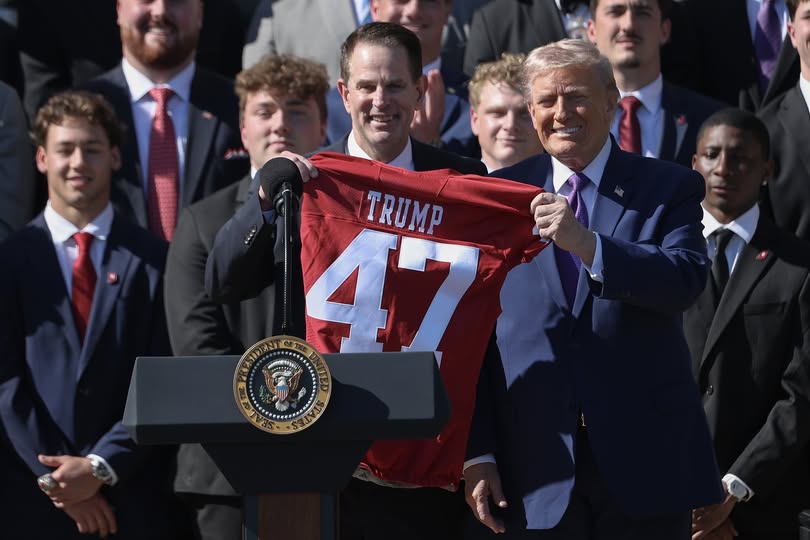
President Donald Trump stood in the East Room of the White House wearing a broad smile as he welcomed the Indiana Hoosiers football for a celebration few around college football ever imagined possible just a few seasons ago. What began as a symbolic championship-style recognition quickly evolved into a lively football conversation, one centered on the remarkable rise of Indiana’s program and the growing number of Hoosiers players earning opportunities across NFL training camps.
Trump, never shy about delivering unscripted reactions during sports ceremonies, appeared genuinely stunned while discussing the amount of Indiana talent currently scattered throughout professional football organizations. As players, coaches, administrators, and invited guests gathered inside the White House, the president repeatedly referenced how rapidly Indiana football had transformed from a rebuilding Big Ten program into a respected pipeline for NFL evaluators.
“I can’t believe how many players you have in NFL camps,” Trump said while addressing the room. “Everywhere I look, another Indiana player is getting a shot. That says something about your culture, your toughness, and your coaching.”
The moment carried extra significance because Indiana football has historically spent decades fighting for relevance inside one of college football’s toughest conferences. Overshadowed for years by perennial powers such as Ohio State Buckeyes football, Michigan Wolverines football, and Penn State Nittany Lions football, the Hoosiers rarely commanded national headlines. Yet the gathering inside the White House reflected a dramatic shift in perception around the program.
Players moved through the reception hall taking photographs, exchanging handshakes, and reflecting on a breakthrough stretch that elevated the school’s national visibility. Coaches who once struggled to convince blue-chip prospects to consider Bloomington now find themselves speaking about postseason expectations, NFL development, and long-term sustainability.
Trump’s appearance with the team created another layer of attention because of the president’s long-running connection to American sports culture. Throughout his public life, Trump has frequently embraced championship teams, major athletes, and headline-grabbing sports moments. This ceremony, however, carried a somewhat different tone. Rather than focusing exclusively on trophies or rankings, much of the conversation centered on opportunity, perseverance, and how Indiana football suddenly became a legitimate launching point for professional careers.
One of the more talked-about moments of the day involved quarterback Fernando Mendoza, who did not attend the White House event in person. Mendoza’s absence quickly sparked speculation online as fans and media members wondered whether scheduling conflicts, football obligations, or other issues kept him away from Washington. Instead of allowing the situation to become a distraction, Mendoza reportedly called into the celebration and spoke with teammates and staff remotely, a gesture that helped maintain the positive atmosphere surrounding the visit.
Sources close to the program indicated Mendoza had prior commitments connected to offseason preparation, but his phone appearance reassured teammates who praised the quarterback’s leadership throughout the offseason. Players inside the room reportedly laughed and cheered as Mendoza addressed the gathering, offering congratulations while expressing disappointment about missing the occasion.
The quarterback’s absence may ultimately become a minor footnote compared to the larger story emerging around Indiana football’s national momentum. For years, NFL scouts viewed the program as a place where individual prospects occasionally surfaced but rarely as a roster loaded with professional depth. That perception appears to be changing rapidly.
Several Hoosiers players have either signed with NFL organizations, earned rookie minicamp invitations, or entered training camp battles following the program’s recent surge in competitiveness. League executives have increasingly praised Indiana’s player development, conditioning standards, and physical style of play. While Indiana still lacks the overwhelming NFL production numbers routinely generated by traditional college football powers, evaluators now speak about the program with growing respect.
That respect became obvious during Trump’s remarks. The president repeatedly emphasized the importance of programs producing disciplined athletes capable of competing professionally. At one point during the ceremony, Trump joked that Indiana’s coaching staff might soon need “an NFL office” inside its football facility because of how often scouts appear around the program.
The room responded with laughter, but beneath the humor sat a legitimate football truth. Indiana’s transformation has become one of the more fascinating developments in the modern college football landscape.
Only a handful of years ago, the Hoosiers were primarily discussed in terms of close losses, rebuilding timelines, and questions surrounding long-term direction. Recruiting battles often ended before they truly began, especially against heavyweight programs with playoff histories and massive national followings. Yet through strategic recruiting, transfer portal success, coaching continuity, and an aggressive culture shift, Indiana slowly repositioned itself.
The rise coincides with broader changes across college athletics. NIL opportunities, conference realignment conversations, and expanded national exposure have created openings for programs once considered secondary football destinations. Indiana capitalized on that environment by targeting overlooked athletes and emphasizing development over star rankings.
Inside the White House gathering, several players reflected on how dramatically external perceptions changed during their careers. Veterans who arrived on campus amid skepticism now leave believing the Hoosiers can consistently compete on the national stage. Younger players, meanwhile, inherit a program carrying far greater expectations than previous generations experienced.
Trump appeared particularly interested in hearing stories about players who overcame adversity before reaching NFL camps. According to attendees, conversations during the event frequently touched on resilience, discipline, and the emotional journey required to survive modern college football. Coaches described athletes who arrived as under-recruited prospects only to develop into professional candidates through relentless work.
That narrative has become central to Indiana’s identity.
Unlike powerhouse schools loaded annually with five-star recruits, Indiana’s rise has often been built around internal growth. Strength programs, film study, accountability systems, and veteran leadership became defining elements of the locker room culture. NFL organizations increasingly value those traits because developmental players capable of adapting quickly frequently become valuable roster pieces.
Trump, who has long branded himself around competitive mentality and winning culture, seemed captivated by those themes. During portions of his remarks, he compared Indiana’s persistence to underdog stories common throughout American sports history. He praised the coaching staff for building what he called “a serious football operation” capable of attracting NFL attention.
The White House celebration also highlighted how college football success now extends beyond championships alone. Programs increasingly measure progress through professional placement, recruiting traction, national exposure, and institutional investment. Indiana’s growing NFL presence represents validation that the program’s infrastructure changes are producing measurable results.
For the players in attendance, the visit represented more than ceremonial recognition. Many spoke afterward about the surreal feeling of walking through the White House while reflecting on their football journeys. Some remembered arriving on campus during uncertain periods when bowl eligibility itself felt ambitious. Now they were celebrating national relevance inside one of the world’s most recognizable buildings.
The symbolism mattered.
College football remains deeply intertwined with American culture and politics, and White House visits often become moments where athletic achievement intersects with national visibility. Indiana’s invitation signaled recognition that the program’s story resonated beyond traditional regional audiences.
Social media reactions to the event varied widely, particularly regarding Mendoza’s absence and Trump’s involvement. Some fans focused on the quarterback’s decision not to attend physically, while others defended his commitment to offseason preparation. Many supporters instead concentrated on the larger accomplishment: Indiana football commanding enough attention to warrant a White House spotlight.
Across sports talk shows and digital platforms, analysts discussed whether Indiana’s NFL pipeline can become sustainable. Skeptics argued that maintaining momentum inside the Big Ten remains extraordinarily difficult given the financial and recruiting advantages held by elite programs. Supporters countered that the modern college football landscape increasingly rewards culture, development, and smart roster construction as much as traditional recruiting dominance.
The truth likely falls somewhere between those viewpoints.
Indiana still faces enormous challenges competing annually against established national contenders. Recruiting battles remain intense. Expectations continue rising. Success brings pressure, scrutiny, and heightened public attention. Yet the program’s trajectory undeniably looks different from previous eras.
NFL scouts now attend practices more frequently. Recruits speak openly about professional aspirations while considering Indiana. National broadcasts discuss the Hoosiers with seriousness rather than novelty. Those shifts matter in shaping long-term program identity.
Trump’s reaction during the ceremony captured that broader sense of surprise surrounding Indiana’s emergence. Even individuals deeply connected to sports culture appear taken aback by how quickly the Hoosiers expanded their professional footprint.
Several players reportedly used the opportunity to network with guests and discuss future ambitions beyond football. Coaches emphasized education, leadership, and personal development throughout the visit, reinforcing the idea that Indiana’s transformation extends beyond wins and losses.
Meanwhile, Mendoza’s remote participation ultimately seemed to strengthen team unity rather than divide attention. Teammates described the quarterback as engaged and supportive despite his absence, and staff members appreciated his effort to remain involved during an important milestone for the program.
His role moving forward may prove critical as Indiana attempts to sustain national momentum. Quarterback play often defines modern college football success, particularly in the high-scoring environment dominating the sport today. Mendoza enters the upcoming season facing heightened expectations not only because of his talent but because he symbolizes the program’s evolving ambitions.
If Indiana continues sending players into NFL opportunities while remaining competitive inside the Big Ten, the White House celebration could eventually be remembered as a turning point — the moment national perception fully shifted.
Programs across college football spend decades chasing legitimacy. Some achieve brief success only to fade quickly once key players depart. Others build foundations strong enough to alter long-term reputations. Indiana’s challenge now involves proving its rise belongs in the second category.
Inside the White House, however, those future questions temporarily gave way to celebration.
Players posed beside presidential podiums. Coaches exchanged stories with officials and guests. Families reflected on sacrifices that helped shape football careers. Trump continued marveling at the number of Hoosiers entering NFL environments, repeatedly returning to the same central point: Indiana football suddenly matters in ways many never expected.
For longtime supporters of the program, hearing those words inside the White House likely felt surreal.
The Hoosiers have endured generations of frustration, heartbreak, coaching turnover, and national irrelevance. Fans remained loyal through difficult seasons largely because they believed meaningful progress remained possible. Recent developments suggest that belief may finally be paying off.
Whether Indiana ultimately becomes a permanent Big Ten power remains uncertain. College football’s landscape changes rapidly, and sustaining success requires constant adaptation. Yet the program’s ability to place players into NFL camps has already altered external perception in powerful ways.
Professional opportunity remains one of the sport’s strongest recruiting tools. Young athletes want evidence that programs can prepare them for the next level. Indiana increasingly possesses that evidence.
As the White House ceremony concluded, players gradually filtered out carrying commemorative memories and renewed confidence about the program’s direction. The event blended politics, football, culture, and symbolism into a uniquely modern sports moment — one where a historically overlooked program stood at the center of national attention.
And perhaps the most revealing part of the day came through Trump’s repeated disbelief.
Not disbelief that Indiana had talented players.
Not disbelief that the team earned recognition.
But disbelief at just how many Hoosiers now occupy NFL camps across the country, turning what once looked impossible into a rapidly growing reality for Indiana football.