If you want to understand the direction of the Ohio State football program’s offensive identity in the coming years, you do not start with the quarterbacks or the skill-position stars. You start in the trenches, where recruiting momentum often moves quietly but determines everything else. That reality was reinforced again this week with the commitment of Davis Seaman, a four-star interior offensive lineman out of Bishop Watterson in Columbus, who became the fifth offensive lineman to join the Ohio State Buckeyes’ 2027 recruiting class.
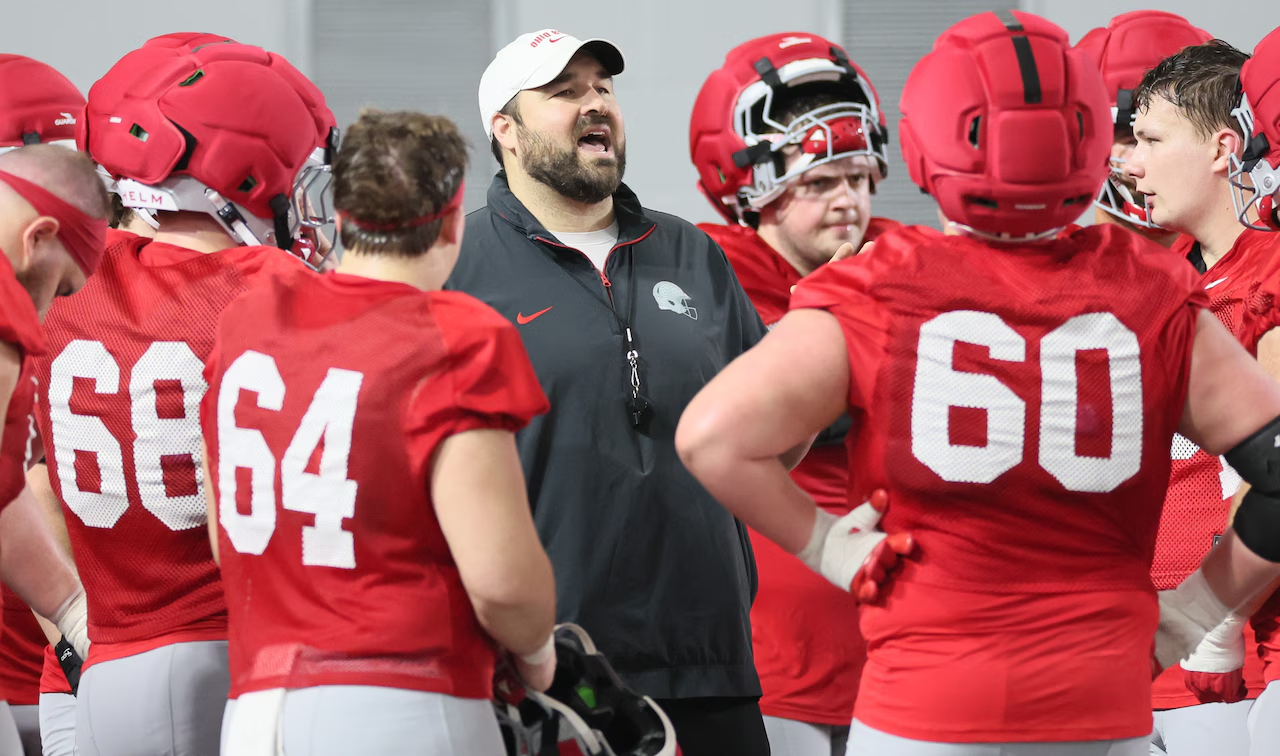
On the surface, it is another in-state commitment for a program that routinely dominates Ohio high school recruiting. But zoom out just a bit, and the picture becomes much more significant. Seaman’s pledge is not an isolated win; it is a data point in what is rapidly becoming one of the most line-heavy recruiting classes Ohio State has assembled in recent memory. It is also a reflection of how coach Tyler Bowen and head coach Ryan Day are reshaping their offensive line philosophy around versatility, projection, and long-term roster construction rather than traditional position labeling.
Seaman, listed at 6-foot-4 and 290 pounds, enters the national recruiting conversation as the No. 404 overall player, the No. 21 interior offensive lineman in the country, and the No. 15 prospect in Ohio. He plays right tackle at Bishop Watterson, a program known for producing fundamentally sound linemen, but his future at the collegiate level is already being projected inside. That distinction is important, not because it limits him, but because it highlights the modern evaluation process Ohio State is leaning into more aggressively than ever.
The commitment also pushes Ohio State to five offensive line pledges in the 2027 cycle out of a total of 11 commitments overall. Nearly half of the class is now dedicated to offensive linemen, a figure that would have been unusual even a few recruiting cycles ago but is increasingly becoming a strategic blueprint for elite programs trying to stabilize line play over the long term.
That development was a focal point on the latest Buckeye Talk podcast episode, where analysts Stefan Krajisnik and Andrew Gillis broke down Seaman’s commitment and its broader implications. Their discussion was less about hype and more about structural philosophy, particularly how Ohio State is building offensive linemen who are not tied down to one specific role before they even arrive on campus.
Krajisnik set the tone by outlining Seaman’s profile and ranking, emphasizing both his physical tools and his standing within Ohio’s talent pool. The significance of being a top-15 player in the state cannot be overstated for Ohio State, a program that has built its championship aspirations on locking down local talent first and supplementing nationally. At 290 pounds already in high school, Seaman fits the prototype of a player who can develop into multiple interior roles depending on how his body evolves once he enters a college strength program.
But it was Gillis who pushed the conversation into the broader evaluative philosophy Ohio State is now embracing. He pointed out a common challenge in recruiting offensive linemen at the high school level: the overwhelming tendency for elite prospects to play tackle regardless of where they will eventually project in college.
“When you recruit offensive linemen, you typically watch these Hudl highlight tapes and you watch all these different clips, and everybody’s playing left tackle. Or everybody’s playing right tackle, because that’s where you put your best lineman. And pretty much every single time, these kids are the best lineman,” Gillis explained.
That reality creates a projection problem for college programs. Evaluators are forced to determine not just whether a player is dominant at the high school level, but whether that dominance translates to a different position against faster, stronger, more technically refined competition. In Seaman’s case, Ohio State sees a player who can start outside but likely settles inside, where leverage, power, and short-area movement matter more than pure lateral protection against edge rushers.
That is where the influence of Bowen becomes especially clear. As Gillis put it during the discussion, “This is a Tyler Bowen group if I’ve ever seen one.”
Bowen’s approach, as described by those around the program and reinforced by recruiting outcomes, centers on positional flexibility rather than rigid assignments. The idea is not simply to recruit guards, tackles, and centers as separate categories, but to recruit offensive linemen as adaptable athletes capable of shifting roles as needed. That philosophy gives Ohio State something it has often lacked in recent seasons: the ability to adjust quickly when injuries, development curves, or depth chart realities force midstream changes.
“I guess the phrase would be positional flexibility. It gives you the versatility to look at this and say, ‘We can put our best five on the field because we feel confident that this is a kid where he will get to Ohio State and we can figure it out,’” Gillis said.
That line captures the essence of what Ohio State is attempting to build. Rather than forcing prospects into rigid positional boxes at age 17 or 18, the staff is prioritizing athletic profiles and developmental ceilings. Once players arrive in Columbus, the staff then works to determine where each lineman fits best within the broader five-man unit.
It is a philosophy that aligns closely with modern offensive football at the highest levels, where versatility along the line is often the difference between sustainable success and inconsistent protection. NFL teams have leaned heavily into this model, and college programs like Ohio State are increasingly following suit.
There is also precedent within the program itself. Players such as Austin Siereveld, referenced during the podcast discussion, illustrate how movement along the line can be a strength rather than a setback. Siereveld’s development trajectory has included position adjustments based on team needs and personal growth, reinforcing the idea that offensive line success at Ohio State is not dependent on where a player starts, but where he ultimately settles after development.
That adaptability is becoming a core selling point in recruiting. Ohio State can now tell offensive line prospects that early position labels are less important than earning one of the five best spots on the field. For elite recruits, that message is powerful because it ties playing time directly to performance rather than recruiting-star hierarchy or predetermined depth charts.
Head coach Ryan Day and Bowen are effectively reframing the offensive line conversation in Columbus. Instead of promising early positional certainty, they are offering something more appealing to many top recruits: a genuine opportunity to compete for a role that best suits their development once they are in the building.
Within that framework, Seaman fits cleanly. His experience at right tackle gives him exposure to pass protection fundamentals, footwork against edge pressure, and the ability to anchor against speed-based rushers. But his projected move inside suggests Ohio State sees him more as a guard who can use his size and strength in confined spaces, where leverage and hand placement define success.
The broader implications of this recruiting class cannot be ignored either. With five offensive linemen already committed, Ohio State is building depth in a way that addresses one of its most scrutinized position groups over the past several seasons. Offensive line play has often been the subject of national discussion whenever the Buckeyes have faced elite defensive fronts, particularly in high-stakes postseason games where protection and run-game consistency are tested at the highest level.
By front-loading the 2027 class with linemen, Ohio State is effectively insulating itself against those future concerns. It also ensures that by the time this group arrives on campus, competition within the room will be intense enough to produce multiple viable starters at each position along the line.
That internal competition is not accidental. It is part of a broader roster-building strategy that relies on volume, versatility, and development timelines that overlap across multiple recruiting cycles. The goal is not simply to land elite prospects, but to ensure that every cycle produces players who can either start or provide immediate rotational depth.
For Seaman, the path forward now shifts from recruitment to development anticipation. His senior season at Bishop Watterson will be watched closely, not just for performance, but for signs of physical and technical growth that might further refine his positional projection. Once he arrives in Columbus, his transition into Ohio State’s strength and conditioning program will likely determine how quickly he can compete for meaningful snaps.
The recruiting momentum also serves as a reminder of Ohio State’s continued dominance within its home state. Securing a top-15 Ohio prospect reinforces the program’s ability to keep elite talent within state lines, even as national recruiting competition intensifies.
And while individual commitments often dominate headlines, the deeper story here is structural. Ohio State is not just collecting offensive linemen. It is building a system designed to maximize flexibility, absorb injuries, and produce consistent line play across multiple seasons.
That is the context in which Seaman’s commitment should be understood. It is not simply about adding another four-star prospect to the board. It is about reinforcing a philosophical shift that prioritizes adaptability over rigid positional identity.
As Krajisnik and Gillis emphasized throughout their breakdown, this class is shaping up to look different from what Ohio State has assembled in the past at the offensive line position. Whether that difference translates into on-field success will ultimately depend on development, coaching, and execution once these players arrive on campus.
But the foundation is being laid now, one commitment at a time, with Davis Seaman serving as the latest piece in a growing blueprint for how Ohio State wants to build its offensive front in the years ahead.