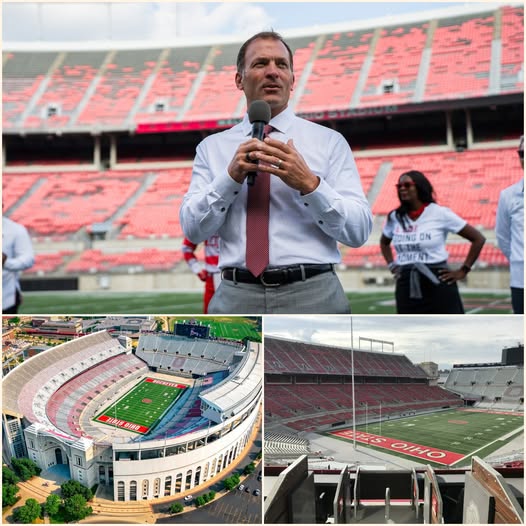
Ross Bjork officially unveiled plans for a staggering $5.6 billion renovation project centered around the iconic Ohio Stadium, a proposal that would become one of the most ambitious athletic infrastructure projects in sports history if fully realized.
The announcement instantly captured national attention not only because of the eye-popping financial commitment but also because of what it symbolizes for the future of collegiate athletics. At a time when universities across the country are adapting to NIL expansion, conference realignment, escalating media rights deals, and growing pressure to modernize facilities, Ohio State’s proposed project appears designed to place the Buckeyes at the forefront of the next generation of sports entertainment.
Speaking before a packed gathering of university trustees, boosters, alumni, media members, and state officials, Bjork described the project as more than a renovation. He called it “a complete reimagining of the Ohio State athletic experience,” emphasizing that the vision stretches far beyond football Saturdays in Columbus. According to Bjork, the long-term plan aims to transform the stadium district into a year-round economic and entertainment hub capable of hosting national championship events, concerts, global sporting showcases, esports competitions, fan festivals, and community events.
The proposed renovation would dramatically reshape the historic stadium while preserving much of the architectural identity that has made the Horseshoe one of college football’s most recognizable venues. Renderings unveiled during the presentation showcased sweeping luxury additions, expanded concourses, upgraded premium seating areas, immersive digital technology, massive hospitality spaces, and futuristic fan engagement features designed to rival the atmosphere of NFL stadiums and international sporting venues.
Bjork emphasized repeatedly that the vision is rooted in balancing tradition with innovation. He acknowledged the emotional connection generations of Ohio State fans have with the stadium while arguing that modernization is necessary to keep pace with the changing economics of elite college athletics.
“This is not about replacing history,” Bjork said during the unveiling. “This is about elevating history into the future.”
The scope of the project reportedly includes major upgrades to seating infrastructure, expanded tunnel access, new athlete recovery facilities, premium suites, interactive museums celebrating Buckeye history, and a redesigned exterior entertainment plaza expected to attract tourism throughout the calendar year. Plans also include advanced sustainability initiatives involving renewable energy systems, water conservation technology, and environmentally conscious construction designs.
Industry experts immediately began comparing the proposal to some of the largest stadium development projects ever attempted in American sports. While exact funding details remain under evaluation, university officials indicated that the project would likely rely on a combination of private donations, corporate partnerships, long-term sponsorship agreements, premium seating revenue, naming-rights opportunities, state economic initiatives, and athletic department financing structures.
The proposed investment reflects the extraordinary financial power currently surrounding major college football programs, particularly those positioned within the expanding Big Ten ecosystem. With media rights deals continuing to explode and universities competing aggressively for national relevance, facilities have become central to recruiting battles, branding, donor engagement, and long-term revenue generation.
Ohio State has long been considered one of the crown jewels of college athletics, consistently ranking among the nation’s most profitable and recognizable programs. Yet Bjork made it clear during his presentation that standing still is no longer an option in the modern landscape.
“The future belongs to the programs willing to evolve,” he said. “And Ohio State intends to lead.”
The announcement quickly generated widespread reaction throughout the sports world. Analysts praised the ambition of the proposal while others questioned whether college athletics has entered an era of spending that risks fundamentally altering the identity of university sports. Social media erupted with debate as fans attempted to process the sheer scale of the proposed investment.
Some supporters viewed the announcement as proof that Ohio State remains committed to maintaining championship standards both on and off the field. Others expressed concerns about the optics of billion-dollar athletic spending during a time when universities nationwide continue facing academic funding challenges and rising educational costs.
Still, the project represents a continuation of a broader trend sweeping across elite college sports. Programs across the country are investing heavily in infrastructure as the competition for recruits, television audiences, and national prestige intensifies. Massive locker rooms, cutting-edge training centers, athlete lounges, nutrition facilities, and luxury seating areas have increasingly become standard expectations among top-tier programs.
Bjork, who arrived at Ohio State with a reputation as one of college athletics’ most aggressive administrators, framed the renovation as an investment not only in athletics but also in economic development and institutional visibility. University officials projected that the expanded stadium district could generate billions in long-term economic activity for Columbus and surrounding communities through tourism, hospitality partnerships, employment opportunities, and large-scale event hosting.
Several local business leaders attending the announcement praised the proposal as a potential game-changer for the city’s national profile. Comparisons were made to entertainment districts developed around professional sports venues in cities such as Atlanta, Los Angeles, and Dallas. University representatives suggested the completed project could transform the area surrounding the stadium into one of the premier sports and entertainment destinations in the Midwest.
The renovation proposal also arrives during a period of enormous transformation within college football itself. The sport has experienced unprecedented shifts in recent years, including conference expansion, NIL compensation, transfer portal movement, playoff restructuring, and escalating television contracts. Athletic departments are under increasing pressure to operate more like professional sports organizations while still maintaining their collegiate identity.
For Ohio State, maintaining national dominance requires constant adaptation. The Buckeyes remain one of the sport’s premier brands, consistently competing for College Football Playoff appearances while attracting elite recruiting classes and generating enormous fan engagement nationwide. Bjork argued that infrastructure investments are now inseparable from competitive success.
Modern recruits, he explained, expect world-class facilities comparable to professional franchises. Fans demand enhanced game-day experiences driven by technology, comfort, accessibility, and entertainment. Corporate partners seek premium hospitality opportunities capable of generating year-round business relationships. According to Bjork, the renovation project is designed to meet all of those evolving expectations simultaneously.
One of the most talked-about elements of the proposal involves immersive fan technology. Preliminary renderings featured enormous high-definition display systems, augmented reality experiences, interactive mobile integrations, and advanced crowd-engagement features designed to create a more dynamic environment inside the stadium. Officials hinted that artificial intelligence and personalized digital services could eventually become integrated into the fan experience.
The project also includes plans for expanded athlete performance spaces. According to university officials, the renovation would create one of the largest integrated sports performance complexes in college athletics, featuring advanced sports science laboratories, recovery centers, nutrition programs, mental wellness resources, and medical research partnerships.
Former Buckeye players attending the announcement described the proposal as evidence of Ohio State’s determination to remain at the forefront of college football’s evolution. Several alumni praised the administration for attempting to position the program not only as a powerhouse of the present but also as a long-term leader in the future landscape of athletics.
The announcement inevitably sparked comparisons to professional sports stadiums known for luxury and spectacle. Analysts noted similarities between aspects of the proposal and recent NFL venue developments, including entertainment plazas, premium hospitality experiences, and mixed-use commercial integration. Some observers argued that the line separating elite college football environments from professional sports continues to blur more each year.
Yet despite the enormous ambition surrounding the project, significant questions remain unanswered. Financial experts immediately began scrutinizing how such a massive undertaking could be funded responsibly. Critics questioned whether escalating infrastructure spending across college athletics is sustainable in the long run, particularly as legal and political pressures continue mounting around athlete compensation models.
Others raised concerns regarding potential impacts on ticket pricing and accessibility for longtime fans. Ohio Stadium has long been celebrated for its electric atmosphere and deeply loyal fan base, and some supporters worry that increasing premium seating and corporate hospitality areas could gradually alter the traditional game-day environment.
Bjork acknowledged those concerns during the announcement and insisted preserving fan culture remains a priority. He emphasized that maintaining accessibility for students and longtime supporters is central to the planning process. University officials stated that sections preserving traditional seating experiences would remain part of the stadium’s design.
Even with those assurances, debate surrounding the commercialization of college sports is unlikely to disappear. The financial scale of the project reflects the extraordinary revenue potential associated with elite football programs, but it also underscores growing tensions about the direction of collegiate athletics as a whole.
Throughout the presentation, however, university leaders consistently framed the renovation as an opportunity to strengthen Ohio State’s overall institutional influence. Officials argued that major athletic success drives national exposure, alumni engagement, fundraising opportunities, and student interest across multiple academic areas. According to administrators, the stadium project represents a broader investment in the university’s future brand positioning.
Construction timelines remain tentative, though early projections suggest the project would unfold in multiple phases over several years. University officials indicated efforts would be made to minimize disruptions to football operations and fan attendance during renovation periods. Some phases may reportedly occur during offseason windows while others could involve temporary seating adjustments.
The scale of the proposal means regulatory approvals, financing structures, architectural planning, and logistical coordination will all play crucial roles moving forward. Still, the unveiling itself sent a powerful message to the rest of the college sports world: Ohio State intends to remain one of the defining giants of modern athletics.
The announcement also further elevated Bjork’s national profile as one of the most influential administrators in collegiate sports. Known for his aggressive approach to branding, expansion, and program development, Bjork has consistently emphasized innovation throughout his leadership career. This proposal may ultimately become the defining initiative of his tenure at Ohio State.
Reaction from rival fan bases ranged from admiration to disbelief. Some praised the ambition and vision behind the project, while others criticized what they viewed as excessive spending in an increasingly commercialized college sports environment. Analysts across television networks and digital platforms debated whether the proposal represents the future of major college athletics or a warning sign of escalating financial competition.
Regardless of perspective, few disputed the historical significance of the announcement itself. Stadium projects of this scale are rare even in professional sports, and the notion of a university athletic department pursuing a $5.6 billion transformation immediately altered the national conversation surrounding collegiate infrastructure investment.
For Buckeye fans, the proposal represents both excitement and expectation. Ohio State already possesses one of the most passionate followings in American sports, and the possibility of transforming the Horseshoe into a futuristic mega-venue only intensified anticipation surrounding the program’s future. Many supporters viewed the announcement as confirmation that the university remains fully committed to competing at the highest possible level for decades to come.
As details continue emerging, the proposal will undoubtedly face scrutiny, debate, and intense public discussion. Questions surrounding funding, priorities, execution, and long-term impact will dominate headlines throughout the coming months. Yet the announcement itself already accomplished something significant: it captured the attention of the entire sports world.
In an era where college football increasingly resembles a global entertainment enterprise, Ohio State’s proposed stadium transformation may ultimately become one of the defining symbols of the sport’s next chapter. Whether viewed as visionary ambition or evidence of runaway commercialization, the scale of the proposal ensures it will remain one of the most talked-about developments in college athletics for years to come.
And as cameras flashed and applause echoed throughout the presentation hall, Bjork stood at the center of a moment that felt larger than a simple renovation announcement. It was a declaration of intent, a statement of power, and perhaps most importantly, a glimpse into the rapidly evolving future of college sports itself.