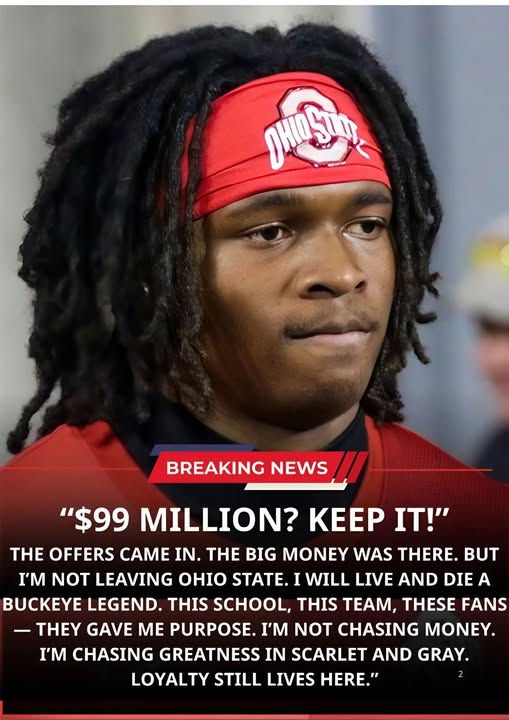
The moment Jeremiah Smith reportedly turned down staggering NIL opportunities from rival programs and reaffirmed his commitment to the Ohio State Buckeyes, the reaction across college football was immediate and explosive. In an era where the transfer portal and NIL deals have transformed the sport into a year-round recruiting battlefield, loyalty has become one of the rarest commodities in the game. That is why Smith’s decision sent shockwaves through locker rooms, fan bases, and coaching staffs nationwide.
For many around the sport, the development represented something larger than a star player staying put. It became a statement about culture, legacy, and the changing identity of college football itself. At a time when elite athletes are routinely presented with life-changing financial offers to leave established programs, Smith’s commitment to Ohio State instantly elevated him from emerging superstar to symbolic figure inside the Buckeyes program.
The former five-star recruit arrived in Columbus carrying enormous expectations. Widely regarded as one of the most gifted wide receiver prospects in recent recruiting history, Smith was expected to become the next great playmaker in a program that has built a reputation for producing elite NFL-caliber receivers. From the moment he stepped on campus, comparisons followed him everywhere. Coaches praised his maturity. Teammates raved about his work ethic. Analysts pointed to his rare blend of size, speed, body control, and explosiveness as traits usually reserved for future first-round draft picks.
But while his talent made headlines, it was his recent decision that transformed the conversation around him.
According to reports circulating around the college football landscape, Smith had opportunities to explore offers that would have dramatically increased his NIL earnings elsewhere. Programs across the country continue to aggressively pursue elite talent, often using massive financial packages as recruiting leverage. Yet despite the growing pressure and the reality of modern college athletics, Smith chose stability over uncertainty and loyalty over leverage.
Inside Columbus, the reaction bordered on euphoric. Ohio State supporters have watched college football enter a new era where roster continuity has become increasingly difficult to maintain. Stars leave unexpectedly. Recruiting classes change overnight. Transfer portal departures reshape championship expectations in a matter of days. Against that backdrop, Smith’s public commitment felt like reassurance that some foundational elements of the sport still matter inside the Buckeyes program.
For head coach Ryan Day, the decision also represented a major cultural victory. Day has faced mounting scrutiny in recent seasons despite maintaining one of the nation’s strongest programs. The pressure surrounding Ohio State is relentless. Winning ten games is not enough. Recruiting top-five classes is not enough. In Columbus, championships define legacies, and every season without a national title intensifies the criticism.
Keeping a player like Smith inside the program therefore carries significance far beyond a single roster move. It reinforces Ohio State’s ability to retain elite talent amid a rapidly changing environment. It also signals that players still believe in the direction of the program despite outside noise and growing expectations.
Within the locker room, Smith’s decision reportedly resonated deeply with teammates. Veteran leaders understand how quickly NIL negotiations and transfer speculation can become distractions during a season. Having one of the program’s biggest stars publicly recommit to the Buckeyes sends a message about collective belief. It creates momentum internally while strengthening the idea that Ohio State’s championship ambitions remain intact.
Around college football, reactions were far more divided.
Some fans celebrated Smith as a throwback competitor who prioritized team loyalty and development over short-term financial gain. Supporters pointed to Ohio State’s long track record of producing NFL receivers and argued that staying in Columbus ultimately gives Smith the best chance to maximize both his collegiate legacy and professional future. Others viewed the situation differently, questioning whether college athletes should ever feel pressure to reject larger financial opportunities in a system that now openly operates like professional sports.
That debate reflects the broader identity crisis currently unfolding across college athletics. NIL has dramatically altered recruiting dynamics, empowering athletes to capitalize on their value while simultaneously reshaping competitive balance nationwide. Some programs have adapted quickly by building aggressive collectives capable of competing financially for elite recruits. Others have leaned heavily on culture, development, and tradition to retain talent.
Ohio State has attempted to balance both approaches. The Buckeyes possess one of the strongest brands in college football, enormous national exposure, elite facilities, and a pipeline to the NFL that few programs can match. Still, even powerhouse programs are no longer immune to roster instability. Every major school now understands that recruiting never truly stops, even after a player signs and enrolls.
That reality is what made Smith’s decision so striking.
The timing also amplifies the importance of the story. Expectations surrounding Ohio State entering the upcoming season are already immense. The Buckeyes are once again projected as national championship contenders, and Smith is expected to play a central role in the offense. His combination of explosiveness and physical dominance gives Ohio State another potentially devastating weapon in a system designed to maximize elite receiver talent.
Opposing defensive coordinators already recognize the challenge he presents. Smith possesses the ability to stretch defenses vertically while also dominating contested catches in traffic. His acceleration after the catch creates matchup nightmares, and his physicality makes him difficult to disrupt at the line of scrimmage. Coaches around the country have quietly acknowledged that players with his overall ceiling rarely become available through recruiting cycles.
That is precisely why rumors of outside interest generated so much attention.
In many ways, the situation became a litmus test for the modern state of college football. Could a major program retain one of its brightest young stars despite escalating NIL competition? Could loyalty still exist within a system increasingly driven by mobility and financial negotiation? Ohio State ultimately received the answer it desperately wanted.
For Buckeyes fans, the emotional response has been intense because Smith represents more than production. He symbolizes hope for a fan base desperate to reclaim the top spot in college football. Rival programs have celebrated recent national championships while Ohio State continues chasing a title that supporters believe should already belong to them. Every elite player who stays committed to the program becomes part of that larger mission.
Smith’s decision may also carry recruiting implications beyond this season. High school prospects closely watch how programs handle star players, culture, and development. Seeing a player of Smith’s caliber publicly embrace Ohio State could strengthen the Buckeyes’ recruiting pitch moving forward. Young athletes notice which programs create long-term trust and stability in an otherwise chaotic landscape.
At the same time, the decision will inevitably increase pressure on both Smith and the Buckeyes entering the season. When a player publicly rejects enormous outside opportunities, expectations skyrocket immediately. Fans now expect Smith to become one of the defining faces of college football. Every touchdown, every big-game performance, and every critical moment will receive amplified attention.
That scrutiny comes with the territory of being an elite athlete at Ohio State. The Buckeyes operate under a national spotlight unlike almost any other program in sports. Every game becomes headline material. Every setback becomes controversy. Every championship pursuit carries emotional weight across an enormous fan base.
Smith appears unfazed by that environment.
Those around the program have repeatedly described him as unusually composed for a player his age. Coaches have praised his discipline in practice. Teammates have pointed to his confidence without arrogance. That maturity may be one of the biggest reasons Ohio State believes he can thrive under mounting expectations.
The Buckeyes also understand that retaining Smith strengthens their offensive identity significantly. Ohio State has consistently produced explosive offenses under Day, particularly at the quarterback and receiver positions. The presence of a dynamic playmaker changes defensive game plans entirely. Opponents must account for Smith on every snap, which creates opportunities for the rest of the offense.
In championship-level football, those details matter enormously.
One elite receiver can tilt critical games. One explosive play can define a season. Ohio State believes Smith has the potential to become the next transformational star in a lineage that already includes several NFL standouts.
National analysts have already begun projecting him as a future top draft prospect, even though his collegiate career is still unfolding. Scouts consistently rave about his physical profile and advanced route-running ability. More importantly, many believe his ceiling remains extraordinarily high because of how early he has developed within Ohio State’s system.
That future potential undoubtedly influenced the attention surrounding outside NIL interest. Programs across the country understand that transcendent talents can alter championship trajectories overnight. Securing a player like Smith would have represented a massive recruiting victory for any contender. Losing him would have been equally devastating for Ohio State.
Instead, the Buckeyes emerged with one of the biggest off-field wins of the offseason.
The story has also reignited discussions about how fans evaluate athlete decisions in the NIL era. Some critics argue that loyalty narratives unfairly romanticize choices that are ultimately business decisions. Others insist that staying committed to a program still carries emotional and cultural significance that transcends money. Smith’s situation became a focal point because it sits directly at the intersection of those competing viewpoints.
Regardless of where people stand in that debate, the outcome undeniably matters for the upcoming season.
Ohio State enters the year with championship expectations, enormous pressure, and little margin for error. Rival programs such as Michigan Wolverines, Georgia Bulldogs, and Alabama Crimson Tide continue competing aggressively for national supremacy. The expanded playoff format has raised stakes across the sport, intensifying every recruiting battle and roster decision.
Within that environment, retaining a generational talent like Smith feels like a defining moment for Ohio State’s trajectory.
It also provides Ryan Day with a powerful counterargument against critics questioning the program’s direction. Elite players generally do not remain fully committed to unstable situations. Smith’s loyalty suggests belief inside the locker room remains strong despite external pressure and constant scrutiny.
Whether that belief ultimately translates into championships remains to be seen.
College football history is filled with offseason optimism that never survives the grind of a full season. Injuries, rivalry games, playoff pressure, and national expectations can rapidly reshape narratives. Yet there is no denying that Smith’s decision injected fresh energy into Ohio State’s championship pursuit.
For now, Buckeyes fans are celebrating a victory that extends far beyond recruiting rankings or NIL headlines. In a sport increasingly defined by uncertainty, they watched one of the nation’s brightest stars choose continuity, commitment, and belief in the program’s future.
And in today’s college football landscape, that kind of loyalty may be more valuable than ever.