The pressure inside the walls of Ohio State Buckeyes has never truly disappeared, but this offseason it has taken on a sharper, louder, almost combustible tone. Every quote is dissected. Every recruiting battle is framed as a referendum. Every transfer portal addition is treated like either a championship puzzle piece or evidence that something fundamental is still missing. Into that atmosphere walked Ryan Day with a statement that immediately detonated across college football.
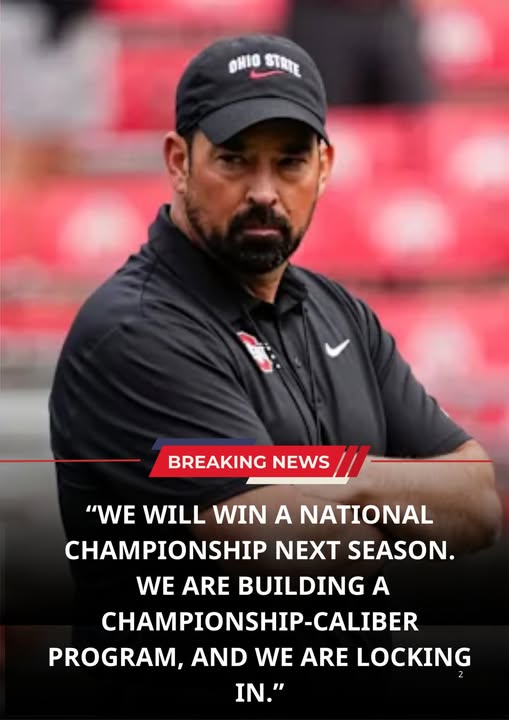
“We will win a national championship next season.”
Not “we can.” Not “we believe.” Not “that’s the goal.” Day delivered the kind of declaration that coaches at powerhouse programs often avoid because of the risk attached to it. At a place like Ohio State, ambition is expected. Certainty is dangerous.
And yet certainty was exactly what Day offered.
Within minutes, the quote spread through social media timelines, sports television debates, message boards, podcasts, and alumni circles from Columbus to every corner of the college football landscape. Some Buckeye fans celebrated the statement as the long-overdue voice of a coach tired of hearing doubts about his toughness, his ceiling, and his ability to finish the biggest games. Others saw it as reckless theater from a program that has repeatedly come close to ultimate glory without securing it in the modern championship era under Day’s leadership.
For rivals, the reaction was immediate and predictable. Supporters of Michigan Wolverines mocked the proclamation as arrogance. Fans tied to Penn State Nittany Lions questioned whether Ohio State had earned the right to speak with that level of certainty after recent disappointments. Around the broader sport, analysts split into two camps: those who viewed the quote as championship-level accountability and those who believed Day had unnecessarily handed ammunition to critics waiting for the slightest stumble.
What makes the moment so fascinating is not simply the quote itself, but the timing behind it.
This is not a coach speaking from a position of unquestioned dominance. This is not Nick Saban at the height of Alabama Crimson Tide rule, casually projecting confidence because multiple championships already sit in the trophy case. This is a coach operating under relentless scrutiny despite an elite winning percentage, multiple playoff appearances, and consistent top-five recruiting classes.
That contradiction defines Ryan Day’s tenure.
At almost any other program in America, Day’s résumé would be celebrated without hesitation. He has won at a staggering rate. He has produced elite offenses, developed NFL talent, and kept Ohio State firmly in the national title conversation year after year. Yet at Ohio State, excellence alone is insufficient. Championships are the standard. Beating Michigan is non-negotiable. Close calls are remembered almost as painfully as collapse.
That is why the quote landed with such force.
To supporters still fully behind Day, the statement sounded like conviction. They heard a coach refusing to coach scared. They saw a leader publicly embracing expectations instead of hiding behind clichés about “taking it one game at a time.” In their eyes, this was Ohio State reclaiming its swagger after years of watching critics frame the program as mentally fragile in the sport’s defining moments.
Those fans point to the roster as evidence that Day’s confidence may not be empty bravado. The Buckeyes are once again loaded with elite talent. Recruiting pipelines remain among the strongest in the nation. The transfer portal has supplied immediate-impact players. The defense appears deeper, faster, and more experienced. The quarterback room carries intrigue. The receiver corps continues to look like an NFL assembly line. Inside the Woody Hayes Athletic Center, there is a genuine belief that the roster is capable of winning every game on the schedule.
From that perspective, Day merely said aloud what championship programs are supposed to believe privately.
But the other side of the divide is equally passionate.
For frustrated Ohio State fans, the quote represented something entirely different: another massive promise before the hardest part arrives. Their frustration is not rooted in mediocrity. It is rooted in proximity. Ohio State has repeatedly been close enough to touch the summit only to fall short at the most painful moments.
Losses to Michigan changed the emotional temperature around the program. Playoff disappointments deepened the anxiety. Every elite program carries pressure, but at Ohio State the emotional math is brutal. One loss can overshadow ten victories. A missed championship opportunity can redefine an otherwise elite season.
That reality is why some fans believe Day’s words created an unnecessary burden.
If Ohio State wins the national championship, the quote instantly becomes iconic. It transforms into the defining soundbite of a coach who challenged everyone — opponents, doubters, even his own fanbase — and delivered. It becomes documentary material. It becomes locker-room mythology. It becomes the moment Day officially crossed from elite coach to unquestioned program legend.
But if Ohio State falls short, especially in another high-profile game against Michigan or in the College Football Playoff, the quote will follow every discussion surrounding the program for years.
That is the gamble Day knowingly accepted.
Modern college football thrives on extremes. Coaches are no longer judged solely by wins and losses; they are evaluated through branding, messaging, and perception cycles that move at internet speed. Every statement becomes content. Every expression becomes a meme. Day’s declaration was tailor-made for that environment because it left no room for ambiguity.
There is also a deeper psychological layer to the moment.
For years, critics outside Columbus have attempted to paint Day as too measured, too careful, too polished. Fair or unfair, some have contrasted him with the edge and emotional intensity associated with old-school Big Ten football culture. His latest declaration shattered that image. It was direct. Defiant. Confrontational, even.
In many ways, it sounded like a coach who has grown tired of hearing that success without a national title is failure.
That frustration is understandable when viewed through the numbers. Very few programs in America have maintained Ohio State’s consistency. Very few coaches survive the week-to-week intensity of leading one of college football’s most scrutinized brands while still winning at an elite level. Yet the Buckeyes exist in a rare category where greatness is expected so routinely that even extraordinary seasons can feel incomplete.
The expanded playoff era may only intensify those expectations. With more opportunities to reach the postseason, fanbases increasingly expect talent-rich programs like Ohio State to break through regularly. Falling short no longer feels like an unfortunate outcome. To some supporters, it feels like squandered opportunity.
Day’s quote, then, was not simply a prediction. It was an attempt to seize control of the narrative before the season even begins.
Instead of allowing pundits to frame Ohio State as vulnerable, he framed the Buckeyes as inevitable.
That distinction matters.
Inside locker rooms, players often respond to certainty. Athletes at elite programs rarely want caution from leadership. They want belief. They want clarity. They want to feel that their coach sees championship potential rather than merely hoping for it. Public confidence can create private momentum, especially in a sport where emotional energy frequently shapes entire seasons.
At the same time, confidence without results becomes combustible.
That is why the quote has divided even former players and longtime Ohio State supporters. Some admire the boldness. Others fear the consequences. They know the standards attached to the scarlet and gray. They know every stumble will now be magnified through the lens of Day’s own words.
Imagine the atmosphere if Ohio State opens the season slowly. Imagine the reaction if Michigan wins again. Imagine the scrutiny surrounding every late-game coaching decision in a playoff matchup. The quote will not disappear. It will live alongside every major moment.
And perhaps that is exactly what Day wanted.
There is a growing sense that college football’s biggest programs increasingly reward emotional force as much as tactical precision. Coaches are expected to recruit like CEOs, motivate like psychologists, and communicate like media personalities. Silence can be interpreted as weakness. Caution can be interpreted as uncertainty.
Day chose the opposite route.
He planted a flag publicly and attached his reputation to it.
The fascinating part is that many around the sport quietly believe Ohio State truly does possess championship-level talent. Rival coaches respect the roster. Analysts continue ranking the Buckeyes among the nation’s elite contenders. NFL scouts remain deeply embedded in the program because of the sheer volume of professional-caliber athletes.
The gap between Ohio State and a national championship has not usually been talent. It has been moments.
One drive. One defensive stop. One missed field goal. One fourth-quarter collapse. One rivalry game that spiraled emotionally. In programs operating at the sport’s highest tier, history often swings on razor-thin margins.
That reality is what makes Day’s declaration both compelling and dangerous.
He is not promising the impossible. He is promising the hardest thing in college football.
Winning a national championship requires health, chemistry, timing, depth, quarterback play, emotional resilience, and sometimes pure luck. A single injury can derail everything. A single turnover can erase an entire season’s work. Even historically dominant teams often need fortunate breaks to survive the playoff gauntlet.
Yet Day spoke with absolute certainty anyway.
In Columbus, that certainty has reignited a fanbase emotionally exhausted from living between hope and frustration. Some supporters are ready to run through walls after hearing their coach speak so boldly. Others are bracing for heartbreak because they have seen how unforgiving modern college football can be.
Either way, indifference is gone.
That may ultimately be the hidden power behind the statement. Ohio State now enters the season with unmistakable emotional stakes. Every game will feel connected to the promise. Every victory will reinforce belief. Every close call will raise tension. The season has already acquired the feel of a national drama before a snap has even been played.
For Day personally, the coming months may define his legacy more than any stretch of his coaching career.
If the Buckeyes break through, the narrative surrounding him changes permanently. The criticisms about big-game shortcomings soften. The doubts about championship pedigree fade. The Michigan conversations lose some sting. His confidence becomes proof of leadership rather than evidence of arrogance.
But if the season ends short of the title once again, the backlash will be merciless because he ensured the standard would be measured against nothing less than a championship.
That is the risk of speaking in absolutes at a program built on absolutes.
Still, there is something undeniably captivating about a coach refusing to hide from expectations. In an era overflowing with carefully rehearsed coach-speak, Ryan Day delivered something raw enough to shake the sport’s emotional landscape. Whether it becomes prophecy or regret remains unknown.
What is certain is this: college football will remember the quote.
And now, so will Ohio State every time it takes the field.