Archie Griffin, the Only Two-Time Heisman Winner, is Fighting His Toughest Battle Off the Field
In the fall of 1974, Archie Griffin carried the ball 239 times for 1,620 yards and twelve touchdowns, leading the Ohio State Buckeyes to Pasadena and himself to the Downtown Athletic Club to accept the Heisman Trophy. A year later, he did it again, becoming the only man in college football history to win the sport’s most prestigious award twice. He made a career of evading tackles, powering through defensive lines for extra yardage and staying upright when physics dictated he should fall. His durability was legendary, his balance unparalleled. But right now, the fight isn’t on the gridiron. It’s not against Michigan or in the Rose Bowl. It’s a personal battle away from the public eye, one that has the entire Ohio State community—and the sport he helped define—holding its breath.
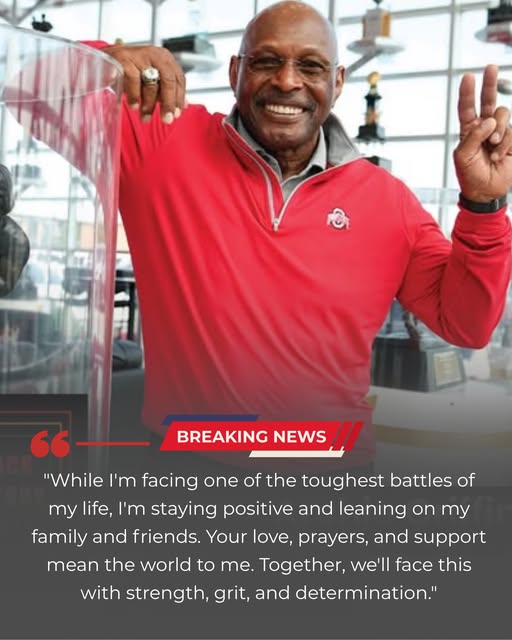
While Archie Griffin has always been a beacon of strength for the Buckeye faithful, recent developments suggest that the 71-year-old legend is facing serious health challenges that have prompted a quiet but urgent call for support from the very fans who have revered him for half a century. The details remain private, as is Griffin’s reserved nature, but sources close to the athletic department have indicated that the former running back is navigating a significant medical situation. In an era where athletes’ health is often treated as public property, Griffin and his family have chosen a path of dignified privacy, but the message coming from Columbus is clear: the man who gave everything to Ohio State needs the faithful to rally around him.
Griffin’s connection to the university and its supporters transcends the typical athlete-alumni relationship. It is a bond forged in the crucible of Big Ten football during the Woody Hayes era, defined by an unprecedented consistency that still stands as an NCAA record. He rushed for at least 100 yards in 31 consecutive regular-season games—a streak that seems almost fictional in the modern era of specialized defenses and rotational backfields . As his former running backs coach Mickey Jackson once put it, the magic wasn’t just in his speed, but in his balance. “How long can I stay up? How long can I maintain my balance and continue on for a score?” Jackson recalled Griffin asking. “You’ll see quite often that he’d stumble two or three times and pick up another 20 yards” . That refusal to go down is the defining characteristic of his playing career. That resilience is what the Buckeyes are hoping he channels now.
Griffin’s accomplishments are not just statistical anomalies; they are foundational stones of Big Ten and NCAA lore. At 5-foot-9, he was hardly an imposing figure, yet he carried the ball an average of 20 times a game without ever missing a contest in his collegiate career . He amassed 5,589 rushing yards for the Scarlet and Gray—still a school record—and led the Buckeyes to a 40-5-1 record and four Big Ten titles between 1972 and 1975 . He earned three All-American selections and remains one of only three players to win the Chicago Tribune Silver Football as the Big Ten’s MVP twice . His 239-yard performance against North Carolina in just his second game as a freshman signaled the arrival of a generational talent. “It’s not the size of the dog in the fight,” he would often say, echoing a mantra that encapsulated his career, “it’s the size of the fight in the dog” .
Perhaps no player in Buckeyes history has been as embraced by the university. In August 2024, a statue of Griffin was unveiled and dedicated in the Court of Champions at Ohio Stadium, and he was the first to “Dot the I” in Script Ohio as a former player during a pregame ceremony . Last summer, he was honored as the first “bell ringer” for a new pregame tradition, striking the bell to fire up the crowd before a showdown with Texas . These aren’t just ceremonial gestures; they are acknowledgements of a legacy that defines Ohio State football. As President Walter “Ted” Carter Jr. said at the statue dedication, “Archie has always represented the best of what being a Buckeye is all about” . Ryan Day, the current head coach, echoed that sentiment, praising Griffin as an example for his players to emulate due to his community impact and “unmatched class” .
Yet, despite this public adoration, Griffin has always been a figure of quiet strength. In the recent unsealed depositions regarding the Dr. Richard Strauss sexual abuse case, Griffin testified that he had no knowledge of the misconduct that occurred during his tenure in the athletic department. He began working at Ohio State in 1985 and spent years overseeing various programs. “Everybody doesn’t hear everything about everyone,” Griffin stated during his deposition, a phrase that encapsulates his desire to stay out of the spotlight while fulfilling his duties to the university . He told lawyers he never witnessed inappropriate behavior and denied rumors surrounding Larkins Hall. While the case is a dark chapter in Ohio State history, Griffin’s testimony painted a picture of a man focused on his work, avoiding the gossip and controversy that swirled around him. He was there to do a job, just as he was on the field in the ’70s.
The news of Griffin’s current health struggles arrives just months after he was actively discussing the state of the game. In May of this year, Griffin was quoted in the Sports Business Journal weighing in on the expanded College Football Playoff and its impact on the Heisman Trophy. “I’ve always felt the more, the better, because it gives more people the opportunity to become a national champion,” Griffin said. “I’m all for that. But, at the same time, I also wouldn’t want to lose the traditions that have made college football what it is… The Heisman certainly is one of those” . The duality of that statement is striking: a legend open to evolution but protective of the sacred. Now, the fight to preserve tradition has shifted to a fight for health.
Griffin’s life has been defined by collisions. He took on linebackers, defensive linemen, and the relentless grind of a 1970s Big Ten schedule. As his center, Steve Myers, recalled, “More than one guy had to bring him down” . Those hits take a toll, but Griffin has always bounced back—whether it was from a brutal game against Illinois or the scrutiny of being the nation’s most celebrated player. He often spoke about the support of his family, particularly his parents James and Margaret, who worked tirelessly to raise their ten children in Columbus after leaving West Virginia coal country . That family foundation, grounded in resilience and hard work, is what has always carried him. “He took a beating,” Jackson admitted. “But he did it for the love of the game and for the Buckeyes.”
For a generation of Ohio State fans, Archie Griffin is more than a footnote in a media guide; he is the embodiment of the program’s ethos. In an era where players are often defined by their speed or size, Griffin was defined by his heart and his character. He is the only player to win the Heisman twice, a feat that makes him a permanent outlier in the history of the sport. With the 50th anniversary of his first Heisman just two years away, the university had planned to celebrate his legacy in a major way . But the focus has shifted from celebration to support.
The history of college football is littered with greats who struggled after their playing days ended. For Griffin, he used his post-football career to give back, serving as the Associate Director of Athletics and later the President and CEO of the Ohio State Alumni Association. He represented the university with the same dignity he displayed on the field. But right now, the scoreboard is not in his favor. This is a fourth-and-long situation. The Buckeye Nation, which has been so quick to honor him with statues and bell-ringing ceremonies, must now circle the wagons.
As ESPN senior sports analyst and former NFL executive Mike Tannenbaum said in an analysis of player wellness, “The transition from the spotlight to normal life is often the hardest challenge an athlete faces. For a guy like Griffin, who was practically worshipped, the physical and emotional toll of that separation—combined with life’s other challenges—is something that requires a support system.”
The Ohio State community is known for its intensity. It is a fan base that boos its rivals with glee and cheers its heroes with ferocity. Now is the time for that energy to be channeled into support for a man who gave the university its greatest moments. Griffin never asked for help on the football field; he just kept his legs churning and refused to fall. But this fight is different. It requires a village. It requires the prayers and support of everyone whose lives he touched, even if only through a grainy highlight reel of a No. 45 charging through a hole in the Horseshoe.
He is a native son of Columbus, born at University Hospital, raised in the city, a Buckeye through and through. The fight ahead is one that statistics cannot predict and a defense cannot stop. It’s a personal battle, and for the first time, he cannot do it alone. The only two-time Heisman winner has never had to face an opponent like this. But if the love of a fan base means anything, he won’t have to face it alone.