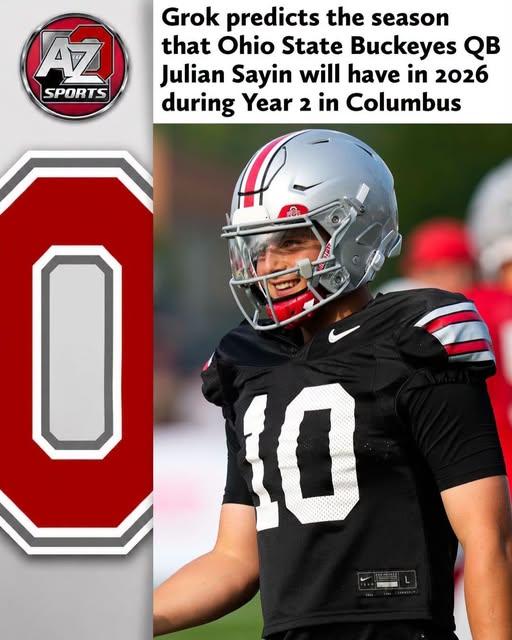
COLUMBUS, Ohio — Julian Sayin’s second season as Ohio State’s starting quarterback already carries the weight of a championship expectation. Now, an artificial-intelligence simulation has put numbers to that pressure, projecting a season that would place Sayin firmly in the national player-of-the-year conversation and potentially deliver another College Football Playoff championship to Columbus.
Grok’s simulation of Ohio State’s 2026 season forecasts Sayin will complete 285 of 440 passes for 3,450 yards, 35 touchdowns and nine interceptions. The model projects a 64.8% completion rate — a significant decline from the extraordinary 77.0% Sayin posted as a first-year starter — but compensates with more touchdown production and another 3,000-plus-yard passing season.
The larger prediction is even more ambitious: Ohio State goes 12-1 before the postseason, wins the Big Ten championship, earns the No. 2 seed in the College Football Playoff and ultimately defeats Georgia 28-24 in the national championship game. Grok has Sayin leading the decisive drive in the title game.
That is not a forecast that should be mistaken for a scouting evaluation or a statistical projection generated from a conventional football model. It is an AI simulation. But it is notable because the scenario reflects the expectations surrounding Sayin and Ohio State entering a season in which anything short of a serious national championship run will be viewed as a disappointment.
Sayin has already established a remarkable statistical baseline.
As a redshirt freshman in 2025, the former five-star prospect completed 301 of 391 passes for 3,610 yards, 32 touchdowns and eight interceptions in 14 games. His 76.98% completion rate led the nation and established a Big Ten record, while his 177.45 passer rating ranked second nationally. His passing yardage ranked fifth in Ohio State single-season history.
Those numbers matter because the biggest question entering Year 2 isn’t whether Sayin can operate an efficient passing game. He already demonstrated that.
The question is whether he can become the quarterback who consistently wins the games Ohio State will be judged by.
The final two games of 2025 provided the clearest warning. Ohio State entered the Big Ten Championship undefeated before falling to Indiana, then lost to Miami in the College Football Playoff. The Buckeyes finished 12-2, leaving the program with a second consecutive CFP appearance but no championship to show for it.
That changes the context surrounding Sayin’s sophomore campaign.
He is no longer the young quarterback replacing an NFL-bound starter. He is the established face of one of the most talented rosters in the country.
Ohio State enters 2026 ranked No. 1 in the preseason coaches poll after receiving 38 first-place votes. The Buckeyes also return four of five offensive-line starters, while Sayin again has All-American-caliber wide receiver Jeremiah Smith operating as his primary weapon.
Smith’s presence could be particularly important to determining whether Grok’s projection is remotely attainable.
Over the past two seasons, Smith has accumulated 2,558 receiving yards and 27 touchdown receptions, both more than any other player in the country over that span, according to Ohio State. He also enters 2026 with 163 receptions.
Grok projects an even bigger season from him: 82 catches, 1,420 yards and 16 touchdowns.
That would give Sayin one of the most dangerous vertical and intermediate receiving threats in college football, while also allowing Ohio State to attack defenses horizontally with spacing concepts, play-action and RPO elements.
But the most consequential change for Sayin could come from the man designing the offense.
Ryan Day hired Arthur Smith as Ohio State’s offensive coordinator in January. Smith brings 17 years of NFL experience to Columbus, including two seasons as the Pittsburgh Steelers’ offensive coordinator and previous experience as Tennessee’s offensive coordinator and Atlanta’s head coach.
Smith’s arrival gives Sayin another layer of development at a pivotal point in his career.
The Buckeyes aren’t simply trying to reproduce what worked in 2025. They are attempting to make the offense more difficult to defend against elite opponents.
That could mean a greater emphasis on play-action, pre-snap motion, multiple personnel groupings and a more physical run game designed to force defenses to commit additional defenders to the box. It also could create more favorable one-on-one opportunities for Smith and Ohio State’s other receivers.
For Sayin, the challenge will be translating that structure into explosive production without sacrificing the accuracy and decision-making that made his freshman season so impressive.
The Grok projection actually offers an interesting contradiction.
A 64.8% completion percentage would be a major regression from Sayin’s 77.0% mark in 2025. Yet the model simultaneously gives him 35 touchdown passes, three more than he threw last season.
That could indicate a quarterback taking more aggressive shots downfield rather than simply operating as a high-efficiency distributor.
And that may be exactly what Ohio State needs.
Sayin’s 2025 rushing numbers also left room for improvement. He finished the season with 42 carries for minus-44 rushing yards, with sacks contributing to the negative total. The ability to create positive yardage when coverage breaks down could become important in 2026, particularly against defenses capable of winning with four-man pressure.
The distinction is critical. Ohio State doesn’t need Sayin to become a Lamar Jackson-style runner. It needs him to punish defenses when they turn their backs in coverage.
A quarterback who can convert third-and-7 with his legs, escape a collapsing pocket or steal five yards in the red zone forces defensive coordinators to account for another gap.
That becomes particularly important in the postseason.
Grok’s simulation has Ohio State losing to Texas 35-28 in Week 2 before winning 11 straight games, including victories over Indiana, USC, Oregon and Michigan. The Buckeyes then defeat Oregon 35-28 in the Big Ten Championship before beating Penn State and Texas in the CFP.
Whether those individual predictions materialize is almost beside the point.
The schedule illustrates the level of quarterback play Ohio State will require.
Texas represents an early measuring stick. Oregon looms as another potential playoff-caliber opponent. Indiana remains relevant after handing Ohio State its most damaging loss of 2025. Michigan remains the rivalry game that can define the regular season.
The Big Ten is no longer a conference in which Ohio State can simply overwhelm most opponents with superior talent and wait for the postseason.
The league’s expansion has increased the number of high-level programs, and Oregon, Indiana, USC, Michigan and Penn State all represent meaningful obstacles in different ways.
That makes Sayin’s efficiency under pressure arguably more important than his raw statistical totals.
There is also an NFL dimension to the story.
Sayin is not draft-eligible in the traditional sense of being an immediate 2027 NFL Draft entrant without considering the specific rules surrounding his college eligibility, but his 2026 season will inevitably be evaluated through the lens of professional quarterback projection. Scouts will examine his arm strength, processing speed, pocket manipulation, anticipation, accuracy outside structure and ability to create when the first read is unavailable.
A second season in Smith’s offense should provide a larger sample of those traits.
The financial dynamics are different from the NFL, where quarterback contracts and salary-cap implications directly shape roster construction. College football’s modern economic landscape instead revolves around revenue sharing, NIL resources and roster management. Ohio State’s ability to retain elite talent around Sayin is therefore an important part of the equation, particularly as the Buckeyes continue operating at the highest level of the sport’s new financial ecosystem.
For now, however, the most important number attached to Sayin is not 3,450, 35 or 64.8.
It is 2025.
He already proved he could play.
He completed nearly 77% of his passes, threw for 3,610 yards, produced 32 touchdowns and became a Heisman Trophy finalist. He won his first 12 starts and established himself as one of the nation’s most efficient passers.
Year 2 is about proving that production can survive the weight of expectation.
Grok sees a quarterback who takes another step, leads Ohio State through a brutal schedule, wins the Big Ten and finishes the job that the 2025 team could not.
The machine predicts 3,450 yards and 35 touchdowns.
Ohio State will ultimately care about something much simpler: whether Julian Sayin is holding the trophy when the season ends.