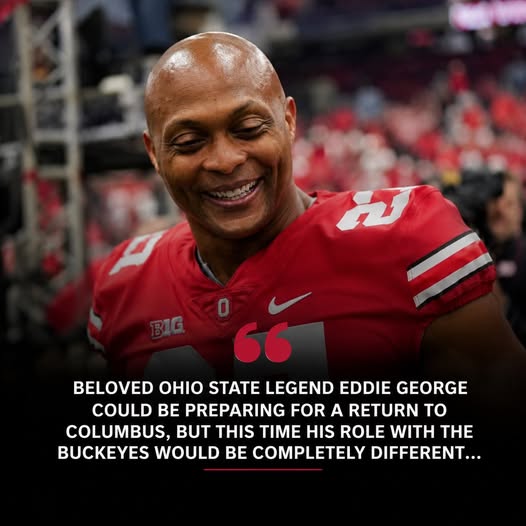
The possibility of Eddie George returning to Columbus would immediately stir something deeper than nostalgia across Buckeye Nation.
For Ohio State fans, George is not simply another former All-American whose name belongs in the program’s record book. He represents one of the defining eras of modern Buckeyes football. He was the bruising centerpiece of John Cooper’s offense, the winner of the 1995 Heisman Trophy and the running back whose combination of power, patience and relentless workload made him one of the most recognizable players in college football.
Now, with George firmly established in the coaching profession, the prospect of a return to Ohio State would carry a dramatically different meaning.
This would not be Eddie George coming back to Columbus to be honored at midfield, to wave to a packed Ohio Stadium or to relive the season that made him a national star. If a future opportunity ever brought him back into the Buckeyes’ operation, George would arrive with an entirely new résumé: former NFL All-Pro, veteran program builder and sitting FBS head coach.
And that is what makes the possibility of a George homecoming intriguing.
There is no official indication that Ohio State has hired George or that he is preparing to leave Bowling Green for a position with the Buckeyes. George remains the Falcons’ head coach as the 2026 season approaches, and any suggestion of an imminent move to Columbus would be premature. But in college football, particularly at a program where relationships, institutional history and expanding football infrastructures increasingly intersect, the question of what a figure such as George could bring to Ohio State is worth examining.
George’s connection to the university has remained unusually strong long after his playing days ended. Ohio State officially brought him back in 2012 in a university leadership role that included business advancement, alumni engagement, fundraising and work with student-athletes.
The relationship, then, has never been one of a former star disappearing into the NFL and occasionally returning for celebrations.
George has remained part of the broader Ohio State orbit.
His football career in Columbus provides the obvious starting point. During his unforgettable 1995 season, George rushed for 1,927 yards and 24 touchdowns, winning the Heisman Trophy, Maxwell Award and Doak Walker Award while becoming the centerpiece of one of college football’s most dominant offenses.
The numbers remain remarkable even when viewed through the lens of the modern game.
George was not simply productive. He was an offensive system unto himself.
At 6-foot-3 and approximately 235 pounds during his playing career, he possessed the size to punish linebackers between the tackles while demonstrating enough vision and lateral agility to exploit overpursuit. His 1995 workload reflected an era in which feature backs were expected to carry an offense, and George became the embodiment of that philosophy.
Ohio State’s current 2026 media guide still lists George prominently throughout its historical records, including his 346-yard all-purpose performance against Illinois in 1995, which ranks among the greatest single-game performances in program history.
But George’s evolution since leaving Columbus may be more relevant to any discussion of a future Buckeyes role than his Heisman season.
After becoming the 14th overall selection in the 1996 NFL draft, George built a nine-year professional career primarily with the Oilers/Titans organization. He rushed for 10,441 yards and 68 touchdowns, adding 268 receptions and more than 2,200 receiving yards. He earned four consecutive Pro Bowl selections from 1997 through 2000 and established himself as one of the NFL’s most durable backs of his generation.
That professional experience gives George something increasingly valuable in the college game: firsthand knowledge of the complete player-development pipeline.
Modern recruiting is no longer built solely around promises of facilities, tradition and playing time. Elite prospects and their families increasingly evaluate programs through a much broader lens. They want to know how a school will develop them physically, technically and professionally. They want information about the transition from college football to the NFL, the financial opportunities available through name, image and likeness and the support systems in place beyond football.
A former Heisman winner and first-round NFL pick who later transitioned into a successful head coach would bring credibility in each of those conversations.
That does not necessarily mean George would need to become an Ohio State assistant coach.
In fact, the most intriguing possibility involving a figure of his stature could be a role that does not fit neatly into the traditional coaching hierarchy.
College football’s biggest programs are increasingly building organizations that resemble professional franchises. Ohio State already operates within a landscape shaped by a 12-team College Football Playoff, NIL-driven roster management, transfer portal movement and an expanded network of analysts, personnel staff and player-development professionals.
The days when every meaningful football role was limited to a coordinator, position coach or recruiting assistant are gone.
A program can now benefit from executives, analysts and advisors whose responsibilities stretch across player development, professional preparation, leadership, alumni relations and strategic personnel evaluation.
George’s background would make him a natural candidate for several versions of that type of position.
He has coached at both the FCS and FBS levels. He inherited a Tennessee State program that had struggled for consistency and helped guide it to consecutive winning seasons in 2023 and 2024, a share of the Big South-OVC title and an FCS playoff berth. His work earned him conference Coach of the Year honors in 2024 and national recognition in the Eddie Robinson Coach of the Year race.
At Bowling Green, George’s transition into the FBS ranks has provided a different challenge. His first Falcons team finished 4-8, but the program’s victory over Toledo offered a glimpse of the competitive identity he has attempted to establish. The Falcons erased a 21-point deficit and scored 28 unanswered points in a rivalry victory that became the program’s first comeback from a deficit of 20 points or more.
That experience matters.
George is no longer simply an iconic former player who might be invited to motivate a team before a major game. He understands the week-to-week demands of building a roster, assembling a coaching staff, managing player development and maintaining a program through losing streaks, injuries and personnel turnover.
Any Ohio State role would therefore come with a different level of potential influence.
The most obvious football fit would involve player development, particularly among offensive skill players and running backs. George’s NFL experience could provide a valuable resource in areas such as pass protection, blitz recognition, route development, ball security and the physical demands of playing the position at the professional level.
The running back position has changed dramatically since George’s NFL prime.
Today’s game demands versatility. A back must identify simulated pressures, understand protection adjustments, contribute in the passing game and operate effectively from spread formations. Advanced offensive metrics have made efficiency increasingly important, but the traditional physical elements of the position remain essential. Success is not simply about yards per carry. Coaches also study success rate, explosive-run percentage, yards after contact, missed tackles forced and a player’s ability to remain efficient in short-yardage situations.
George played in an era that placed extraordinary emphasis on durability and volume, and his NFL experience would offer historical context to a new generation of players navigating a position that has become more specialized.
There is also a broader cultural component.
Ohio State has always understood the value of connecting current players with the program’s history. The Buckeyes’ tradition is one of the sport’s greatest recruiting assets, but tradition only carries real value when current players understand the standard behind it.
George represents a bridge between generations.
He played for Ohio State before the modern NIL era, before the transfer portal reshaped roster management and before social media transformed the daily lives of college athletes. Yet his career has continued to evolve with the sport. He has worked in business, entertainment, higher education and now coaching, creating a perspective that extends beyond football.
For Ohio State, that versatility could matter.
The Buckeyes do not need another reminder of their history. Their facilities, championship banners and NFL draft results already communicate that message.
What they could always benefit from, however, is another credible voice capable of translating the expectations of an elite program to a generation of players whose college experience looks entirely different from the one George knew in the 1990s.
A potential George return would also raise an important question about the structure of modern college football staffs.
Would a former FBS head coach be interested in leaving a head-coaching position for an assistant’s role? Under ordinary circumstances, that would represent a difficult career calculation. George is currently building Bowling Green’s program, and his staff underwent changes entering the 2026 season as he continued shaping the Falcons’ organizational structure.
For that reason, any realistic return to Ohio State would likely depend on the nature of the opportunity.
A traditional position-coaching job would be one scenario. A broader leadership or player-development position could be another. An advisory role connecting the football program with alumni, professional development and institutional initiatives would present yet another possibility.
Those distinctions would matter because George’s value is unusually broad.
He brings the credibility of a former superstar, but he also brings the perspective of someone who has spent the past five years learning the realities of coaching. His total career head-coaching record through the 2025 season stood at 32-38, including his Tennessee State tenure and first year at Bowling Green. The record is not the résumé of a coach ready to claim instant success at every stop, but it does reflect experience gained through rebuilding and program management rather than celebrity appearances.
That is a critical difference.
Ohio State would not be bringing Eddie George back merely because of who he was.
The more interesting question is what he has become.
For the Buckeyes, any future reunion could provide another powerful connection between the program’s past and the increasingly complicated demands of its future. For George, a return to Columbus could offer the opportunity to influence the institution where his football identity was forged.
For now, though, the only confirmed reality is that George remains at Bowling Green, where he is preparing for another season as an FBS head coach.
Still, college football has changed enough that the old definitions of a “return home” no longer apply.
If Eddie George ever walks back into the Ohio State football complex in an official capacity, it may not be as the Heisman Trophy-winning running back fans remember.
It may be as something Ohio State did not have a use for when George was carrying the football in the Horseshoe: a modern football leader with experience across nearly every level of the game.
And that would make the homecoming far more than a celebration of the past.
It would be a decision about the future.