Ohio State’s Early Fall Camp Has Three Clear Risers — And Their Emergence Could Reshape the Buckeyes’ 2026 Title Chase
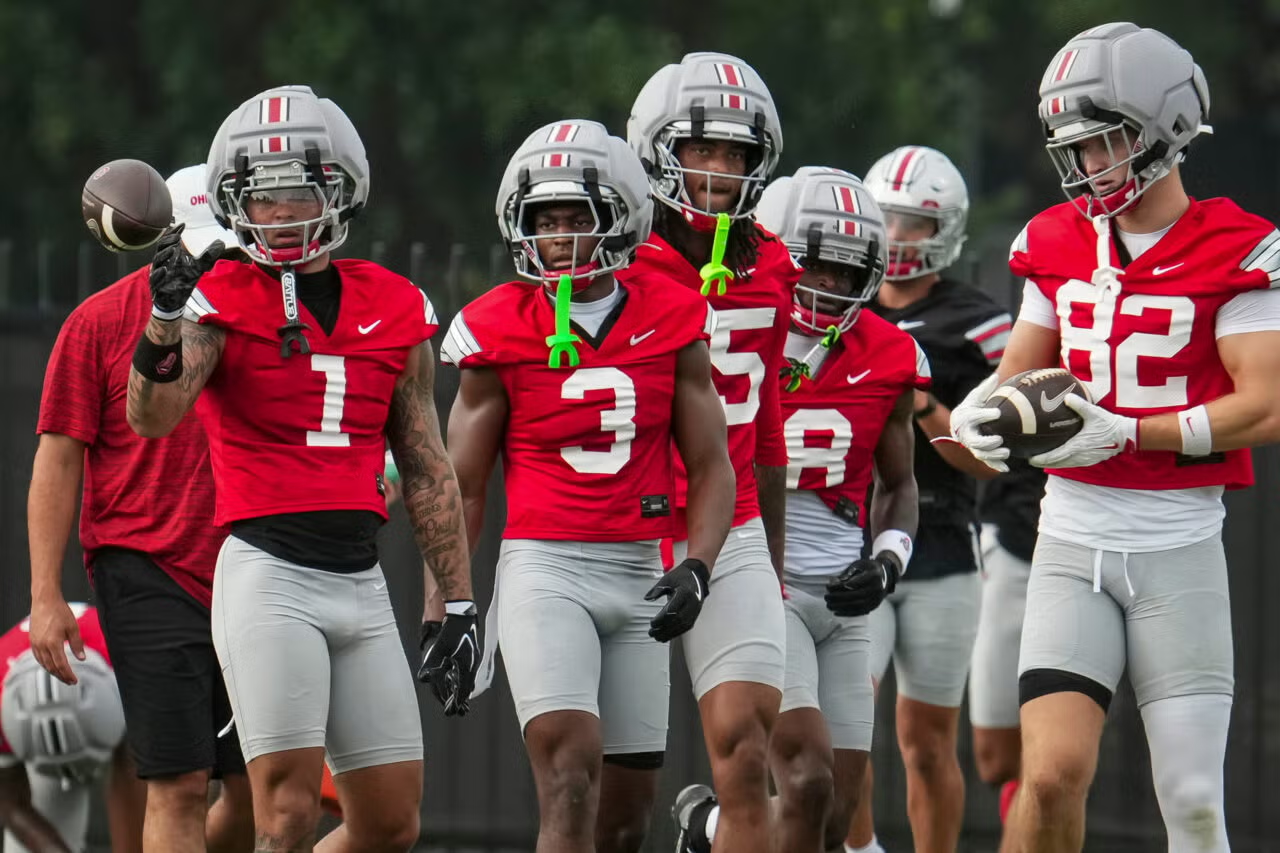
COLUMBUS, Ohio — Ohio State entered fall camp with one of college football’s deepest rosters and another national championship expectation hanging over the Woody Hayes Athletic Center. Less than a week into open practices, however, three players have separated themselves from an already loaded field, forcing their way into conversations that could reshape Ryan Day’s depth chart before Week 1.
Transfer wide receiver Devin McCuin, running back Isaiah West, and freshman defensive back Jay Timmons have generated the strongest early momentum during the Buckeyes’ open portion of camp, earning first-team repetitions and praise from coaches while positioning themselves for significant roles as Ohio State prepares for its season opener against Ball State.
For a program chasing another College Football Playoff appearance, August storylines rarely decide championships. But they often determine who earns the snaps that matter most when conference play arrives.
Few newcomers have made a quicker impression than McCuin.
The UTSA transfer arrived in Columbus after producing 726 receiving yards and eight touchdowns last season, but questions remained about how his production would translate into one of college football’s most demanding receiver rooms. Early indications suggest that adjustment has happened faster than expected.
McCuin has consistently worked alongside the first-team offense, emerging as a legitimate candidate to become Ohio State’s No. 2 receiving option opposite Jeremiah Smith, whose superstar status already commands defensive game plans every Saturday.
The contrast between the two receivers creates intriguing possibilities for offensive coordinator Arthur Smith.
Jeremiah Smith remains the physical mismatch capable of winning contested catches and drawing bracket coverage. McCuin offers a different dimension — explosive acceleration after the catch, vertical separation, and the ability to turn routine completions into chunk plays.
That versatility addresses one of Ohio State’s biggest offseason objectives.
The Buckeyes have emphasized generating more explosive plays in the passing game after an offense that, despite elite talent, occasionally lacked consistent yards-after-catch production. McCuin’s skill set directly targets that weakness.
CBS Sports has also identified McCuin as one of college football’s biggest early fall camp risers nationally, noting that he appears to have moved ahead in Ohio State’s competition for the second receiver role.
If that trajectory continues, opposing defensive coordinators may find themselves choosing between doubling Jeremiah Smith or leaving McCuin isolated against single coverage.
Neither option looks particularly comfortable.
The biggest surprise of camp may be unfolding in Ohio State’s backfield.
Isaiah West entered camp behind established production, particularly with Bo Jackson returning after a 1,000-yard season. Instead, West has seized a significant share of first-team repetitions while validating months of offseason work praised by Ryan Day himself.
Day publicly noted that West enjoyed perhaps the strongest offseason on the roster, and those improvements have become visible during team drills.
His increased physicality stands out.
West added noticeable strength during winter conditioning, giving him improved contact balance without sacrificing the burst that made him an intriguing rotational option previously. His ability to accelerate through interior rushing lanes fits the downhill identity Arthur Smith wants to establish.
Rather than creating a traditional starter-backup hierarchy, Ohio State increasingly appears positioned for a true 1A-1B rushing partnership.
Modern championship offenses rarely rely on a single workhorse runner.
Instead, they maximize efficiency through fresh legs, varied rushing concepts, and complementary skill sets.
West’s emergence gives Ohio State another explosive runner capable of handling meaningful carries while reducing wear on Jackson throughout a demanding Big Ten schedule.
That development carries broader implications for quarterback Julian Sayin as well.
A stronger rushing attack simplifies play-action opportunities, slows opposing pass rushes, and creates cleaner throwing windows against increasingly aggressive Big Ten defenses.
Perhaps the most intriguing development belongs to the youngest player among the trio.
Freshman Jay Timmons has quickly become one of Ohio State’s most fascinating defensive stories after earning first-team slot defensive back repetitions during camp despite arriving as a true freshman.
Replacing experienced defenders is never simple, particularly in Matt Patricia’s defensive system, which demands communication, versatility, and discipline from nickel defenders.
Yet Timmons appears increasingly comfortable.
His rapid ascent also validates Ohio State’s late recruiting push.
The Buckeyes successfully flipped Timmons from Florida State during the recruiting cycle, believing his athletic profile projected immediate playing potential. Early camp suggests those evaluations may have underestimated how quickly he’d compete for meaningful snaps.
Slot defenders occupy one of football’s most demanding positions.
They defend quick slot receivers, support run defense, blitz off the edge, and communicate coverage adjustments before the snap.
For a freshman to earn trust there before the season begins represents a significant vote of confidence.
Ohio State’s defensive transition makes Timmons’ emergence even more valuable.
The Buckeyes lost multiple experienced contributors, creating opportunities for young defenders to establish themselves before conference play intensifies.
Camp buzz naturally deserves caution.
Every August produces breakout stories that fade once live games begin.
Ryan Day understands that distinction better than most.
The veteran coach has consistently emphasized that roster evaluations extend beyond highlight catches and impressive practice periods.
Pad level, assignment discipline, pass protection, special teams contributions, and situational football ultimately determine playing time.
Still, these early trends matter because they align with Ohio State’s broader roster construction.
The Buckeyes didn’t simply recruit talented players.
They recruited players capable of filling specific needs.
McCuin brings explosive perimeter production.
West strengthens a physical rushing identity.
Timmons provides immediate athletic versatility on defense.
Collectively, they address three important areas entering the season.
The broader context makes these developments particularly significant.
Ohio State begins camp carrying familiar expectations.
Every preseason conversation includes national championship aspirations, Big Ten supremacy, and playoff positioning.
But this roster also enters with meaningful transitions.
Arthur Smith continues shaping the offense around greater physicality.
Matt Patricia oversees defensive evolution.
Several transfer additions must integrate quickly.
Depth chart battles remain unsettled across multiple positions.
That creates opportunity.
Veterans anchor the roster.
Center Carson Hinzman provides stability after earning All-American recognition while leading an offensive line expected to become the foundation of Ohio State’s offense.
Jeremiah Smith remains college football’s premier receiving threat.
Julian Sayin continues directing one of the nation’s most talented offenses.
The newcomers aren’t replacing those stars.
They’re expanding what Ohio State can become.
Championship teams rarely emerge solely because of established stars.
They often succeed because previously overlooked contributors become indispensable.
Think of playoff teams whose rotational receivers became postseason heroes.
Backup running backs who controlled fourth quarters.
Fresh defensive backs who stabilized rebuilt secondaries.
Ohio State hopes these early risers follow that pattern.
The Big Ten landscape leaves little room for slow starts.
Penn State, Michigan, Oregon, and other conference contenders possess enough talent to punish early-season uncertainty.
Building depth before those matchups arrive could become one of Ohio State’s biggest competitive advantages.
McCuin’s emergence potentially transforms receiver rotations.
West’s development strengthens offensive balance.
Timmons’ rapid progress enhances defensive flexibility.
Together, they provide Ryan Day additional lineup combinations that could prove invaluable once injuries, fatigue, and conference adjustments inevitably test the roster.
Fall camp remains incomplete.
Depth charts will continue changing.
Position battles remain unresolved.
Yet through the open portion of practice, three names have consistently generated the strongest momentum inside Ohio State’s football facility.
In a championship program where earning first-team repetitions requires outperforming future NFL talent, that represents more than August optimism.
It represents opportunity.
And if these early camp risers continue converting practice momentum into regular-season production, Ohio State’s pursuit of another College Football Playoff berth may ultimately be remembered as beginning with three players who quietly changed the conversation before September ever arrived.