SEC’s New Pro-Player Ban Puts LSU, Lane Kiffin and Two Former NFL Hopefuls at Center of Eligibility Fight
BATON ROUGE, La. — The Southeastern Conference has drawn a line that college football has spent much of the past several years trying to define.
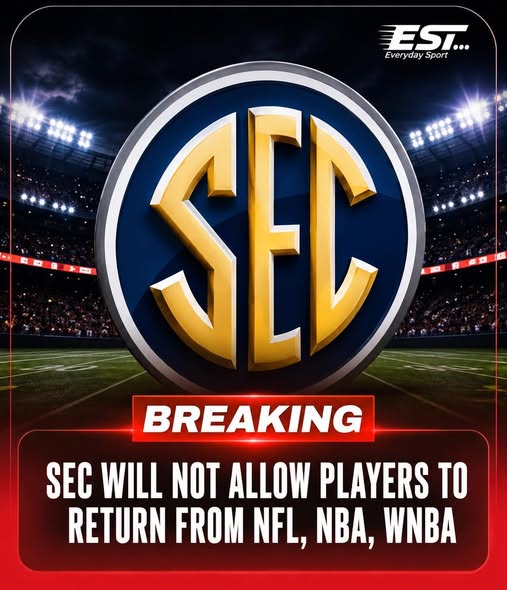
In a sweeping new policy approved by SEC leadership, member schools are prohibited from rostering athletes who previously declared for a professional draft without properly withdrawing, signed contracts with professional teams or appeared on professional rosters. The decision places LSU’s recent additions of tight end Dae’Quan Wright and defensive lineman Zxavian Harris in immediate jeopardy and escalates an already volatile national fight over who, exactly, is still eligible to play college football.
The rule arrives at a particularly inconvenient moment for LSU and first-year Tigers coach Lane Kiffin.
Wright and Harris, both former Ole Miss players who spent time pursuing NFL opportunities after the 2025 season, recently committed to join Kiffin in Baton Rouge. Both players had previously played for Kiffin at Ole Miss, making their potential return less like a traditional transfer acquisition and more like an unprecedented second act in college football.
But the SEC’s new standard could stop that reunion before either player takes a snap.
The policy applies to athletes who declared for the NFL, NBA or WNBA drafts and failed to withdraw within the appropriate framework, signed professional contracts or appeared on the roster of a professional team or affiliated league. SEC commissioner Greg Sankey has been authorized to enforce the policy and impose penalties against member institutions that fail to comply. The conference’s decision followed a similar move by the Big Ten, which adopted restrictions aimed at preventing football players with professional experience from returning to compete at its schools.
For LSU, the timing could hardly be more consequential.
Wright and Harris were part of a group of former college players from the high school class of 2022 who have challenged the NCAA’s eligibility framework in court. A Louisiana court order opened the door for affected athletes to seek an additional season of eligibility, creating a legal pathway that LSU attempted to use in building its 2026 roster.
The court action is central to the dispute.
The NCAA’s eligibility rules have undergone significant changes in recent years, particularly as lawsuits have repeatedly challenged long-standing restrictions on athlete movement, compensation and years of participation. Players who entered college under one set of expectations have argued that subsequent rule changes should not leave them at a competitive disadvantage.
For Wright and Harris, that legal uncertainty created an unusual opportunity: pursue the NFL, fail to secure a long-term professional role, and then potentially return to college football with an additional year of eligibility.
That possibility was almost unimaginable under the traditional amateurism model.
It is now at the heart of one of the most important governance disputes college athletics has faced since NIL transformed the economic structure of the sport.
Wright, a tight end who played at Virginia Tech before transferring to Ole Miss, followed the familiar path of an NFL hopeful after his college career appeared to be complete. He signed with the Philadelphia Eagles and later spent time with the Cleveland Browns before his return to college became a realistic possibility. Harris, a defensive lineman who also played for Kiffin at Ole Miss, spent time with the New Orleans Saints. Their professional opportunities did not produce secure NFL futures, but the Louisiana court ruling gave them a potential route back to the college game.
That route, however, now runs directly into the SEC.
The conference’s action is about more than two players.
SEC officials have argued that allowing athletes to sign professional contracts, appear on professional rosters and then return to college competition creates a fundamental competitive-equity problem. The distinction between college and professional football has already been blurred by NIL compensation, revenue-sharing changes and an increasingly aggressive transfer market. Allowing players to test the NFL and return to college if the opportunity does not work out could create an entirely new roster-management system.
Imagine the consequences.
A player could finish four seasons of college football, declare for the NFL draft, sign with a team as an undrafted free agent and attend training camp. If he were released, he could potentially re-enter the college market and become one of the most experienced players available before the season.
That would dramatically alter recruiting calendars, scholarship planning and roster construction.
Coaches already build teams around a transfer portal that can reshape a depth chart in weeks. Adding former NFL players to the equation would create a second professional-to-college pipeline — one in which programs with the largest NIL resources could potentially compete for experienced players who had already been evaluated by NFL scouting departments.
From the SEC’s perspective, that is a bridge too far.
The conference has explicitly argued that athletes who choose to leave college athletics, sign professional contracts and compete professionally should not then be permitted to return to college competition. The concern is not simply philosophical. It is competitive.
Every roster spot occupied by a former professional player is a roster spot unavailable to a high school recruit, a traditional transfer or a player already developing within the program. In an era when scholarship limits and revenue-sharing structures are already changing how teams distribute resources, the addition of professional returnees could further destabilize roster management.
Yet Kiffin has argued that LSU did not create the legal circumstances surrounding Wright and Harris.
His position is straightforward: If a court determines that an athlete has eligibility and that athlete is available to every program, LSU has every right to recruit him.
Kiffin has also pointed to what he views as an inconsistency in college sports. Courts have already intervened in eligibility cases involving athletes seeking additional seasons, including high-profile challenges to NCAA restrictions. LSU’s position, according to Kiffin, was that the program was operating within the legal environment that existed at the time.
He has acknowledged that the situation involving former NFL players is unusual, but has questioned whether a conference can simply disregard a court order that grants athletes broader eligibility rights.
That argument could now become the next front in the legal battle.
The SEC can establish conference membership rules, but athletes affected by the policy could challenge whether the conference’s restrictions conflict with court orders or broader legal principles governing competition and employment opportunities. College athletics has repeatedly learned in recent years that a rule adopted by an association is not necessarily a rule that will survive judicial scrutiny.
The NCAA’s traditional system has been dismantled piece by piece through litigation.
Transfer restrictions have been challenged. NIL prohibitions have fallen. Limits on athlete compensation have faced antitrust scrutiny. Eligibility rules that once seemed untouchable have become subjects of lawsuits in state and federal courts.
The SEC’s new policy could be tested in the same environment.
For LSU, however, the immediate football question is more practical.
What happens to the roster if Wright and Harris cannot play?
Wright would have given the Tigers an experienced tight end with SEC familiarity and a working knowledge of Kiffin’s offensive system. That matters in an offense built around tempo, matchup manipulation and pre-snap identification. Kiffin has consistently used tight ends not merely as inline blockers but as versatile pieces capable of creating personnel mismatches against linebackers and safeties.
A veteran player who already understands the language and structure of the system could have accelerated LSU’s offensive transition.
Harris represented a different type of value.
Interior defensive linemen are among the most difficult players to acquire in the transfer market, particularly those with SEC experience. A defensive front depends on more than sack production. The ability to anchor against double teams, maintain gap integrity and force runners into help defenders can determine whether an entire defense remains structurally sound.
An experienced interior player can improve a defense even when his statistics do not reflect the impact.
Losing either player would affect depth. Losing both would force LSU to adjust its roster calculations late in the offseason.
The bigger issue, though, is what the SEC’s decision says about the sport’s future.
College football has reached a point where conferences are beginning to establish their own boundaries when national governance fails to produce a uniform answer.
The Big Ten moved first with its restriction on football players returning from professional contracts or rosters. The SEC followed with a broader policy that also addresses basketball. The developments raise the possibility that other major conferences could consider similar action, creating a patchwork system in which an athlete’s eligibility depends not only on NCAA rules or court decisions but also on the conference in which he intends to compete.
That could have significant implications for the College Football Playoff landscape.
If major conferences adopt different eligibility standards, schools could find themselves competing under fundamentally different roster rules. A player potentially eligible in one conference might be barred in another. Programs outside the SEC and Big Ten could theoretically gain access to talent unavailable to the two richest and most powerful leagues.
That is precisely the kind of imbalance the sport’s power brokers have spent decades trying to avoid.
There is also an NFL angle.
The traditional relationship between college football and the NFL has depended on a relatively clear progression: high school to college, college to professional football. Players can transfer between college programs, but entering the professional ranks has historically represented the end of collegiate eligibility.
The new wave of litigation threatens to complicate that progression.
NFL teams could find themselves evaluating players who view training camp not as a final step away from college football but as an opportunity they can reverse if a roster spot does not materialize. Agents and players would have to weigh the financial risk of signing professional contracts against the potential earning power available through NIL and revenue-sharing opportunities in college.
In some cases, a productive college season could become more valuable than an uncertain future on an NFL practice squad.
That economic reality may be one reason the issue escalated so quickly.
The question is no longer whether college athletes are compensated. They are.
The question now is whether a player can move freely between the college and professional systems once compensation, contracts and roster appearances enter the equation.
For the moment, the SEC has given its answer.
Not here.
That leaves Wright and Harris facing an uncertain future at LSU and places Kiffin’s aggressive roster-building strategy under an intense spotlight. The Tigers believed they had found a legal path to add two experienced former players who knew their head coach and could immediately strengthen the roster.
The SEC has now attempted to close that path.
Whether the conference’s rule ultimately survives legal scrutiny is another question entirely.
And in modern college football, that may be the most important question of all.
Because the fight over Dae’Quan Wright and Zxavian Harris is no longer simply about whether two former Ole Miss players can suit up for LSU.
It is about who gets to decide where the line between college football and professional football actually exists — the NCAA, the conferences, the courts or the athletes themselves.