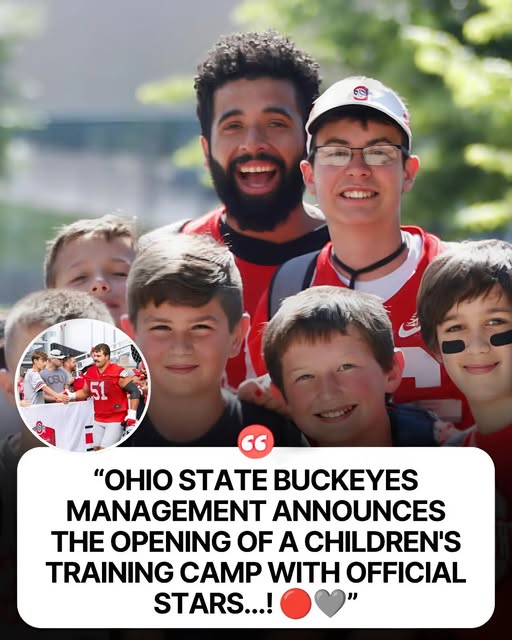
The field at Ohio Stadium has hosted national championship celebrations, Heisman Trophy winners, Rose Bowl heroes and generations of college football stars. Soon, according to the announcement described by Ohio State, it will offer something entirely different: an opportunity for children to step onto the turf at the Horseshoe, learn from official stars and participate in a free training experience designed to introduce young athletes to the fundamentals of the sport.
The initiative, billed as a special children’s training camp at Ohio Stadium, represents more than a typical youth clinic. The program is centered on participation, instruction and access, giving children the chance to experience one of college football’s most recognizable venues while learning basic athletic skills from established figures associated with the program.
The announcement immediately carries significance beyond the field itself. In an era when major college athletic departments increasingly operate at the intersection of competition, revenue generation, name, image and likeness opportunities and professional-style player development, community engagement remains a critical part of maintaining a program’s connection to the people who support it.
For Ohio State, the value of opening the Horseshoe to young participants is rooted in that connection.
The Buckeyes are one of the most visible brands in college athletics, with Ohio Stadium serving as both a historic landmark and one of the sport’s most intimidating environments on fall Saturdays. For generations of Ohio State players, running onto the field beneath the stadium’s towering decks has represented the culmination of years spent developing as young athletes.
This camp reverses that journey, at least temporarily.
Instead of asking children to wait until they reach high school, college or the professional level to experience the stadium, the program brings them directly onto the field. The emphasis, according to the announcement, will be on learning, sportsmanship, confidence and teamwork — principles that extend beyond wins and losses.
The camp is also expected to give participants an opportunity to interact with official stars and instructors, creating the kind of direct connection that can make youth participation programs especially meaningful. For a child standing on the same field where Ohio State has produced countless All-Americans and NFL players, the experience can turn the abstract idea of athletic ambition into something tangible.
That matters in the modern sports landscape.
Youth participation is the foundation of every competitive pipeline, but the benefits of organized sports are not limited to identifying the next elite prospect. Coaches and development specialists have long emphasized that early participation can help children build movement skills, learn how to function within a group and develop resilience through competition.
The technical side of the training will introduce participants to basic fundamentals, while the broader structure is designed to encourage communication and cooperation. Whether the activities involve passing, catching, footwork, spatial awareness or introductory contact principles adapted for young athletes, the objective is to create an environment where instruction is paired with enjoyment.
That balance is particularly important.
At the highest levels of football, development is increasingly specialized. College programs evaluate prospects through measurable athletic traits, game film, positional production and advanced performance indicators. Recruiting departments track speed, explosiveness, size and competitive progression years before many prospects reach college campuses.
Ohio State itself has built one of the nation’s most sophisticated football operations around that model. The program recruits nationally, develops players for the NFL and competes annually for Big Ten championships and College Football Playoff positions.
But the earliest stage of athletic development looks nothing like a recruiting database.
For most children, the first lesson is considerably simpler: how to enjoy the game.
That is where programs such as this camp can have their greatest impact. The environment allows young participants to learn without the pressure attached to rankings, scholarships or future projections. There will be no College Football Playoff implications attached to a dropped pass or missed assignment. The focus is on participation and development.
The symbolism of holding the event at Ohio Stadium amplifies that message.
The Horseshoe has long been central to Ohio State’s identity. Built in the early 1920s and expanded and modernized over the decades, the stadium has evolved into one of the defining venues in American college football. Its capacity, tradition and atmosphere make it a destination for recruits and visiting teams alike.
On game days, the field is occupied by athletes competing under extraordinary scrutiny. Television cameras, NFL scouts, recruiting analysts and millions of fans can follow every possession. A single play can shape a player’s reputation or alter the trajectory of an entire season.
The children participating in this camp will encounter a different version of the stadium — one built around instruction rather than pressure.
That distinction could be particularly valuable for families who might not otherwise have access to this type of experience. By offering the camp free of charge, the initiative removes one of the barriers that can limit participation in organized athletics. Youth sports have become increasingly expensive in many communities, particularly as private training, travel competition and specialized coaching have grown.
A free program inside a major college football venue creates access that is difficult to replicate.
It also aligns with a broader trend across college athletics. Major programs increasingly recognize that their influence extends beyond recruiting cycles and Saturday results. Community events, youth clinics and educational initiatives allow athletic departments to maintain relationships with younger generations while reinforcing the values that sports programs frequently promote.
For Ohio State, the timing comes as the football program continues to operate under the enormous expectations that accompany one of the sport’s premier brands. Every season brings championship aspirations, NFL Draft evaluations and intense scrutiny of recruiting and roster construction.
The modern college game has become even more complex with the expansion of the transfer portal, the evolution of NIL opportunities and the continued emphasis on roster management. Teams are now required to balance player retention, incoming recruiting classes, development and financial resources with a level of strategic planning that increasingly resembles professional football.
The pressure at the top has never been greater.
Yet youth programs offer a reminder of where the game begins.
Before an athlete becomes a five-star recruit, a starting quarterback or an NFL Draft prospect, there is usually a first experience with a football, a first coach and a first team. Those moments rarely make headlines, but they can shape whether a young athlete continues participating in the sport.
That is the broader significance of Ohio State’s camp.
The Buckeyes are not simply opening a stadium. They are opening a pathway into the experience of organized athletics, giving children an opportunity to learn in a setting normally reserved for elite competition.
The presence of official stars and instructors could add another dimension. Young athletes often learn differently when they can watch established players demonstrate the skills being taught. Seeing proper body positioning, balance, footwork and ball-handling techniques in person can provide a clearer understanding than instruction alone.
Just as important, interaction with athletes can humanize the stars children normally see only from the stands or on television.
For the players involved, the camp also presents an opportunity to understand the influence attached to wearing an Ohio State uniform. The relationship between elite athletes and young fans has always been a significant part of college sports, but NIL and social media have transformed the visibility of individual players.
Today’s college stars are increasingly recognizable brands. Their performances can generate national attention, endorsement opportunities and massive audiences online.
Programs such as this camp can redirect that visibility toward mentorship.
There is no salary cap calculation or trade deadline consequence attached to a youth training session, and there should not be. But the initiative still exists within a football ecosystem increasingly defined by the business of sports.
At the NFL level, roster construction revolves around contracts, guaranteed money, cap allocations and positional value. At the college level, programs are navigating their own rapidly changing economic environment through NIL structures and evolving revenue models.
The common thread, however, remains talent development.
The NFL depends on college football to produce professional players. College football depends on high school development. High school football, in turn, is supported by communities, coaches and early participation opportunities that introduce children to the game.
The pipeline begins long before a scouting report is written.
Ohio State’s children’s camp will not determine the outcome of the next Big Ten race or reshape the College Football Playoff bracket. It will not change the Buckeyes’ depth chart or affect an NFL franchise’s salary cap.
Its impact will be measured differently.
It may be found in the child who gains confidence after completing a drill, the young participant who discovers a love for teamwork, or the future athlete who remembers stepping onto the Ohio Stadium turf for the first time.
For one day, perhaps more, the Horseshoe will belong to the next generation.
And for a program built on history, tradition and the pursuit of excellence, that may be the most fitting use of the field of all.
The Buckeyes’ special free children’s training camp is ultimately an investment in something that cannot be measured by recruiting rankings, advanced analytics or championship odds: the opportunity to make sports accessible, memorable and meaningful.
Inside one of college football’s grandest stadiums, the next lesson will not be about pressure, rankings or expectations.
It will be about learning the game — and enjoying it.