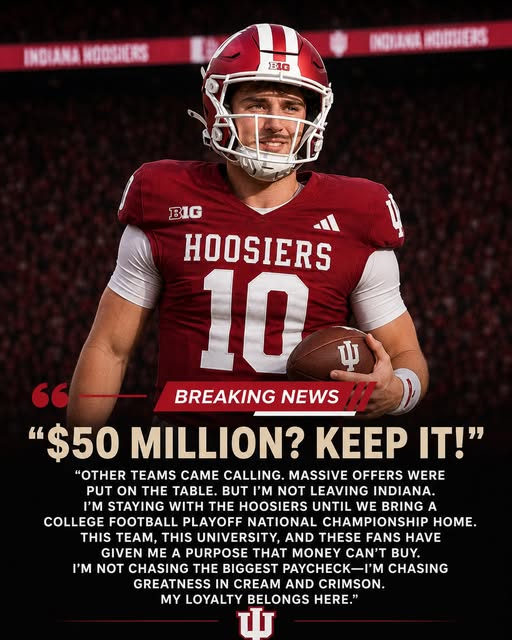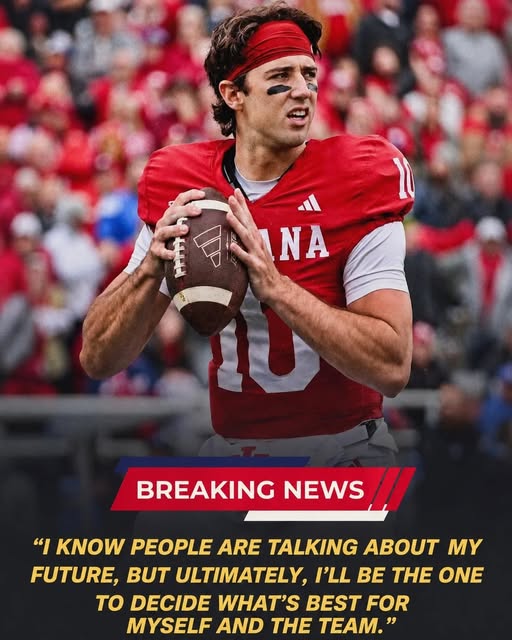
BLOOMINGTON, Ind. — Josh Hoover arrived at Indiana carrying an unusual burden: replace a Heisman Trophy winner, take command of the defending national champions and prove that Curt Cignetti’s quarterback succession plan was more than a remarkable two-year trend.
Now, with the 2026 season finally at the doorstep, the pressure surrounding Hoover has intensified.
The former TCU quarterback is entering his lone season of eligibility at Indiana, and while there is no credible reporting that he is preparing to leave the program, speculation surrounding his future has grown largely because of the stakes attached to his arrival. Indiana has become one of college football’s most aggressive transfer-portal programs, and the quarterback position has become the center of its rapid rise.
Hoover, however, has consistently presented himself as a player focused on the present rather than the noise surrounding what comes next.
When he committed to Indiana in January, he understood exactly what he was walking into. Fernando Mendoza had just completed one of the greatest seasons in program history, throwing for 3,535 yards and 41 touchdowns against only six interceptions while leading Indiana to an unprecedented 16-0 record and its first national championship.
That standard does not disappear simply because Mendoza is now preparing for his NFL career.
For Hoover, the challenge is straightforward: become Josh Hoover, not the next Fernando Mendoza.
“I got more comfortable,” Hoover said during Indiana’s spring program, discussing his transition into offensive coordinator Mike Shanahan’s system. “Marrying up footwork and reads and seeing the coverage and defense” became a central part of his development.
That process is particularly important because Hoover is not an inexperienced quarterback hoping to discover himself in the Big Ten.
He has already played 35 college games and made 31 starts at TCU. Indiana lists him as a two-time team captain with 16 career 300-yard passing performances and eight games in which he threw at least four touchdown passes.
His résumé is substantial.
Over his final three seasons at TCU, Hoover completed 65.1% of his passes for 9,627 yards, 71 touchdowns and 33 interceptions. In 2025 alone, he threw for 3,472 yards and 29 touchdowns while completing 65.9% of his attempts. He also threw 13 interceptions, a figure that remains the most obvious statistical blemish on his profile.
That combination — experience, production and turnovers — is what makes Hoover such an intriguing quarterback entering the season.
He is not being asked to learn how to play quarterback at the Power Four level. He is being asked to become more efficient at it.
That distinction matters.
Cignetti has built Indiana’s recent success around veteran quarterbacks who understand how to process defenses, distribute the football and avoid turning explosive offensive opportunities into negative plays. Kurtis Rourke helped take Indiana to its first College Football Playoff appearance. Mendoza followed with a Heisman-winning campaign and a perfect championship season.
Hoover is now the third transfer quarterback asked to continue that progression.
Cignetti has been clear that he believes Hoover is capable of doing it.
“He embraced that challenge when he made the decision to come here,” Cignetti said during the spring. “He’s a process-oriented guy.”
That endorsement is significant because Indiana is not entering 2026 as a rebuilding program.
The Hoosiers are the defending national champions and enter the season ranked No. 6 in the Associated Press preseason poll. The roster contains 60 returning players, including 11 who made multiple starts in 2025, while the program added 44 newcomers, 18 of whom arrived through the transfer portal.
The infrastructure around Hoover is therefore designed to give him a chance to succeed immediately.
Indiana retained substantial defensive experience, added transfer talent and enters the year with an offensive line expected to provide stability. The receiving corps also remains dangerous despite the departure of Omar Cooper Jr. and Elijah Sarratt to the NFL, with Charlie Becker, Nick Marsh and several emerging contributors giving Hoover multiple avenues to attack defenses.
The bigger question is whether Hoover can turn that supporting cast into another elite offense.
That will determine far more than his individual reputation.
Indiana’s schedule leaves little room for prolonged adjustment. The Hoosiers open Sept. 5 against North Texas before facing Howard and Western Kentucky. Then comes Northwestern, followed by road games against Rutgers and Nebraska before the schedule turns brutal.
Ohio State visits Bloomington on Oct. 17. Indiana travels to Michigan the following week. USC arrives in November, followed by a trip to Washington before the regular-season finale against Purdue.
In other words, Hoover’s performance could ultimately decide whether Indiana is merely a defending champion or a legitimate repeat contender.
The quarterback’s statistical efficiency will be especially important.
Indiana does not necessarily need Hoover to reproduce Mendoza’s 41-touchdown season. It needs him to maximize possessions, protect the football and consistently convert high-leverage downs. His career interception rate and decision-making under pressure will be scrutinized heavily against Big Ten defenses capable of disguising coverage and generating pressure without sacrificing numbers in the box.
That is where Indiana’s defense could become an important advantage.
Hoover spent the spring going against a unit Cignetti’s staff believes can be among the nation’s best. Rather than viewing those practices as an obstacle, Hoover described them as an opportunity to sharpen his ability to identify defensive structures and make decisions before the snap.
That preparation could prove invaluable once the schedule reaches October.
There is also a larger storyline surrounding Hoover’s future.
Because he has one season of eligibility remaining, his immediate future beyond 2026 is naturally uncertain. There is currently no credible evidence establishing that Indiana is preparing to move on from him or that Hoover is seeking another transfer. In fact, Indiana’s recent public messaging has centered on his development as the starting quarterback.
But college football’s transfer-portal environment makes certainty difficult.
Quarterbacks with extensive starting experience and strong production can command