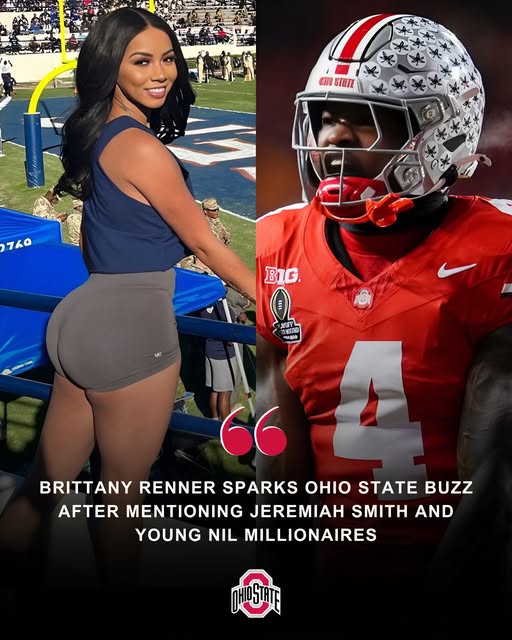
In a livestream clip that circulated widely across social platforms this weekend, Instagram model and content creator Brittany Renner stated she is seeking “young NIL millionaire” partners and referenced Ohio State star wide receiver Jeremiah Smith by name, claiming he had expressed interest in going out. The remarks, delivered in casual conversation, quickly drew attention given Smith’s status as one of college football’s highest-profile and highest-valued players under the Name, Image and Likeness system.
Renner, 34, who has a child with NBA forward P.J. Washington, has previously spoken publicly about relationships involving athletes. In the recent comments she described a preference for younger, financially successful college athletes enabled by NIL deals and specifically brought up Smith. Clips of the remarks, some under a minute long, accumulated millions of views within hours. Independent reporting from multiple outlets confirmed the core statements but noted that any claimed interaction with Smith remains unverified by the player or his representatives.
Smith, born November 29, 2005, is 20 years old and entering his junior season at Ohio State. The Miami Gardens, Florida, product enrolled early after a decorated high-school career at Chaminade-Madonna Prep, where he established himself as the consensus top recruit in the 2024 class. As a true freshman in 2024 he helped lead the Buckeyes to a College Football Playoff national championship, setting FBS freshman receiving records along the way. Through two seasons he has recorded 163 receptions for 2,558 yards and 27 receiving touchdowns, earning Big Ten Receiver of the Year honors in both 2024 and 2025, Big Ten Freshman of the Year recognition, and unanimous All-American status in 2025.
On3’s NIL valuation places Smith at approximately $5 million entering the 2026 season, ranking him among the top five athletes across all college sports and near the top of the football-specific list. His portfolio includes landmark deals: he became the first college football player to appear on a Red Bull can, signed with Adidas for marketing campaigns, and has additional partnerships that have included brands such as Nintendo and KeyBank. Reports earlier this year indicated he declined transfer-portal offers reportedly exceeding $10 million to remain in Columbus, a decision that reinforced both his on-field value to the Buckeyes and his off-field earning power.
Ohio State head coach Ryan Day has consistently praised Smith’s maturity and focus. Day has described the receiver as unusually advanced in his approach for his age while emphasizing the need to allow young players room to grow. The program’s offensive scheme under Day and coordinator coordinators has featured Smith as a primary weapon, utilizing his combination of size (listed at 6-foot-3, 215-223 pounds), contested-catch ability, and yards-after-catch explosiveness. Advanced metrics from his first two seasons show elite production in separation rate, target share, and red-zone efficiency, placing him in conversations with recent Ohio State receivers who transitioned successfully to the NFL.
The timing of the social-media attention coincides with the start of fall camp and the final stretch of preparation for the 2026 season. Ohio State enters the year as a perennial College Football Playoff contender in a reconfigured Big Ten that continues to feature high-stakes matchups against Michigan, Penn State, Oregon, and others. Smith’s presence as a returning All-American gives the Buckeyes a proven vertical and intermediate threat who can command double coverage and open opportunities for complementary pieces in the passing game. Any external distraction, even one generated entirely by third-party comments, arrives at a moment when the program prioritizes continuity after a national title and consecutive strong individual seasons from its star receiver.
NIL has fundamentally altered the financial landscape of college athletics since its widespread adoption. Players of Smith’s caliber now command multi-million-dollar valuations built on performance, social-media reach, and brand partnerships rather than traditional athletic scholarships alone. That economic shift has produced a cohort of college athletes whose off-field earnings rival or exceed those of many professional rookies. Public commentary about those earnings, particularly when framed around personal relationships, inevitably intersects with broader conversations about age gaps, consent, privacy, and the vulnerabilities that can accompany sudden wealth at a young age. Renner’s remarks explicitly tied financial status to romantic interest; the ensuing online reaction mixed criticism of the age difference with debate over the new realities of athlete monetization.
No statement has been issued by Smith, his family, Ohio State’s athletic department, or his NIL representatives regarding Renner’s comments. In the absence of confirmation, the claims remain one-sided. College athletes under NIL rules retain agency over their personal brands and private lives, yet the intensity of modern social-media amplification means even unsolicited public remarks can generate significant noise. Programs and agents increasingly counsel players on managing external attention, particularly as valuations climb and visibility increases.
From a competitive standpoint, Smith’s value to Ohio State extends beyond raw production. His ability to win at all three levels of the route tree, combined with reliable hands and physicality after the catch, makes him a schematic cornerstone. Defenses must account for him on every snap, which in turn creates favorable matchups elsewhere. Maintaining focus through the noise of a long season—media obligations, NIL commitments, academic requirements, and the physical demands of Big Ten football—has been a hallmark of successful recent Buckeyes teams. Day’s staff has emphasized culture and process; how individual players filter off-field distractions forms part of that process.
League-wide, the episode underscores ongoing adjustments to the NIL era. Collectives, brand deals, and revenue-sharing frameworks have concentrated significant resources in the hands of a relatively small group of elite athletes, many of them still teenagers or early-twenties college students. That concentration invites both opportunity and external interest. Analysts tracking the transfer portal and roster retention note that financial packages now rank alongside scheme fit, coaching continuity, and championship windows as retention factors. Smith’s decision to stay at Ohio State despite larger reported offers elsewhere illustrated one high-profile example of a player weighing those variables.
Historically, college football has long navigated intersections of celebrity, money, and personal lives. The difference today is scale and speed. A single livestream segment can reach millions before a team’s communications staff has drafted a response. For a player projected as a potential high selection in the 2027 NFL Draft, protecting both on-field trajectory and personal privacy becomes a practical necessity. Smith’s production trajectory—record-setting freshman numbers followed by unanimous All-American recognition—positions him for an early professional declaration if he chooses, though he has given no public indication of leaving after the 2026 season.
Coaching perspectives around the sport generally stress compartmentalization. Elite performers are expected to treat external noise as background static while executing the weekly preparation cycle of film study, practice, recovery, and game planning. Teammates and support staff often serve as buffers. At Ohio State, the infrastructure surrounding high-profile players includes academic support, strength and conditioning resources, and NIL education components designed to help athletes navigate sudden financial and social complexity.
Broader NFL landscape implications remain indirect. Front offices evaluating college talent already factor maturity, decision-making, and handling of adversity into their assessments. A player who continues to produce at an elite level while managing elevated off-field attention reinforces positive evaluations; any sustained distraction would register as a data point. For now, the story remains confined to social-media conversation and secondary sports coverage rather than confirmed involvement by the athlete himself.
As the Buckeyes move through camp and into the regular season, the focus inside the Woody Hayes Athletic Center will center on execution, depth-chart competition, and the pursuit of another deep playoff run. Jeremiah Smith’s on-field role is clear: continue operating as one of the most productive and physically imposing wide receivers in the sport. The unverified personal claims circulating online do not alter the statistical record, the scheme design, or the competitive stakes awaiting Ohio State in 2026. In an era when NIL wealth and social-media visibility travel together, the boundary between public performance and private life grows thinner, yet the scoreboard remains the ultimate measure for players and programs alike.