Ohio State Legend C.J. Stroud Just Spoke Out About Julian Sayin
COLUMBUS, Ohio — The expectations attached to the Ohio State quarterback position are unlike almost any in college football. National championships, Heisman Trophy campaigns, first-round NFL draft picks and the relentless scrutiny of a fan base that measures success against the sport’s highest standard all come with the job.
Julian Sayin is learning that reality in real time.
And now, one of the most accomplished quarterbacks in modern Ohio State history believes the young signal-caller has the temperament to handle it.
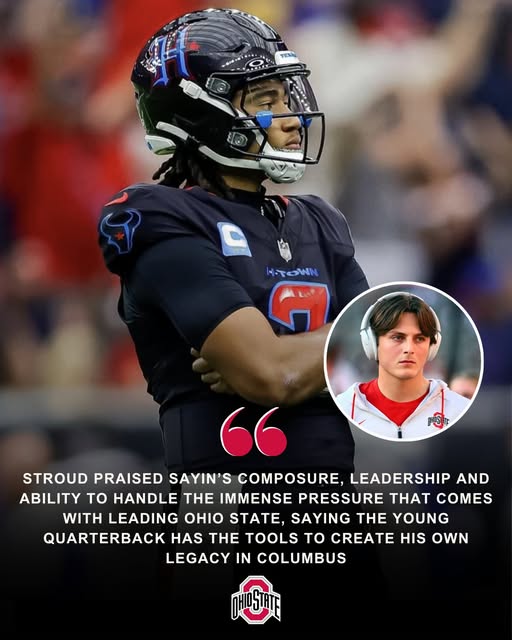
Former Buckeyes star and current Houston Texans quarterback C.J. Stroud praised Sayin’s composure, leadership and ability to operate under pressure, offering a significant vote of confidence in a quarterback attempting to establish himself at one of college football’s most demanding positions.
Stroud’s message was not that Sayin should attempt to become the next C.J. Stroud.
It was that Sayin has an opportunity to become the first Julian Sayin.
That distinction matters in Columbus.
Ohio State has spent much of the past decade producing quarterbacks who arrived with enormous expectations and departed with their own chapters in program history. Dwayne Haskins set a single-season passing standard during the Buckeyes’ 2018 campaign. Justin Fields helped return Ohio State to the College Football Playoff and produced one of the greatest postseason performances in program history against Clemson. Stroud followed with consecutive Heisman Trophy finalist seasons before becoming the No. 2 overall pick in the 2023 NFL draft.
The quarterback position has become both a launching pad and a pressure cooker.
Sayin now occupies the center of that environment.
The former highly regarded recruit arrived in Columbus carrying the type of résumé that naturally creates comparisons. He possesses the arm talent, release quickness and passing mechanics associated with modern high-level quarterback play. But the challenge awaiting him extends far beyond the ability to drive the football outside the numbers or layer a throw over a linebacker.
At Ohio State, the quarterback must command the offense, manage a nationally prominent roster and survive every week under the microscope.
That is where Stroud’s assessment carries particular weight.
Stroud understands the difference between playing quarterback and leading Ohio State’s offense. During his two seasons as the Buckeyes’ starter, he threw for more than 8,000 yards and 85 touchdowns while developing into one of the most polished pocket passers in college football. He twice finished among the leading candidates for the Heisman Trophy and elevated his draft stock to the point that Houston selected him second overall.
His career, however, was not defined solely by production.
Stroud played through the expectations that accompany the position. Every loss generated debate. Every incomplete pass became material for analysis. The pressure surrounding the annual rivalry with Michigan was unavoidable. And the postseason standard was always clear: Ohio State expected to compete for national championships.
Those experiences give Stroud a unique perspective when evaluating a young quarterback such as Sayin.
The physical tools can be identified quickly. The more difficult evaluation involves everything that happens between snaps.
Can a quarterback maintain his poise after an interception? Can he identify disguised coverage before the snap and adjust the protection accordingly? Can he manage the pocket when the interior begins to collapse? Can he remain aggressive without becoming reckless? Can he earn the trust of veteran receivers, offensive linemen and coaches?
Those are the questions that ultimately determine whether a talented prospect becomes a successful Ohio State quarterback.
Stroud’s praise of Sayin’s composure suggests he sees qualities that cannot be measured solely through passing velocity or recruiting rankings.
That composure will be especially important as Sayin continues developing within an Ohio State offense built around an expectation of efficiency and explosive production. The Buckeyes have consistently recruited elite skill-position talent, creating opportunities for quarterbacks to attack defenses at every level of the field. But that depth also increases the importance of timing, anticipation and decision-making.
Ohio State’s passing offense has traditionally demanded more than simply identifying an open receiver.
The quarterback must understand route leverage, coverage rotation and defensive tendencies. Against split-safety structures, he may need to recognize when the defense is attempting to remove explosive plays and respond by taking efficient completions underneath. Against single-high looks, the quarterback must identify isolated matchups and determine whether the protection can hold long enough to attack vertically.
Those decisions often occur within seconds.
For a young quarterback, the transition is substantial.
The college game is faster than high school football, but the bigger adjustment often involves complexity. Defensive coordinators disguise coverage more effectively, alter fronts before the snap and create post-snap pictures designed to force hesitation. A quarterback who possesses elite arm talent but processes information slowly can become vulnerable.
Conversely, a quarterback with calm feet, disciplined eyes and a willingness to take what the defense provides can keep an offense on schedule.
That is one reason leadership and composure remain central to Sayin’s development.
Ohio State does not need Sayin to win every game with a spectacular throw. The Buckeyes need a quarterback capable of protecting possessions, creating explosive plays when opportunities emerge and maintaining control of the offense when games become uncomfortable.
Stroud experienced that challenge at the highest level of college football.
His defining Ohio State performance may have come in defeat, when he threw for 348 yards and four touchdowns against Georgia in the College Football Playoff semifinal following the 2022 season. The performance demonstrated a part of Stroud’s game that critics had questioned: his ability to create outside the structure of the offense and use his mobility when the situation demanded it.
That lesson also applies to Sayin.
A quarterback’s legacy is rarely constructed in controlled conditions.
It is shaped by how he responds when the initial read disappears, when the protection breaks down or when the offense faces third-and-long late in a rivalry game. Ohio State’s history is filled with talented players. The quarterbacks remembered most clearly are the ones who delivered when the circumstances became most demanding.
Sayin will have the opportunity to define himself through those moments rather than through comparisons to the quarterbacks who preceded him.
That could also be critical for Ohio State’s broader championship ambitions.
The modern College Football Playoff landscape places an even greater premium on quarterback durability and consistency. A team with national title expectations can no longer view a single difficult performance as the end of its season. The expanded playoff structure has created more potential paths to a championship, but it has also increased the number of high-pressure games a contender may need to survive.
For Ohio State, that means quarterback development cannot be evaluated only through highlight throws.
Completion percentage matters. Turnover-worthy plays matter. Third-down efficiency matters. Red-zone decision-making matters. The ability to avoid negative plays and keep the offense ahead of schedule often matters just as much as the spectacular deep completion that dominates social media.
If Sayin can combine his natural passing ability with the type of situational discipline required at the position, he could provide Ohio State with the stability necessary to navigate a demanding Big Ten schedule and compete deep into the postseason.
The NFL implications are significant as well.
Ohio State has become an increasingly important pipeline for professional quarterback talent, and Stroud’s immediate success with the Texans elevated the program’s profile even further. NFL evaluators studying Sayin in the future will not simply examine his physical traits. They will study his command of the offense, his processing against complex coverages and his performance in high-leverage situations.
They will ask whether he can function from the pocket while also creating when the play structure fails.
Those are questions Stroud has already answered at both the college and professional levels.
For now, however, Sayin’s focus remains in Columbus, where expectations do not pause for development timelines.
That is the reality of being Ohio State’s quarterback.
Every practice is evaluated. Every public appearance is analyzed. Every game carries implications for conference positioning, playoff seeding and the program’s national reputation.
Stroud knows that better than most.
His praise of Sayin, therefore, should not be interpreted as a guarantee of future greatness. College football history is filled with gifted quarterbacks whose careers failed to follow a predictable trajectory.
But it is a meaningful endorsement from someone who has already walked the path Sayin is beginning to travel.
Ohio State does not need Sayin to recreate Stroud’s career, Fields’ career or anyone else’s.
The Buckeyes need him to develop into a quarterback capable of handling the moment.
According to Stroud, Sayin has the composure, leadership qualities and physical tools to begin doing exactly that.
The rest will be determined on the field.
And at Ohio State, where every quarterback is eventually judged by the biggest games, that is where a legacy truly begins.