C.J. Stroud Has the NFL Talking — But the $3 Million Surprise Is Bigger Than Football
C.J. Stroud has spent much of his young NFL career making headlines with his right arm. This time, however, the story surrounding the Houston Texans quarterback has nothing to do with a fourth-quarter throw, a playoff drive or another step in the evolution of one of football’s most closely watched young passers.
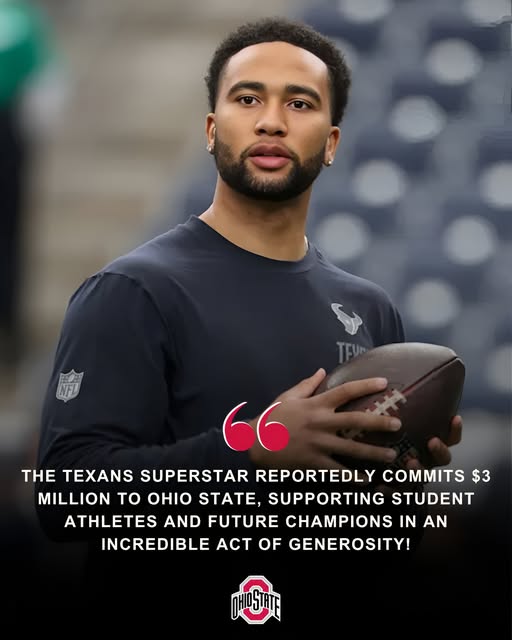
A claim circulating about Stroud committing his entire $3 million in earnings to support Ohio State’s NCAA programs, student-athletes, athletic development and future athletes would represent one of the most significant philanthropic gestures yet associated with a current NFL quarterback toward his alma mater.
But there is an important distinction between a powerful story and a verified one.
Publicly available reporting confirms that Stroud has previously given back to Ohio State athletics and became the first former Buckeyes athlete to donate to THE Foundation, an Ohio State-focused NIL collective, in 2024. The amount of that contribution was not publicly disclosed by the collective. Subsequent reporting described the donation as falling between $50,000 and $100,000. There is currently no verified public announcement from Stroud, Ohio State or THE Foundation confirming that he has donated $3 million or committed his entire $3 million in earnings to Ohio State athletics.
That clarification matters because the underlying story still says something significant about where college athletics is headed — and why Stroud’s relationship with Ohio State remains relevant well beyond his departure from Columbus.
Stroud arrived at Ohio State as a highly regarded quarterback prospect from Southern California and eventually developed into one of the most productive passers in program history. In two seasons as the Buckeyes’ primary starter, he threw for 8,123 yards and 85 touchdowns, establishing himself as a two-time Heisman Trophy finalist and helping maintain Ohio State’s reputation as one of the nation’s premier quarterback-development programs.
His college career also unfolded during a transformational period for the sport.
Name, image and likeness opportunities were beginning to reshape recruiting, roster construction and the financial relationship between athletes and the programs they represented. Stroud was among the Ohio State players who benefited from that changing marketplace, with his NIL value estimated at approximately $2.9 million during his final college season.
That history made his decision to become a donor to Ohio State’s NIL ecosystem noteworthy. The quarterback who had benefited from the new financial opportunities available to college athletes was now participating in an effort designed to create opportunities for the next generation.
The symbolism is particularly powerful in 2026, when the economics of college sports bear little resemblance to the system Stroud entered as a freshman.
Ohio State has publicly prepared for an era in which major athletic departments are directly involved in athlete compensation. The school previously projected approximately $20.5 million in direct NIL-related payments to student-athletes for the 2025-26 academic year while committing to continue supporting all 36 varsity programs.
That financial transformation has created a new reality for programs across the country.
The most visible conversation centers on football and men’s basketball because those sports drive much of the revenue. But Ohio State’s athletic department supports approximately 1,000 student-athletes across 36 varsity programs, making the financial challenge considerably more complex than simply assembling a championship football roster.
Ohio State generated a record $336 million in athletic revenue during fiscal year 2025 and received more than $68 million in donor-funded contributions. The department also reported more than $24.9 million in athletic student aid. Those numbers illustrate both the scale of the Buckeyes’ operation and the increasing importance of philanthropy as athletic departments attempt to balance scholarships, facilities, athlete compensation and the long-term sustainability of broad-based sports programs.
A $3 million gift, if formally confirmed, would therefore carry implications beyond its headline value.
Depending on how the money was structured and where it was directed, such a contribution could support scholarships, athlete development, leadership programming, facilities, women’s sports or other athletic priorities. Ohio State already maintains giving funds that support grant-in-aid, the overall student-athlete experience, leadership development, football facilities and women’s athletics.
The larger point is that former athletes are becoming increasingly important participants in the financial ecosystem they once inhabited as players.
For decades, the traditional relationship was straightforward. Universities developed athletes. Professional leagues drafted them. Successful alumni occasionally returned as donors, but their philanthropy existed largely outside the competitive machinery of recruiting and roster retention.
NIL changed that equation.
Now, former players can contribute to collectives, support athlete initiatives, finance facilities or participate in philanthropic efforts tied directly to the experience of current student-athletes. Stroud’s verified involvement with THE Foundation represented an early example of that evolving model.
THE Foundation describes itself as an Ohio State-focused collective that facilitates opportunities connecting football and basketball student-athletes with charitable organizations and community initiatives. Its stated mission reflects the increasingly complicated intersection of NIL, philanthropy and athlete development.
Stroud’s potential role in that ecosystem also fits the broader trajectory of his career.
The Texans selected him with the No. 2 overall pick in the 2023 NFL draft and signed him to a four-year contract worth approximately $36.3 million, including a signing bonus of more than $23.3 million and full guarantees under the terms of his rookie agreement.
That rookie contract, negotiated within the NFL’s collective bargaining agreement and rookie wage scale, is separate from the salary-cap calculations facing Houston in any particular season. The Texans carry Stroud’s cap charges according to the structure of his rookie deal, while his eventual second contract is likely to become one of the most consequential financial decisions in franchise history.
That is where the football implications become impossible to ignore.
The NFL has watched a new generation of young quarterbacks transform the league’s economic landscape. A franchise quarterback on a rookie contract can provide enormous roster-building flexibility, allowing teams to devote cap resources toward offensive line depth, pass rush, coverage players and high-priced veterans.
Once that quarterback reaches the extension phase, however, the equation changes.
For Houston, Stroud’s long-term development remains central to every major personnel decision. His processing speed, pocket movement and ability to attack defenses outside structure have already demonstrated why the Texans viewed him as a franchise-changing investment. But the next stage of his career will be judged differently.
The expectations rise.
Defenses accumulate tape. Coordinators identify tendencies. Protection issues become magnified. The quarterback is expected not simply to create explosive plays but to consistently win from the pocket, control pre-snap identification and sustain efficient offensive football when opponents remove the first option.
That is the life cycle of a modern NFL quarterback.
The charitable dimension of the Stroud story, meanwhile, provides a reminder that an athlete’s influence can extend beyond the box score. College athletics increasingly requires former players, donors and corporate partners to participate in sustaining the programs that helped develop them.
Ohio State has already embraced that changing commercial environment. In July, the athletic department announced a landmark partnership with JPMorganChase that includes jersey patches across all 36 men’s and women’s varsity programs, NIL opportunities for student-athletes and expanded financial education and career-development resources.
That context makes the conversation around Stroud’s reported $3 million contribution understandable, even if the specific figure has not been publicly verified.
A gift of that magnitude would be significant. It would also fit a broader movement in which college athletics is becoming increasingly dependent on a combination of institutional revenue, corporate partnerships, NIL investment and philanthropy.
For the Buckeyes, every major contribution must now be viewed through the lens of an athletic department attempting to remain competitive nationally while supporting one of the largest and most comprehensive sports programs in the country.
For Stroud, the verified part of the story is already meaningful.
He left Ohio State, became one of the NFL’s most important young quarterbacks and then returned to the ecosystem that helped launch his career as a donor. That relationship carries weight in an era when former players can do far more than attend games, sign autographs or deliver motivational speeches.
They can help shape the future of the programs they once represented.
And if the reported $3 million commitment is eventually confirmed through an official announcement, the impact could extend well beyond one athlete or one football season. It would represent a major example of a current NFL star reinvesting substantial resources into the college sports infrastructure that helped produce him.
Until then, the $3 million figure should be treated carefully.
The verified story is compelling enough on its own: C.J. Stroud has already demonstrated a willingness to give back to Ohio State and participate in the rapidly changing NIL and athlete-support landscape. And as college athletics continues its transformation, the former Buckeye quarterback may be part of an emerging model in which the stars who profit from the system also help invest in the athletes coming behind them.
In today’s football economy, that may be every bit as consequential as another touchdown pass.