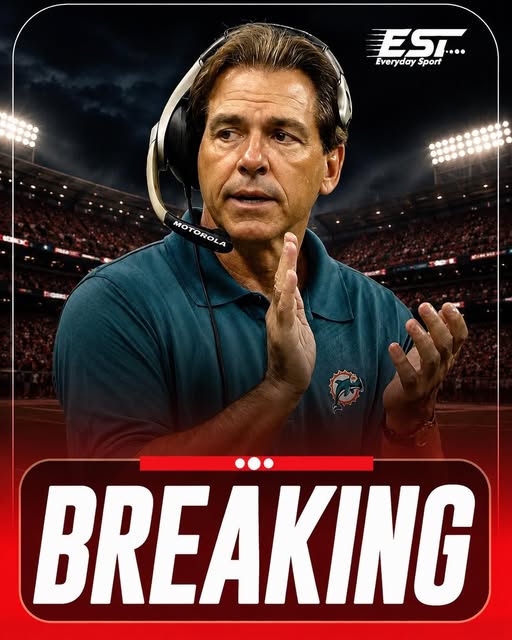
Nick Saban built one of the greatest careers in the history of college football, winning seven national championships and transforming Alabama into the sport’s modern dynasty. But when he looks back on the one season that took him away from the college game, Saban has made clear that his decision to leave LSU for the NFL was the biggest professional mistake of his career.
Saban’s brief and turbulent tenure with the Miami Dolphins lasted only two seasons, from 2005 through 2006, and ended with his return to college football. The experience, he has said, reinforced something that would ultimately define the rest of his career: He belonged in the college game.
More specifically, Saban came to appreciate the part of coaching that extended beyond game plans, recruiting battles and championship pursuits. In college football, he had the opportunity to recruit young players, establish a culture and help shape their development both on the field and away from it.
The NFL offered a different challenge. It was a league built around established professionals, contracts, salary caps, personnel departments and the relentless pressure to win immediately. Saban entered Miami believing his meticulous approach to organization and player development could translate to the professional level. Instead, his experience exposed the differences between coaching college players and managing an NFL roster.
“I think probably the biggest mistake that I ever made professionally was leaving LSU to go to the Miami Dolphins,” Saban has said of the decision.
The statement is striking considering what Saban accomplished before and after his NFL detour.
At LSU, Saban inherited a program that had struggled for consistency and turned it into a national champion. In 2003, the Tigers finished 13-1 and won the BCS national championship, establishing Saban as one of the most accomplished coaches in the country. His success in Baton Rouge made him a natural candidate for the NFL, and Miami hired him in December 2004 to replace Dave Wannstedt.
At the time, the move made sense.
The Dolphins were one of the NFL’s most recognizable franchises but were searching for stability following the retirement of Dan Marino and years of inconsistency at quarterback. Saban arrived with a reputation as an elite defensive mind, an exceptional organizer and one of the country’s most demanding coaches.
His first season produced a 9-7 record in 2005. Miami improved significantly from its 4-12 finish the previous year, and the Dolphins remained in playoff contention late into the season. But the quarterback position remained unresolved, and the franchise’s inability to establish long-term stability at the most important position in football would become the defining issue of Saban’s tenure.
The following offseason produced one of the most discussed episodes in modern NFL history.
Miami pursued Drew Brees in free agency after Brees suffered a serious shoulder injury with the San Diego Chargers. The Dolphins’ medical staff ultimately raised concerns about the quarterback’s recovery, and Miami chose not to complete a deal. Brees instead signed with the New Orleans Saints, where he became a Super Bowl champion, a Super Bowl MVP and one of the most productive quarterbacks in league history.
Saban and the Dolphins instead traded for Daunte Culpepper, who was recovering from a significant knee injury. Culpepper struggled to regain his previous form, starting only four games for Miami in 2006 before his season ended.
The Brees decision has since become inseparable from discussions about Saban’s NFL career, although the situation was more complicated than a simple coaching choice. Medical evaluations, organizational concerns and the uncertainty surrounding Brees’ shoulder all played significant roles in Miami’s decision-making process.
Still, the consequences were enormous.
Brees became the centerpiece of Sean Payton’s Saints teams and helped change the trajectory of an entire franchise. Miami continued searching for quarterback stability. For Saban, the episode became part of a larger lesson about the NFL: A coach can control preparation, scheme and culture, but roster construction is influenced by injuries, contracts, medical decisions, personnel evaluations and circumstances that often extend beyond one person’s authority.
The 2006 season unraveled.
Miami finished 6-10, losing several close games and struggling to generate consistency offensively. The Dolphins ranked near the bottom of the league in scoring, and the quarterback instability that had followed the organization from the previous season continued. Saban finished his NFL tenure with a 15-17 record.
On the surface, those numbers hardly suggested a catastrophic failure. Saban had improved Miami’s record in his first season and remained within striking distance of a .500 career record despite inheriting a franchise in transition.
But the experience clearly did not fit the vision he had for his professional future.
The difference was philosophical as much as competitive.
In college football, Saban could construct a program from the ground up. Recruiting allowed him to identify players whose physical traits, mentality and personality matched the culture he wanted to establish. Players entered the program young and often stayed for several years, giving coaches an opportunity to develop them physically, technically and personally.
The NFL operates on a different clock.
Veterans are professionals with established habits, contracts shape roster decisions, free agency can quickly alter a locker room, and the salary cap forces teams to make difficult choices about which players to keep and which to replace. Coaches can develop talent, but they are often working with a roster that changes dramatically from year to year.
Saban’s greatest strength had always been his ability to build systems.
His programs were known for detailed preparation, accountability and player development. At Alabama, he would eventually turn that philosophy into an unprecedented championship machine. But the Miami experience helped clarify where that approach was most effective.
After the 2006 season, Saban returned to college football and accepted the Alabama job. The move was initially met with skepticism. Alabama was one of the sport’s traditional powers, but the program had endured NCAA sanctions, coaching instability and years of inconsistency.
What followed changed college football.
Saban won six national championships at Alabama, adding to the title he captured at LSU and giving him seven championships overall as a head coach. He developed a system that dominated recruiting, player development and game preparation while sending waves of talent to the NFL.
The lessons from Miami were part of that evolution.
Saban returned to college football with an even clearer understanding of the environment in which he could have the greatest impact. He could recruit players at the beginning of their careers, teach them the expectations of elite football and oversee their growth over several seasons.
That process became central to the Alabama dynasty.
The program consistently developed NFL talent at quarterback, running back, wide receiver, offensive line and virtually every defensive position. Saban’s defenses evolved with the sport, moving from traditional power-oriented structures to more versatile units designed to handle spread offenses and modern passing attacks.
His offense changed as well. Alabama transitioned from a run-heavy identity into a more explosive passing attack, particularly during the later stages of his career.
The ability to evolve separated Saban from many of his contemporaries. But his preference for college football was rooted in something more fundamental than tactical flexibility.
He valued development.
That does not mean Saban rejected the NFL or viewed professional football as inferior. The league represented the highest level of the sport, and his brief time in Miami gave him a firsthand understanding of its complexity.
Instead, the experience confirmed that his coaching philosophy was best suited to the college environment.
For today’s college coaches, Saban’s career provides an increasingly relevant case study. The boundary between college football and professional football has narrowed considerably because of NIL, the transfer portal and the changing structure of athlete compensation. Roster retention has become more complicated, and programs now face challenges that resemble professional personnel management.
Yet Saban’s success was built during an era when coaches could establish long-term continuity with players and develop them within a structured system.
The modern version of college football has changed dramatically, but Saban’s fundamental belief in development remains relevant. The best programs still depend on identifying talent, improving players and building a culture capable of surviving roster turnover.
Saban’s NFL experience also remains a fascinating chapter because of what happened afterward.
Had he remained in Miami, perhaps his career would have taken an entirely different path. The Dolphins might have eventually found stability at quarterback. Saban could have developed into a successful long-term NFL coach.
But football history suggests that his departure from Miami ultimately benefited both his legacy and college football.
His return to the college game produced one of the sport’s greatest dynasties. Alabama became the standard by which every major program measured itself, winning national championships across multiple eras and adapting to dramatic changes in offensive philosophy, recruiting and the College Football Playoff.
The NFL chapter, meanwhile, remains the rare detour in an otherwise extraordinary coaching career.
For Saban, however, the lesson was simple.
The move to Miami taught him where he belonged.
The biggest professional mistake of his career became one of the most important decisions in shaping his legacy. By leaving LSU for the NFL, Saban discovered that his greatest strengths were not limited to calling defenses or managing games on Sundays.
They were rooted in building programs, developing young players and creating an environment where talent could grow into championship-level performance.
When he returned to college football, he did not simply resume his career.
He found the place where he would redefine it.