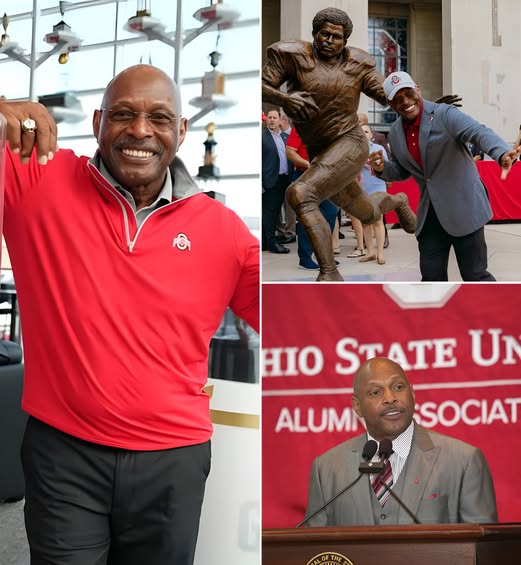
COLUMBUS, Ohio — Archie Griffin has spent more than five decades giving Ohio State something money cannot buy: an enduring connection between the program’s past and its future.
Now, the two-time Heisman Trophy winner is once again at the center of a conversation about what it means to give back to the university that made him a legend.
A widely circulated claim that Griffin has announced a new, multi-million-dollar commitment specifically to Ohio State football has generated significant attention across Buckeye Nation. But there is an important distinction between the emerging claim and what Ohio State has publicly documented: the university has not, in the sources reviewed, announced a new multi-million-dollar football pledge from Griffin in 2026.
What is beyond dispute is Griffin’s extraordinary history of philanthropy at Ohio State — and the scale of his existing commitment to helping student-athletes.
In 2002, Griffin and his wife, Bonita, established the Archie Griffin Endowment Fund for Olympic Sports. According to Ohio State, that endowment has distributed more than $1.6 million in scholarships since its creation and has grown to a value of more than $4 million. Its purpose is to provide undergraduate athletes in Olympic sports with resources to pursue both their education and athletic careers.
That distinction matters because Griffin’s legacy in Columbus has never been limited to what he accomplished between the lines.
He is the only two-time Heisman Trophy winner in college football history. He led the Buckeyes to four consecutive Big Ten championships from 1972 through 1975, started in four consecutive Rose Bowls and finished his Ohio State career with 5,589 rushing yards — a school record that still stands.
His No. 45 has been retired. His statue stands at Ohio Stadium. His name is permanently attached to the Big Ten championship game’s offensive MVP award.
And yet, perhaps the most revealing part of Griffin’s legacy is what happened after the touchdowns stopped.
Griffin returned to Columbus following his NFL career and spent decades serving the university in various capacities. His relationship with Ohio State evolved from that of star player to administrator, ambassador, philanthropist and elder statesman.
That history gives any new commitment from Griffin a significance that extends well beyond the dollar figure.
College football has changed dramatically since Griffin’s playing days. The sport now operates in an era defined by name, image and likeness opportunities, transfer-portal movement, revenue sharing and increasingly sophisticated roster-management strategies. Programs competing for championships must invest not only in facilities and coaching, but also in the financial infrastructure required to build and retain elite rosters.
Ohio State is no exception.
For decades, the Buckeyes’ competitive advantage was built around tradition, recruiting reach, coaching stability and one of the sport’s most powerful home environments. In the modern era, those assets remain important, but they operate alongside an increasingly complex financial ecosystem.
That makes alumni involvement especially consequential.
A contribution directed toward scholarships or broader student-athlete support can provide long-term stability. A gift directed toward football infrastructure could potentially support facilities, recruiting resources or other program needs. And philanthropic support for athletics can help a university preserve resources for areas that do not generate the same level of commercial revenue as football.
The precise purpose and structure of any new Griffin commitment would therefore be critical.
It would also explain why the story has resonated so strongly with Buckeye supporters.
Griffin does not need Ohio State to validate his legacy. His football résumé is already secure.
Heisman voters did that in 1974 and 1975.
The record books did it with his 5,589 rushing yards.
The College Football Hall of Fame did it with his induction in 1986.
Ohio State did it permanently when the university retired his No. 45 in 1999.
And in August 2024, the university unveiled a statue of Griffin at Ohio Stadium, giving fans another permanent reminder of the player who helped define an era of Ohio State football.
The more compelling story, then, is what Griffin has chosen to do with that legacy.
Ohio State’s own account of his philanthropy makes clear that his giving philosophy is centered on creating opportunities for student-athletes. The endowment is designed not simply to put Griffin’s name on a building or program, but to provide recurring support for athletes pursuing both education and competition.
That philosophy fits the way Griffin has spoken about his Ohio State career for decades.
He has consistently emphasized teammates, coaches and the university rather than treating his individual accomplishments as a solo achievement. When discussing his Heisman victories, Griffin has often redirected the credit toward the people around him.
That attitude is part of why his standing in Columbus is different from that of most former stars.
There are great players.
There are champions.
There are Heisman winners.
And then there are figures who become institutional symbols.
Griffin belongs in the final category.
His impact is particularly relevant now because Ohio State is attempting to maintain its position among the sport’s financial and competitive superpowers.
The Buckeyes operate in a Big Ten environment that includes some of the nation’s wealthiest and most ambitious athletic departments. The conference’s expansion has increased both its national footprint and its competitive depth, while the changing college-athletics economic model has made roster construction increasingly dependent on resources beyond traditional scholarship budgets.
Ohio State’s challenge is not merely to recruit talented players. It is to keep enough elite talent on the roster to withstand the demands of a 12-team College Football Playoff era, where depth, injury resilience and positional specialization can determine whether a championship contender survives December.
That is where the broader significance of alumni support becomes apparent.
A program with financial flexibility can attack weaknesses more aggressively. It can invest in infrastructure. It can support student-athlete development. It can strengthen the ecosystem surrounding the roster.
But the most important question is not how much money changes hands.
It is what that money ultimately makes possible.
For Griffin, that principle has already been demonstrated.
His endowment has helped student-athletes who will never rush for 5,000 yards, never win the Heisman Trophy and never have their numbers retired. That may be precisely the point.
Griffin knows better than most that a college football career is temporary.
The opportunity created by that career can last a lifetime.
That is why any confirmed new multi-million-dollar commitment from Griffin would carry such emotional weight in Columbus. It would not simply be another contribution from a wealthy alumnus or former star. It would represent a player who benefited enormously from Ohio State choosing to reinvest in the next generation.
For a university whose football identity is built on continuity, that symbolism matters.
Griffin arrived in Columbus in 1972, played for Woody Hayes and helped establish one of the great sustained stretches in Ohio State history. The Buckeyes went 40-5-1 during his four seasons, won four Big Ten championships and reached four consecutive Rose Bowls.
More than half a century later, his connection to the program remains remarkably intact.
Just this week, Griffin appeared at Ohio Stadium alongside current Buckeyes players to help launch Ohio State’s participation in the Big Ten’s “We Give Blood” campaign.
That image says almost everything.
The uniforms change.
The coaches change.
The offensive systems evolve.
The economics of college football change beyond recognition.
Archie Griffin remains.
And if a new major financial commitment from the Buckeye legend is formally confirmed, its greatest significance may not be the number attached to it.
It will be the message behind it.
For Griffin, Ohio State has never simply been the place where he played football.
It is home.
And after all these years, he is still finding ways to invest in what comes next.